

Introduction
Fence installation is the process of setting posts, rails or panels, and gates along a marked boundary to form a fence that gives privacy, security, and a clear property edge. Fence installation starts with a survey check, permits, and utility marking, then moves to post holes, concrete footings, panels, and gates.
Fence installation covers types, cost, wood versus vinyl choice, permits, build steps, DIY versus professional choice, and upkeep. Fence installation suits a backyard privacy fence, a front picket fence, a pool fence, a pet fence, and a large boundary fence. The main parts are posts, rails or panels, pickets or mesh, concrete footings, gates, hinges, and latches. The guide also names the checks that stop a fence from leaning, the repair costs that follow a missed check, and the upkeep cycle that keeps each material at the top of its lifespan range.
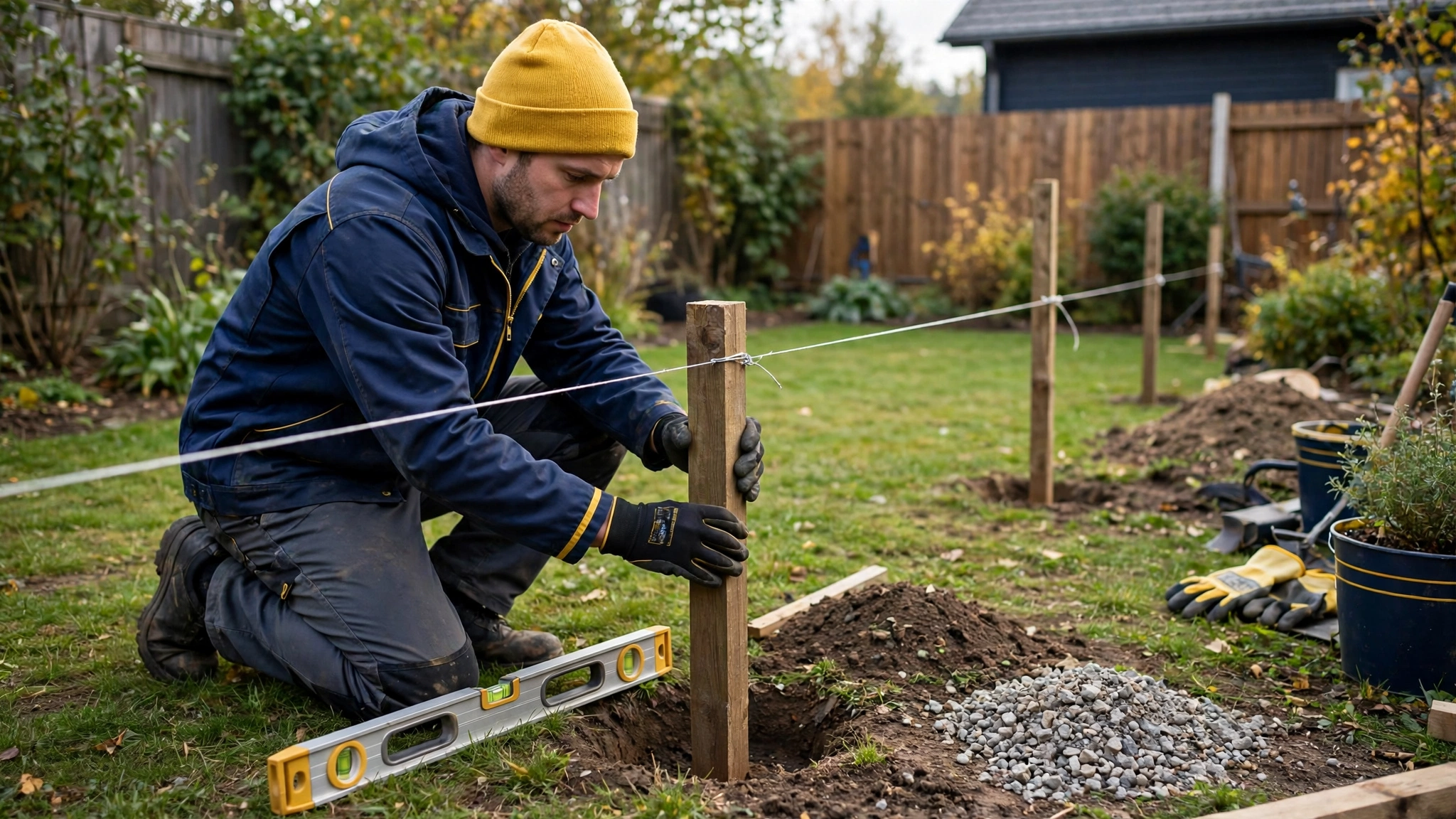
- Fence installation sets posts, panels or mesh, and gates along a marked boundary after survey, permit, and utility checks.
- Installed costs in 2026 run from $10 to $20 per linear foot for a 4 foot chain-link fence to $30 to $55 per linear foot for composite, with gates priced apart (Source: Ecostify, 2026).
- Post depth, concrete cure time, and drainage decide fence life more than board choice.
- Wood needs stain or seal cycles, while vinyl, aluminum, and composite need mainly washing and hardware checks.
- Check permits, homeowners association rules, property lines, and buried utilities before digging a single post hole.
What Is Fence Installation?
Fence installation is the work of marking a fence line, digging post holes, setting posts in concrete or compacted base material, fixing rails, panels, or mesh to the posts, and fitting gates with hinges and latches. Fence installation ends with checks for plumb posts, level rails, even gaps, and gates that swing and latch cleanly.
A fence is a structure that encloses an area, typically outdoors, built from posts connected by boards, wire, rails, or netting (Source: Wikipedia, 2026). Posts carry the load, rails or panels span the posts, and gates give controlled entry. A fence fails at the posts first, so post depth and drainage decide fence life more than board choice.
Browse the Home Improvement guides for more home projects. Voice of Wave covers home projects for general readers. Planning checks matter as much as the build.
What Types of Fences Can You Install?
Fence types divide by purpose first and material second: privacy fences block sight lines, picket fences mark a front boundary, chain-link fences contain pets at low cost, metal fences guard pools and entries, and rail fences mark large rural boundaries. Fence installation matches the fence type to privacy, security, pet control, pool safety, wind, and local rules.
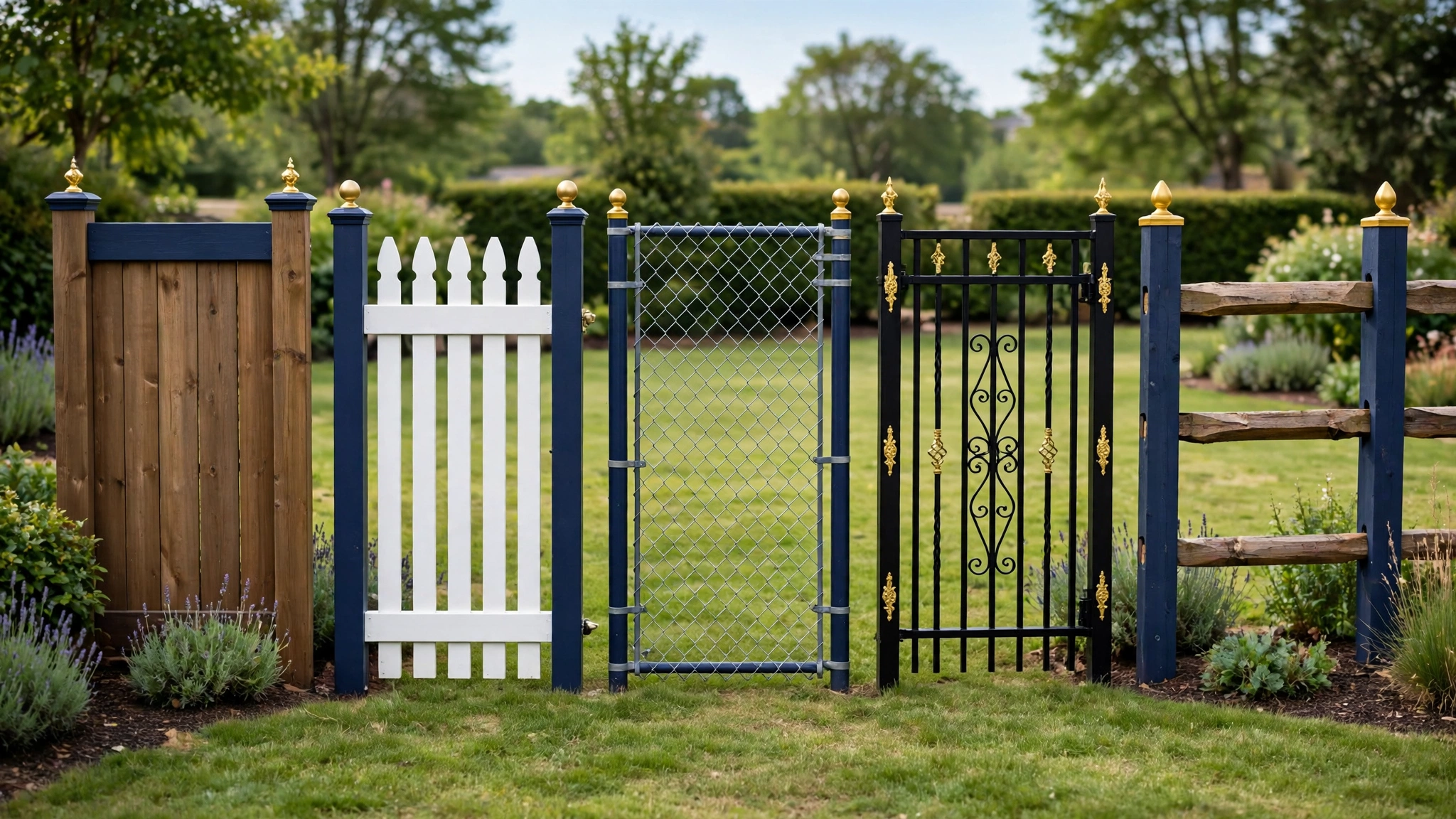
Fences serve boundary, privacy, security, pet, pool, decorative, and agricultural purposes (Source: Wikipedia, 2026). A privacy fence uses solid boards with no gaps. A picket fence uses spaced vertical boards at a lower height. A chain-link fence uses woven wire in a diamond pattern. A metal fence uses aluminum, steel, or wrought iron pickets and rails. A split rail fence uses wide horizontal rails with open space between rails.
| Fence style | Best use | Privacy level | Common heights |
|---|---|---|---|
| Privacy fence | Backyard privacy, noise screening, pet control | High, solid boards | 6 feet in most cases (Source: Ecostify, 2026) |
| Picket fence | Front yard boundary, garden edge, curb appeal | Low, spaced boards | 3 feet to 4 feet in most cases (Source: Modernize, 2026) |
| Chain-link fence | Pet runs, large yards, utility areas | Low unless slats are added | 3 feet to 8 feet, with 10 feet and 12 feet for courts (Source: Wikipedia, 2026) |
| Aluminum or metal fence | Pool fence, front entry, decorative boundary | Low, open pickets | 4 feet to 6 feet in most cases |
| Split rail fence | Farms, ranches, large lots | Low, open rails | 3 feet to 4 feet in most cases |
| Lattice top fence | Privacy with light and air flow | Medium to high | 6 feet in most cases |
Check local height limits before ordering.
Material choice follows the fence style. Wood suits privacy and picket fences and takes paint or stain. Vinyl needs no stain. Chain-link suits long runs, and privacy slats add screening for a fee. Aluminum suits pool fences. Wrought iron needs rust checks. Composite gives a wood look with no stain cycle. The fence types and functions overview on Wikipedia lists boundary, privacy, security, decorative, and pool fence functions in one place, and that list helps a buyer name the job before choosing a material.
How Much Does Fence Installation Cost in 2026?
Fence installation cost in 2026 runs from $10 to $20 per linear foot installed for a 4 foot chain-link fence, $17 to $28 for treated pine, $22 to $38 for cedar, $25 to $45 for vinyl, and $30 to $55 for composite (Source: Ecostify, 2026).
All costs in the table below are installed costs for a standard run on fairly flat ground, as reported by Ecostify (2026). Fence installation cost per foot is the unit every quote should state, with gates, removal, and permits listed apart. Privacy fence installation costs follow the same material bands, with solid boards raising the total above open fence styles. HomeGuide (2026) reports wider bands for the same materials: wood $20 to $50, vinyl $30 to $60, composite $20 to $85, aluminum $25 to $75, chain-link $9 to $30, and wrought iron $50 to $85 per linear foot. The gap between sources shows why 3 written quotes beat a single online range.
| Material | Installed cost per linear foot (Source: Ecostify, 2026) | Typical lifespan (Source: Ecostify, 2026) |
|---|---|---|
| Chain-link, 4 feet | $10 to $20 | 15 to 25 years |
| Treated pine privacy | $17 to $28 | 15 to 20 years |
| Cedar privacy | $22 to $38 | 20 to 30 years |
| Vinyl | $25 to $45 | 30 years or more |
| Aluminum | $26 to $42 | 30 to 50 years |
| Wrought iron | $28 to $55 | 50 to 100 years |
| Composite | $30 to $55 | 25 to 30 years |
Cost rises with length, height, gates, slope, rock, roots, access limits, and old fence removal. Each added foot of height adds about 15 percent to 25 percent to material cost per linear foot (Source: Ecostify, 2026). An 8 foot fence costs about 40 percent to 60 percent more than a 6 foot fence of the same material (Source: Ecostify, 2026). Stepped fences cost 10 percent to 20 percent more, racked fences cost 15 percent to 30 percent more, rocky soil adds $5 to $15 per post hole, and old fence removal adds $3 to $8 per linear foot (Source: Ecostify, 2026).
Gates sit outside the per-foot price because gates need heavier posts, hinges, and latches. A single walk gate costs $150 to $500, a double drive gate costs $400 to $1,500, a sliding gate costs $800 to $3,000, and an automated opener adds $500 to $2,500 (Source: Ecostify, 2026). A 150 linear foot run totals $1,500 to $3,000 for chain-link, $2,550 to $4,200 for treated pine, $3,300 to $5,700 for cedar, $3,750 to $6,750 for vinyl, and $4,500 to $8,250 for composite, before gates and fees (Source: Ecostify, 2026). The cheapest fence per foot is not the cheapest fence over 20 years.
Wood vs Vinyl: Which Fence Material Fits Your Home?
Wood fits buyers who want a natural look, easy repair, and lower upfront cost, and vinyl fits buyers who want low upkeep, steady color, and a longer stain-free life. Wood fence installation costs less at install and more in upkeep, while vinyl fence installation costs more at install and less in upkeep.
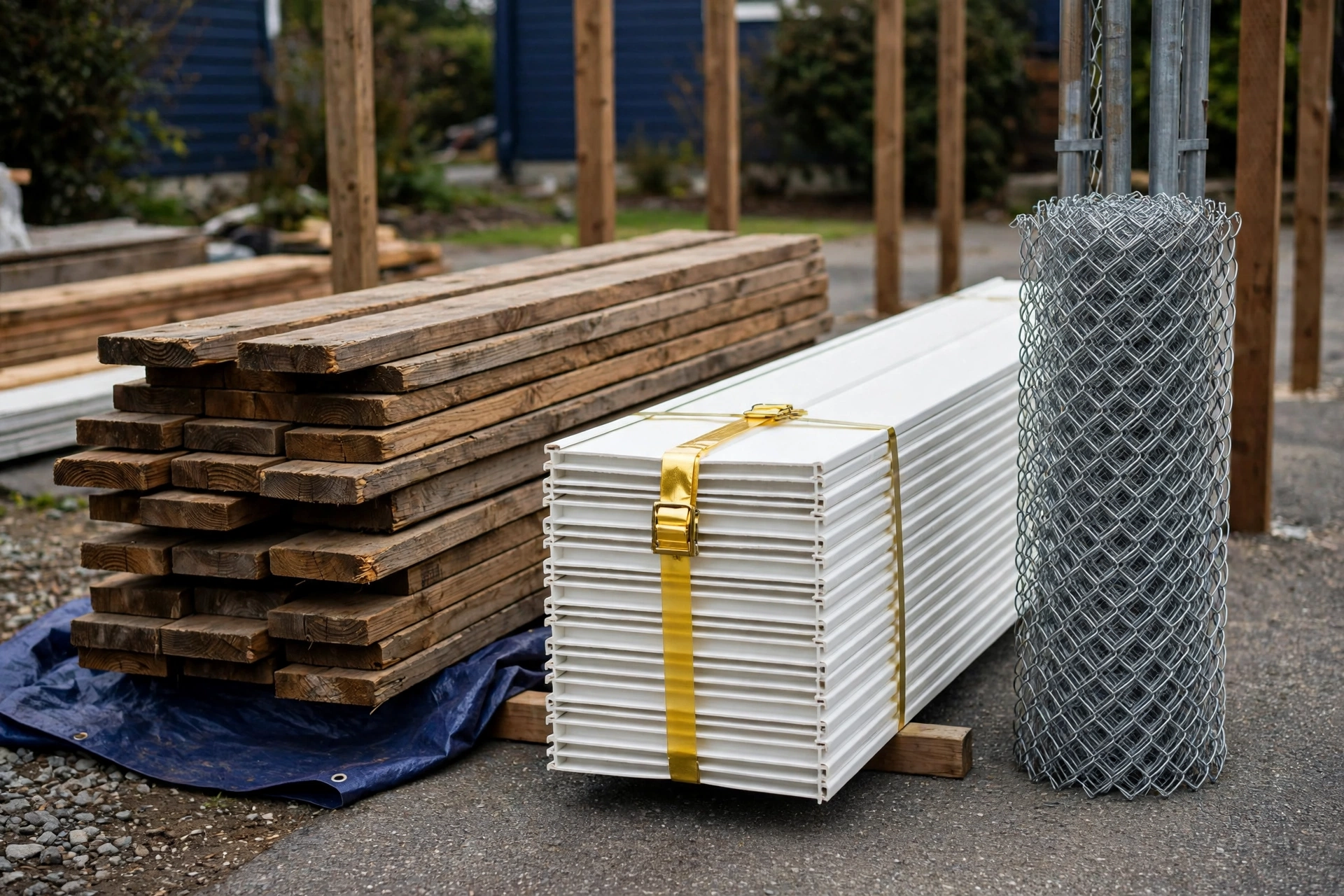
Wood uses pressure-treated pine, cedar, or redwood boards fixed to wood or steel posts. Vinyl uses hollow PVC panels that lock together and need no stain. Chain-link uses woven steel wire stretched between terminal and line posts. Aluminum uses coated metal pickets that resist rust. Composite uses boards made from wood fiber and plastic that resist rot and insects.
| Factor | Wood fence | Vinyl fence |
|---|---|---|
| Installed cost per linear foot | $17 to $38 for treated pine and cedar privacy (Source: Ecostify, 2026) | $25 to $45 (Source: Ecostify, 2026) |
| Typical lifespan | 15 to 30 years by wood type (Source: Ecostify, 2026) | 30 years or more (Source: Ecostify, 2026) |
| Upkeep cycle | Stain or seal every 2 to 3 years for treated pine, every 3 to 5 years for cedar (Source: Ecostify, 2026) | Wash with soap and water, check hardware |
| Repair ease | Single boards swap out with screws and matching boards | Panels swap out, but color match depends on the product line |
| Weather weak points | Rot, warp, insects, and sun graying | Brittle in extreme cold, blow-over risk in high wind for solid panels (Source: HomeGuide, 2026) |
| Best fit | Natural look, custom heights, easy spot repair | Low upkeep, humid climates, steady color |
Choose wood when the budget sits tight or single-board repair matters most. Choose vinyl when upkeep time matters most. Choose chain-link when the run is long and privacy is not the job. Choose aluminum for a pool. Choose composite for a wood look with no stain cycle. A material decision is a 20 year decision: compare installed cost plus upkeep plus lifespan, not installed cost alone.
For wood care after the fence is up, read Deck Repair and Maintenance: Complete Guide 2026.
Do You Need a Permit for Fence Installation?
Yes, many fence projects need a permit, and a permit is most likely when the fence stands over 6 feet tall, guards a pool, sits on a boundary, or sits in a regulated zone. Check the local building office before ordering materials, since permit rules change by city, county, and homeowners association.
Fence permit requirements vary by city, county, and association, so check both offices in writing. Permit fees typically range from $25 to $250 (Source: Ecostify, 2026), and HomeGuide (2026) reports $40 to $150. Some offices ask for a site plan showing the fence line, property lines, structures, and easements, and some require a permit for any fence. Pool fences face added rules for height and self-closing hardware, and a pool gate latch often must sit at least 54 inches above grade (Source: Ecostify, 2026).
Homeowners associations add a second approval layer. Common rules cap front yard fences at 4 feet and backyard fences at 6 feet, limit materials and colors, and require design approval before work starts (Source: Ecostify, 2026). A fence built without approval can draw fines and a removal order.
A boundary survey costs $300 to $800 and gives a legal record of the property edge (Source: Ecostify, 2026). Old stakes and neighbor agreement do not replace a survey when the line is in doubt. Tell neighbors about the plan, agree on the finished side, and keep the fence inside the boundary unless a written agreement exists. Call 811 before digging so utility firms can mark buried lines. A permit check, a survey check, and a utility check cost little next to a fence moved after a dispute.
How Do You Install a Fence Step by Step?
Fence installation follows 8 steps in order: confirm the line and permits, mark utilities, set the layout, dig post holes, set posts in concrete, fix rails or panels, fit gates, and run final checks. Fence installation starts with paper checks and ends with a gate test, and post setting decides whether the fence stays straight.
- Confirm the property line, permits, and association approval in writing.
- Call 811 and mark all buried utility lines before digging.
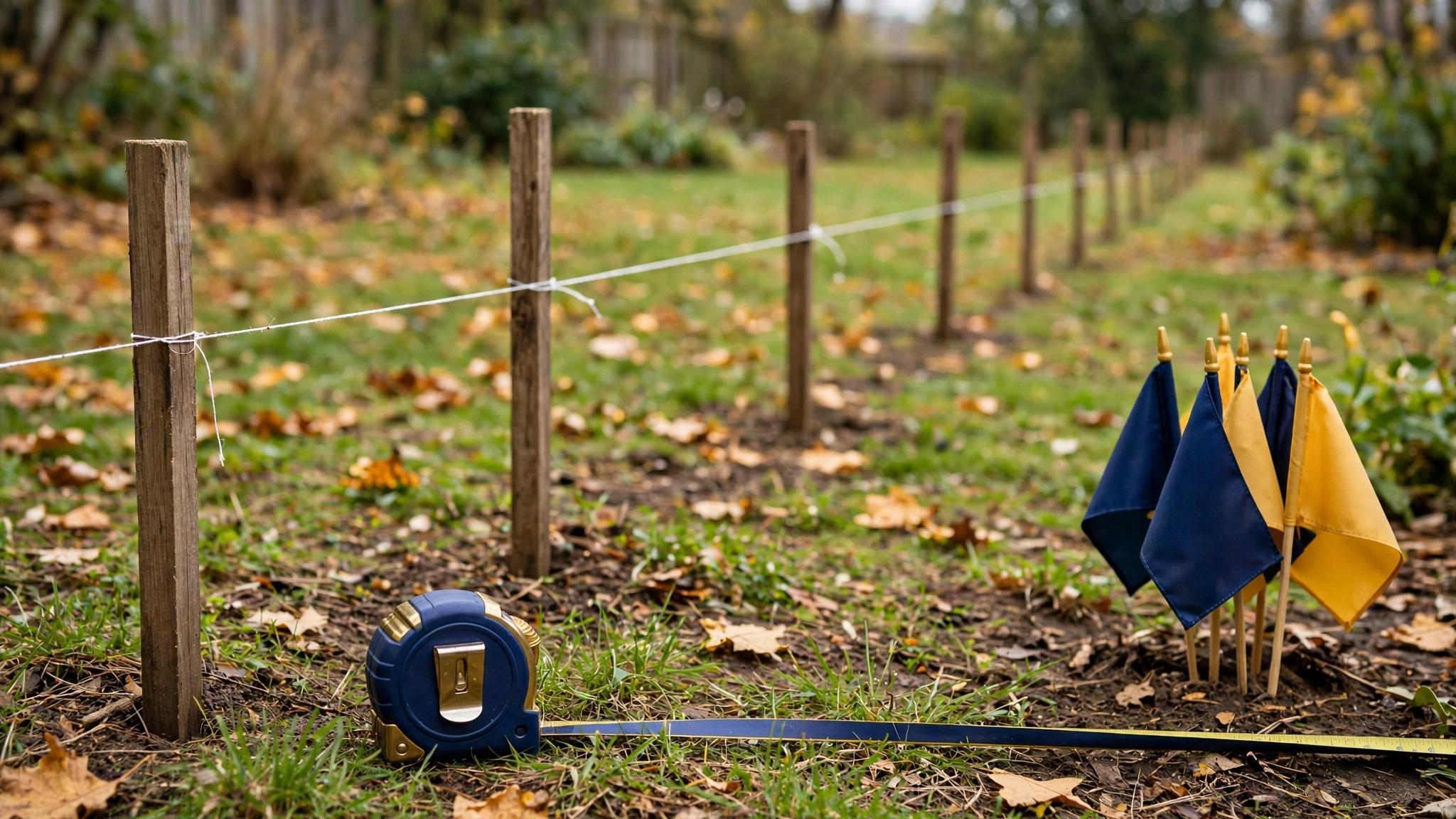
- Mark the fence line with stakes and string, then mark each post spot.
- Dig post holes 12 inches to 18 inches wide and 24 inches to 36 inches deep (Source: Today’s Homeowner, 2026).
- Fence post installation: set posts plumb in concrete, brace each post, and let concrete cure.
- Fix rails, panels, or mesh to posts, level at each bay.
- Fit gates with heavy posts, hinges, latches, and drop rods.
- Check plumb, level, gaps, and gate swing, then seal wood.
Post holes for most fence types run 12 inches to 18 inches wide and 24 inches to 36 inches deep (Source: Today’s Homeowner, 2026). Posts should sit at a depth equal to one-third of total post length, plus 4 inches for gravel drainage (Source: Ecostify, 2026). A 6 foot fence on an 8 foot post needs a hole about 30 inches to 32 inches deep (Source: Ecostify, 2026). Concrete needs 24 hours to 48 hours to cure (Source: Ecostify, 2026). A stepped fence drops each panel on a slope, while a racked fence follows the slope angle.
Tools include a tape measure, level, string line, stakes, post hole digger or auger, shovel, and safety gear. Chain-link fence installation differs from panel work: terminal posts sit in concrete footings, line posts sit at intervals of no more than 10 feet, and mesh stretches tight between terminal posts (Source: Wikipedia, 2026). Chain-link mesh uses a standard diamond size of 2 inches, with wire gauge commonly 9, 11, or 11.5 (Source: Wikipedia, 2026). The chain-link fence construction guide on Wikipedia describes terminal posts, line posts, tension wire, and fence ties. Straight string lines, plumb posts, and cured concrete give a fence its line.
Should You Hire a Professional or Install a Fence Yourself?
Hire a professional for long runs, slopes, rock, multiple gates, or pool fences, and choose DIY fence installation for short, flat runs with simple panels and no permit or wiring complexity. DIY fence installation saves labor cost and costs time, tools, and rework risk, while professional fence installation buys speed, crew equipment, and a labor warranty.
DIY suits a handy homeowner with a helper, a rented auger, and 3 to 5 weekends for a 150 linear foot cedar run (Source: Ecostify, 2026). A professional crew completes the same run in 1 to 3 days, setting 25 to 40 posts per day against 6 to 10 for a DIY homeowner (Source: Ecostify, 2026). DIY savings typically run 35 percent to 50 percent of total cost (Source: Ecostify, 2026). Tool rental runs $100 to $300, and labor for the cedar run runs $1,500 to $3,000 (Source: Ecostify, 2026).
| Factor | DIY fence installation | Professional fence installation |
|---|---|---|
| Labor cost | Time only, plus tool rental | $1,500 to $3,000 for a 150 foot cedar run (Source: Ecostify, 2026) |
| Time for 150 feet | 3 to 5 weekends (Source: Ecostify, 2026) | 1 to 3 days (Source: Ecostify, 2026) |
| Posts per day | 6 to 10 (Source: Ecostify, 2026) | 25 to 40 (Source: Ecostify, 2026) |
| Warranty | Material only in most cases | Material plus labor, often 1 to 5 years (Source: Ecostify, 2026) |
| Best fit | Short, flat, simple panel runs | Slopes, rock, long runs, gates, pool fences |
| Main risk | Crooked posts set in concrete, wrong line | Higher upfront cost, contractor scheduling |
Ask each contractor for a written quote listing material, post type, post depth, footing method, gate hardware, removal, permits, and warranty. Verify license and insurance and ask for 2 references. Voice of Wave publishes practical home guides that help readers compare quotes line by line. A low quote that skips concrete footings costs more in repair than a higher quote with sound footings.

How Do You Maintain a Fence and Fix Common Problems?
Fence maintenance means a twice-yearly inspection, prompt repair of loose boards, rust, and leaning posts, and a stain or wash cycle matched to the material. Fence maintenance keeps small faults small: a loose board fixed in spring stays a loose board, while a loose post left for a year becomes a leaning fence run.
Inspect a fence each spring and fall: walk the line, push each post, check rails and boards, test gates, and look for rot, rust, and insect tunnels. Wash vinyl, aluminum, and composite fences with soap and water. Touch up chips on metal fences at once.
| Material | Upkeep cycle (Source: Ecostify, 2026) | Typical lifespan (Source: Ecostify, 2026) |
|---|---|---|
| Treated pine | Stain or seal every 2 to 3 years | 15 to 20 years |
| Cedar | Stain every 3 to 5 years | 20 to 30 years |
| Vinyl | Wash only, check hardware | 30 years or more |
| Aluminum | Wash only, check hardware | 30 to 50 years |
| Wrought iron | Rust touch-up every 2 to 4 years | 50 to 100 years |
| Composite | Wash only, check hardware | 25 to 30 years |
| Chain-link | Wash, check ties and tension | 15 to 25 years |
Common problems have direct fixes: replace a rotted board with a matching board, reset a leaning post plumb in concrete, fix a sagging gate with heavier hinges and a diagonal brace, and re-tension chain-link mesh. Modernize (2026) reports repair costs from $100 to $300 for a panel, $150 to $400 for a post, and $100 to $500 for a gate. On my own fence line, boards nearest a downspout showed soft spots first, so downspouts and sprinklers get checked first at each inspection. Check the wettest spots first, since rot starts where water sits longest.

Conclusion
Fence installation gives a clear boundary, privacy, and security when the line is marked right, posts sit deep in cured concrete, panels run level, and gates latch cleanly. Cost depends on material, length, height, gates, slope, and soil, with 2026 ranges from $10 to $20 per linear foot for chain-link to $30 to $55 for composite (Source: Ecostify, 2026). Wood suits easy repair, vinyl suits low upkeep, and chain-link suits long runs. Permits, survey checks, and utility marking come before digging. Voice of Wave readers can use the tables and the 8-step sequence to compare quotes and check work on site.
Continue reading: browse the latest articles for more home guides.
Frequently Asked Questions
How much does fence installation cost?
Fence installation costs $10 to $20 per linear foot for a 4 foot chain-link fence, $17 to $28 for treated pine, $22 to $38 for cedar, $25 to $45 for vinyl, and $30 to $55 for composite, installed (Source: Ecostify, 2026). Gates, slope, rock, removal, permits, and survey fees sit outside the per-foot rate.
How long does fence installation take?
Fence installation takes 1 to 3 days for a professional crew on a 150 linear foot run, and 3 to 5 weekends for a DIY homeowner (Source: Ecostify, 2026). Concrete needs 24 hours to 48 hours to cure (Source: Ecostify, 2026). Permits, surveys, and delivery add days before work starts.
Do I need a permit to install a fence?
Yes, many fence projects need a permit, most often for fences over 6 feet tall, pool fences, boundary fences, or fences in regulated zones. Permit fees typically range from $25 to $250 (Source: Ecostify, 2026). Check the local building office and homeowners association before ordering materials, since rules change by city, county, and association.
How deep should fence posts be?
Fence posts should sit at a depth equal to one-third of the total post length, plus 4 inches for gravel drainage (Source: Ecostify, 2026). A 6 foot fence on an 8 foot post needs a hole about 30 inches to 32 inches deep (Source: Ecostify, 2026). Cold climates need holes below the frost line.
What is the cheapest fence to install?
Chain-link is the cheapest fence to install, at $10 to $20 per linear foot for a 4 foot fence (Source: Ecostify, 2026). Split rail fences cost $10 to $25 per linear foot (Source: Modernize, 2026). Both give low privacy, so use them for pet control, large yards, and boundary marking.
Wood or vinyl: which fence lasts longer?
Vinyl lasts longer than wood, with a typical lifespan of 30 years or more against 15 to 20 years for treated pine and 20 to 30 years for cedar (Source: Ecostify, 2026). Vinyl needs washing only, while wood needs stain or seal cycles every 2 to 5 years (Source: Ecostify, 2026).