
Introduction
Air conditioner maintenance is the routine cleaning, inspection, and adjustment work that keeps an air conditioner cooling a home at full strength, with lower energy use and fewer breakdowns. Air conditioner maintenance covers 5 core jobs: cleaning or replacing filters, cleaning coils, clearing the condensate drain, checking airflow and controls, and booking a professional inspection once a year. A home air conditioner moves heat out of rooms through refrigerant, coils, a compressor, and a fan, and each part loses performance when dirt, debris, or a worn part blocks the path. This guide gives a seasonal calendar, a step list for each DIY task, a cost range for professional service, and warning signs that need a technician. Readers with central, window, or ductless systems can follow the same core routine and adjust only the steps that differ by system type.
- Replace or clean the air filter every 1 to 3 months during cooling season, monthly with pets, dust, or heavy use.
- Book one professional inspection each year, in spring, before the first heat wave.
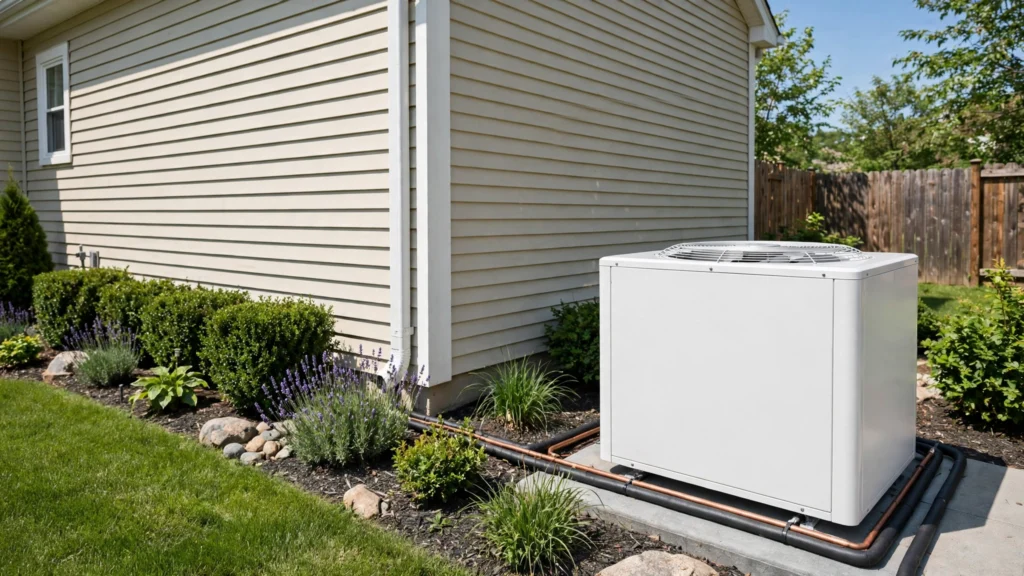
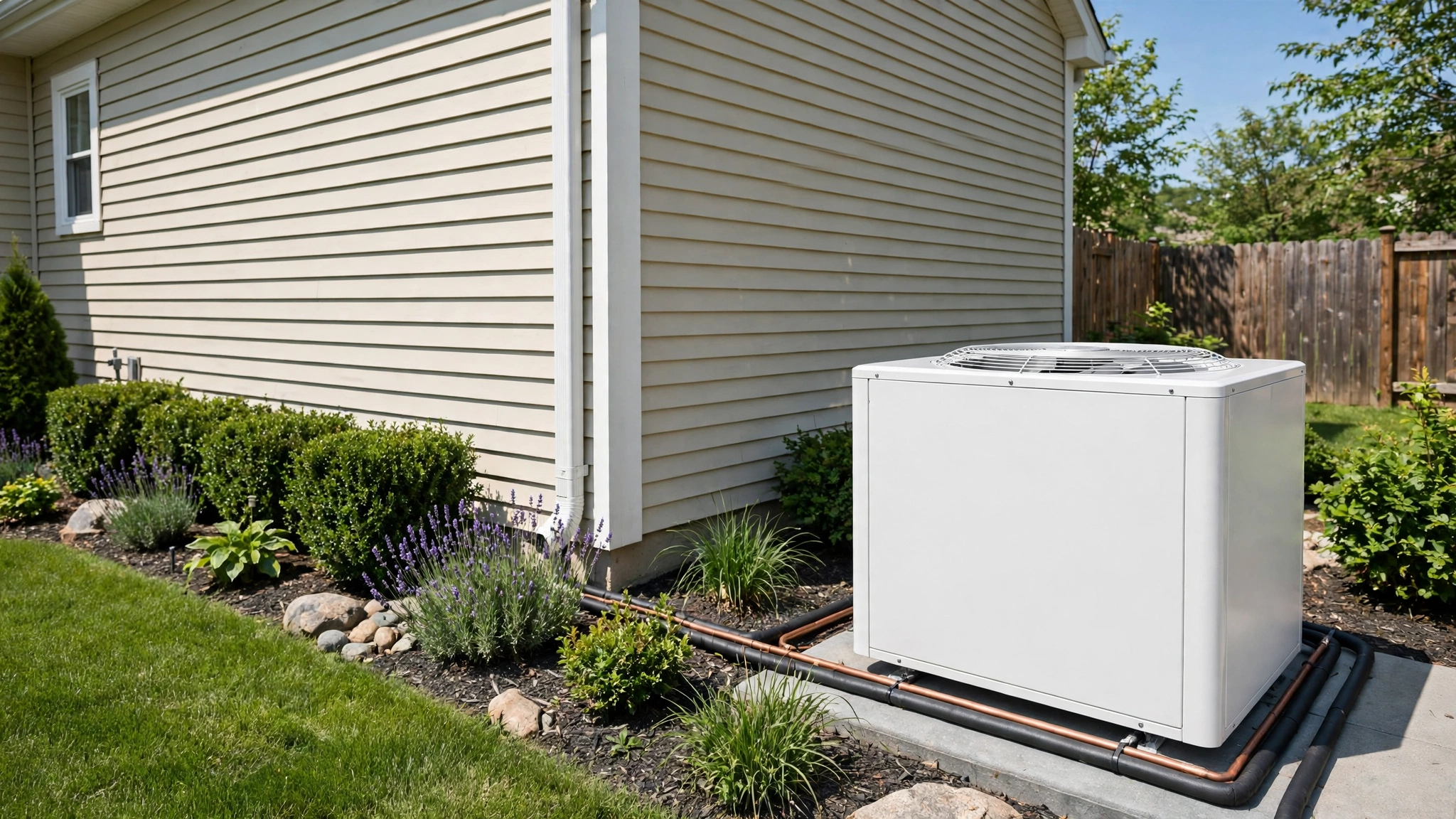
- Keep 2 feet of clear space around the outdoor unit, and rinse coils gently, never with a pressure washer.
- Clear the condensate drain each spring, since a blocked drain causes leaks.
- Stop DIY work and call a technician for refrigerant, electrical, burning smell, or repeated breaker trips.
What Is Air Conditioner Maintenance?
Air conditioner maintenance is the scheduled cleaning, inspection, and tuning of an air conditioner, and air conditioner maintenance keeps cooling output steady, energy use low, and breakdown risk low. An air conditioner has 4 main parts: an indoor evaporator coil, an outdoor condenser coil, a compressor, and a fan. Refrigerant absorbs heat indoors and releases heat outdoors, and dirt on either coil forces longer run times. Maintenance removes those blocks and catches small faults before they become a failed compressor or a frozen coil. The Home Improvement guides on this site cover other routine home care jobs.
Air conditioner maintenance has 3 layers: monthly care for filters, vents, and clear space; seasonal care for coil cleaning, drain clearing, and a system test; and annual professional care for refrigerant, electrical safety, motors, and controls. Homeowners handle the first 2 layers with basic tools, and technicians handle the third layer.
How Often Should You Service an Air Conditioner?
You should service an air conditioner once a year with a professional inspection, and you should check filters every month during the cooling season. A professional inspection belongs in spring, 2 to 4 weeks before regular cooling starts, so any repair happens before peak demand and peak prices. Filter checks belong on a monthly rhythm, even when replacement happens every 2 or 3 months. Coil cleaning belongs on an annual rhythm, twice yearly near dusty roads or coastal salt air. Drain checks belong in spring and again mid summer.
The 12 month calendar below turns that rhythm into dated jobs.
| Month | Task |
|---|---|
| March or April | Professional inspection, new filter, clear outdoor unit, cooling test |
| May | Rinse condenser coil, clear drain, check vents and thermostat |
| June to August | Monthly filter check, clear storm debris, watch for ice or leaks |
| September | New filter, clean outdoor unit, final cooling test |
| October to February | Clear leaves, snow, and debris; follow the heating filter schedule |
A home that runs cooling for 8 months or more, or a heat pump that cools and heats, needs a second check in autumn for heating mode.
What Does the Air Conditioner Maintenance Checklist Cover?
The air conditioner maintenance checklist covers 8 areas: filters, coils, drains, airflow, thermostat, electrical parts, refrigerant, and safety controls. The checklist below separates DIY tasks from technician tasks, so no reader mistakes a gauge job for a household job. Work through the DIY rows in order, top to bottom, and leave technician rows for the annual visit.
| Area | Task | Who handles it |
|---|---|---|
| Filter | Replace or clean the filter | Homeowner |
| Outdoor coil | Clear debris, rinse fins gently | Homeowner |
| Indoor coil | Inspect for dust and ice | Technician deep clean |
| Condensate drain | Flush line, check pan | Homeowner flush, technician blockage |
| Airflow | Open vents, clear returns, check visible duct leaks | Homeowner vents, technician ducts |
| Thermostat | Test settings, replace batteries, check calibration | Homeowner |
| Electrical | Tighten connections, test capacitors and contactors | Technician |
| Refrigerant | Measure level and pressure, check for leaks | Technician |
| Safety controls | Test start cycle, shutoff, overload protection | Technician |
Each row has a failure mode: a dirty filter starves airflow, a dirty coil wastes energy, a blocked drain leaks water, a loose connection overheats, and low refrigerant freezes the indoor coil.
How Do You Clean or Replace the Air Filter?
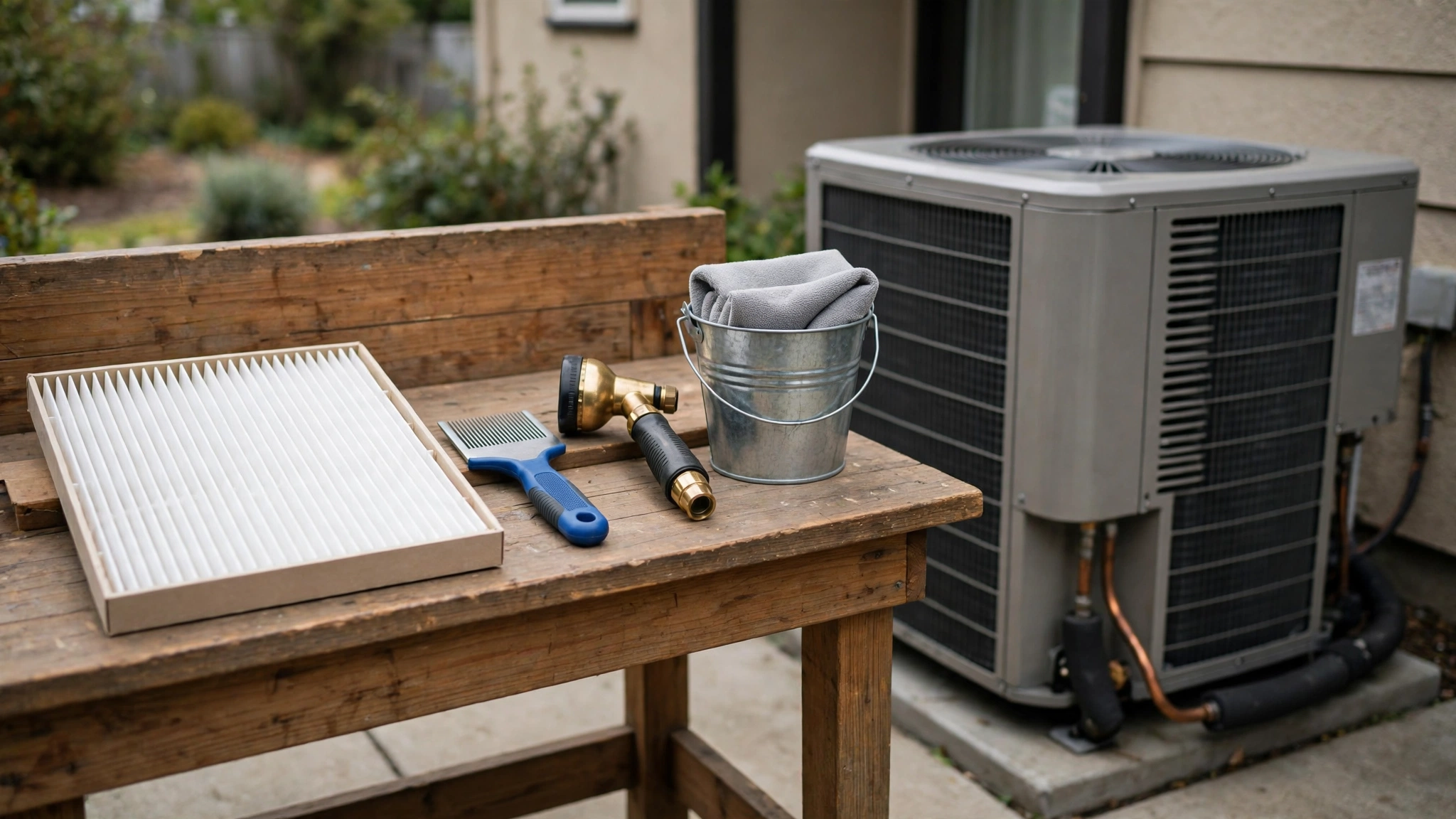
To clean or replace the air filter, switch the system off, remove the old filter, note its size and airflow arrow, and fit a new filter or a washed and fully dried reusable filter. Follow these steps in order, and keep the system off until the filter sits flat in its slot with no gaps at the edges.
- Switch the thermostat to off and switch off power at the indoor unit switch.
- Open the filter slot at the return vent or the indoor air handler.
- Slide the old filter out and read the size printed on its frame.
- Vacuum loose dust from the slot and the return grille.
- Fit the new filter with the airflow arrow pointing toward the blower.
- Close the slot, restore power, and set the thermostat back to cool.
- Write the change date on the filter frame or on a phone reminder.
Filter type matters. Disposable pleated filters trap more dust than flat fiberglass filters, and they suit most homes. Washable filters need full drying before refitting, since a damp filter grows mold and restricts airflow. Minimum Efficiency Reporting Value (MERV) rates filtration from 1 to 16, with higher numbers trapping smaller particles. Most homes suit MERV 8 to 11, and a weak blower can lose airflow above MERV 11, so check the system manual first.
How Do You Clean the Outdoor Condenser Unit?
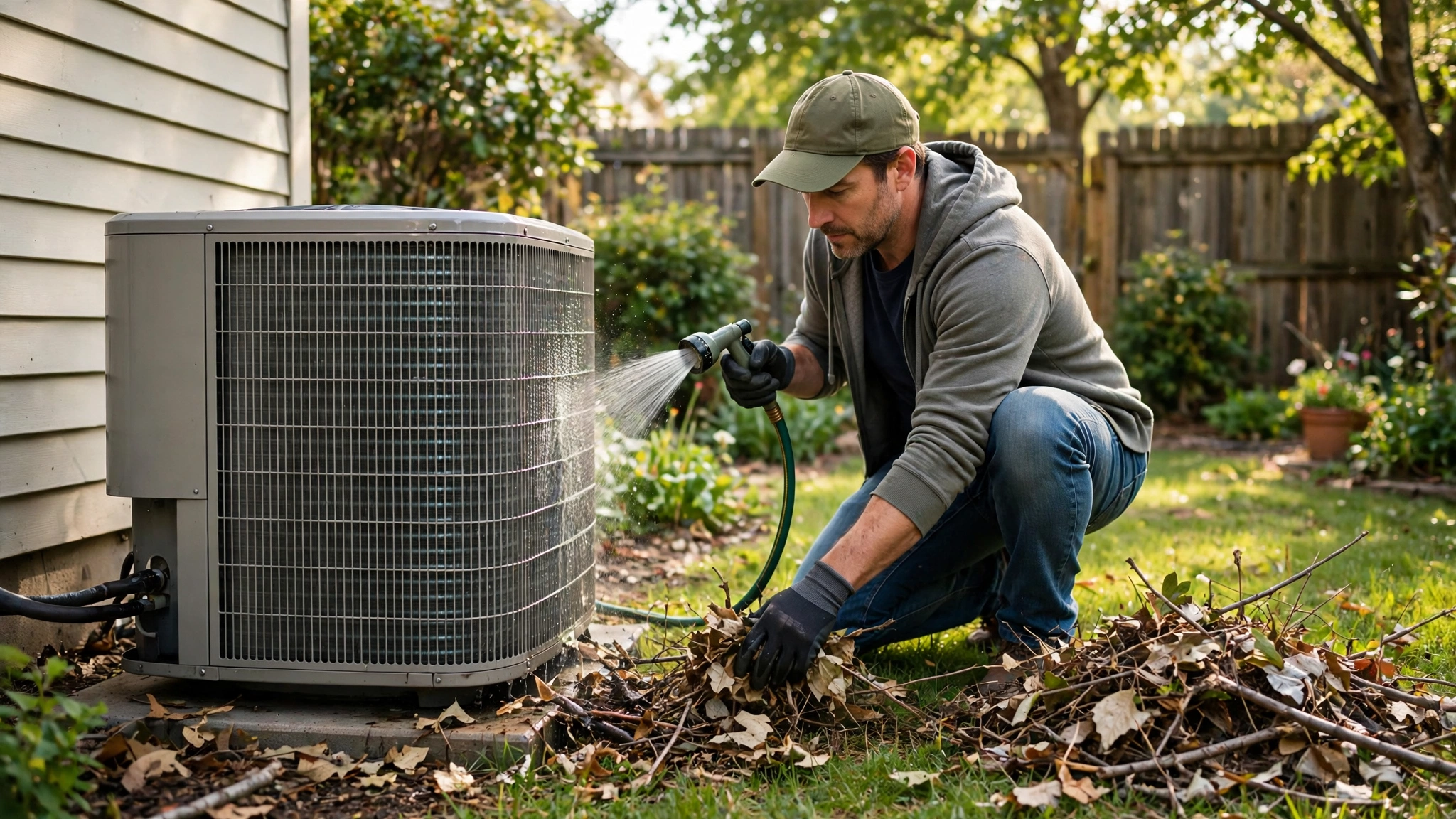
To clean the outdoor condenser unit, switch power off at the outdoor disconnect, clear debris from around the unit, rinse the fins gently from inside out, and restore power only after the fins dry. The condenser sheds heat to outside air, so blocked fins force longer, harder compressor runs.
- Switch power off at the outdoor disconnect box beside the unit.
- Remove leaves, grass clippings, and trash from the base and the fins.
- Trim plants back to 2 feet of clear space on all sides.
- Rinse fins with a garden hose at low pressure, spraying from inside the unit outward where access allows.
- Straighten bent fins gently with a fin comb, using light pressure only.
- Check that the unit sits level on its pad, since a tilted unit strains the compressor.
- Restore power and run a cooling test for 10 minutes, listening for grinding, rattling, or buzzing.
Never use a pressure washer on fins, since high pressure bends fins flat and blocks airflow. Never stack storage against the unit, and never cover it with a tight plastic sheet in winter unless the maker recommends a cover, since trapped moisture rusts parts.
What Should You Check Inside the Home?
Inside the home, check the indoor coil for ice and dust, the condensate drain for flow, the vents for blockage, and the thermostat for correct settings. Start at the thermostat: a cool setting, fresh batteries, and a reading within 2 degrees of a room thermometer rules out control faults before deeper checks.
Check vents next. Open all supply vents, even in unused rooms, since closed vents raise duct pressure and strain the blower. Clear return grilles of furniture, rugs, and curtains, and vacuum vent covers. Rooms that stay warmer than the rest of the home point to blocked vents, duct leaks, or low airflow.
Check the indoor coil and drain at the air handler. Switch the system off if ice appears, since running an iced coil damages the compressor. Pour 1 cup of white vinegar into the drain access port, wait 30 minutes, then flush with water. A full drain pan means a blockage to clear before the next cooling run.
For a related home care routine that also deals with blocked lines, read the drain cleaning guide for methods that clear household pipes.
Central vs Window vs Ductless: Which Maintenance Differs?
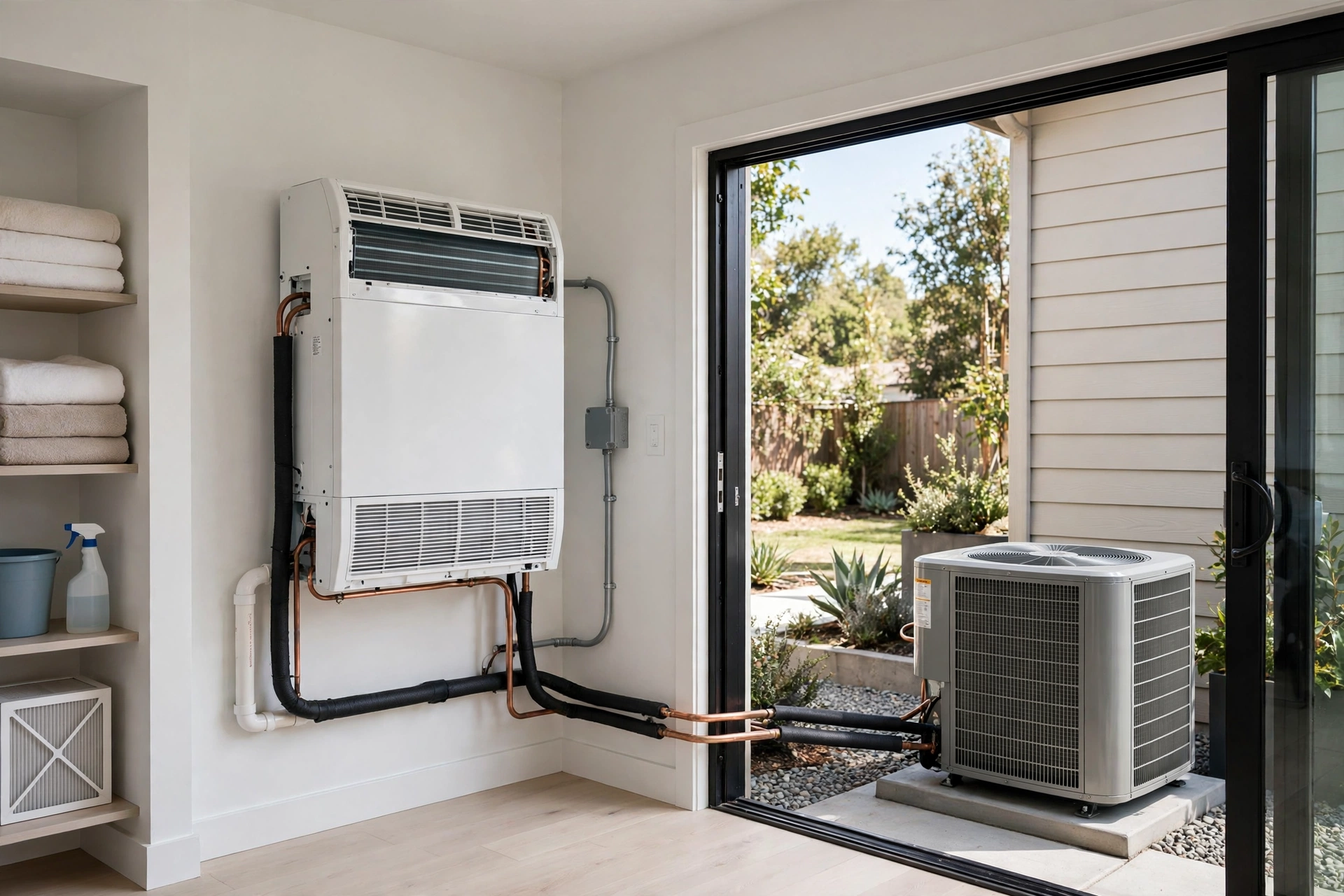
Central, window, and ductless air conditioners share filter, coil, and drain care, and they differ in duct care, drain access, and unit access. Central systems cool through ducts, so duct leaks and dirty ducts affect every room. Window units cool one room, so seal and tilt matter more than ducts. Ductless mini split systems cool one room per indoor head, so each head needs its own filter and coil check. The table below shows the difference at a glance.
| Task | Central system | Window unit | Ductless mini split |
|---|---|---|---|
| Filter | Return vent or air handler | Front panel filter | Each indoor head filter |
| Coils | Outdoor plus indoor coil | Front and rear coil in one box | Indoor head plus outdoor coil |
| Drain | Line to a floor drain or pump | Tilted drain to outside | Line per indoor head |
| Ducts | Inspect for leaks and insulation | No ducts | No ducts |
| Seal | Duct joints | Window seal and side panels | Refrigerant line insulation |
| Winter care | Clear outdoor unit, heating check | Remove or seal for winter | Clear outdoor unit, heating check |
Window units need 2 extra checks: the window seal each spring, since gaps let warm air in, and the tilt, since a window unit must tilt slightly outward so condensate drains outside. Ductless heads need wiping to stop dust on sensors, plus a check of outdoor line insulation for cracks.
Efficiency ratings also differ by age. The seasonal energy efficiency ratio (SEER) rates cooling output over a season against electricity input, and higher SEER ratings mean higher efficiency. The United States moved to SEER2 testing from January 1, 2023 (Source: United States Department of Energy, 2023), so compare SEER2 ratings with SEER2 ratings. The seasonal energy efficiency ratio guide explains how SEER ratings are calculated.
How Much Does Professional Air Conditioner Maintenance Cost?
Professional air conditioner maintenance costs $170 to $752 per service visit in national average ranges, and most people pay around $354, based on Thumbtack data from 2026. A basic tune-up sits at the low end, and a full service with coil cleaning, refrigerant checks, and electrical testing sits higher. Annual plans cost $150 to $500 per year in widely quoted ranges. Emergency calls cost more, so a spring booking avoids emergency fees.
| Service | Typical range | What it includes |
|---|---|---|
| Basic tune-up | $75 to $150 | Inspection, filter change, basic cleaning, system test |
| Full annual service | $170 to $354 | Coil cleaning, refrigerant check, electrical test, drain clearing |
| Maintenance plan | $150 to $500 per year | 2 visits, priority scheduling, repair discounts |
| Coil cleaning alone | $100 to $400 | Evaporator and condenser coil cleaning |
| Duct cleaning | $300 to $500 | Full duct system cleaning, every 3 to 5 years |
Prices vary by region, system size, and access. Ask for a written list before the visit, including items outside the quoted price, such as refrigerant top ups or parts. Keep the service report, since a written record of annual service supports warranty claims with many makers.
What Are the Warning Signs That an Air Conditioner Needs Repair?
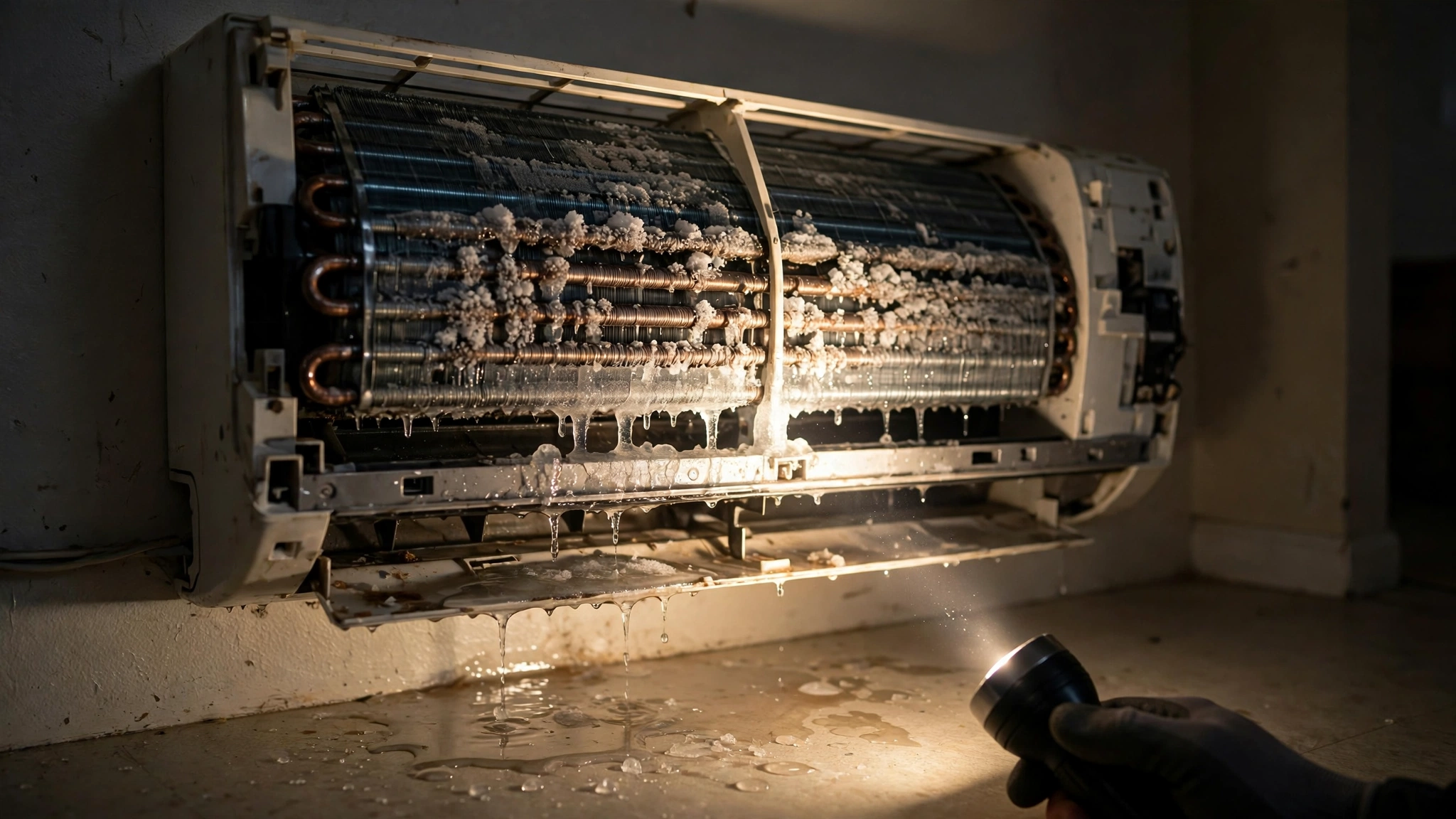
Warning signs that an air conditioner needs repair include warm air from vents, weak airflow, ice on coils, water leaks, loud noises, bad smells, short cycling, and repeated breaker trips. Each symptom points to a likely cause, and the table below pairs each symptom with the first safe action. Stop DIY work at the action column limit, and call a technician when the cause sits in the technician column.
| Symptom | Likely cause | First safe action |
|---|---|---|
| Warm air from vents | Low refrigerant, dirty coil, thermostat fault | Check filter and thermostat, then call a technician |
| Weak airflow | Clogged filter, blocked vents, blower fault | Replace filter, open vents, then call a technician |
| Ice on the indoor coil | Low refrigerant, low airflow | Switch off, check filter, call a technician |
| Water leak indoors | Blocked drain, cracked pan | Switch off, check drain, call a technician if blocked |
| Grinding or squealing | Worn bearing, loose belt | Switch off, call a technician |
| Burning smell | Electrical fault, overheated motor | Switch off at the breaker, call a technician at once |
| Musty smell | Mold in drain pan, dirty coil | Clean drain, call a technician for coil cleaning |
| Short cycling | Oversized unit, thermostat fault, low refrigerant | Check thermostat, call a technician |
| Breaker trips repeatedly | Electrical fault, compressor fault | Do not reset repeatedly, call a technician |
Short cycling means rapid start and stop cycles, and short cycling wastes energy and wears the compressor. Repeated breaker trips mean a fault that needs testing, not repeated resets, and a burning smell means power off at the breaker at once.
DIY vs Professional: When Should You Call a Technician?
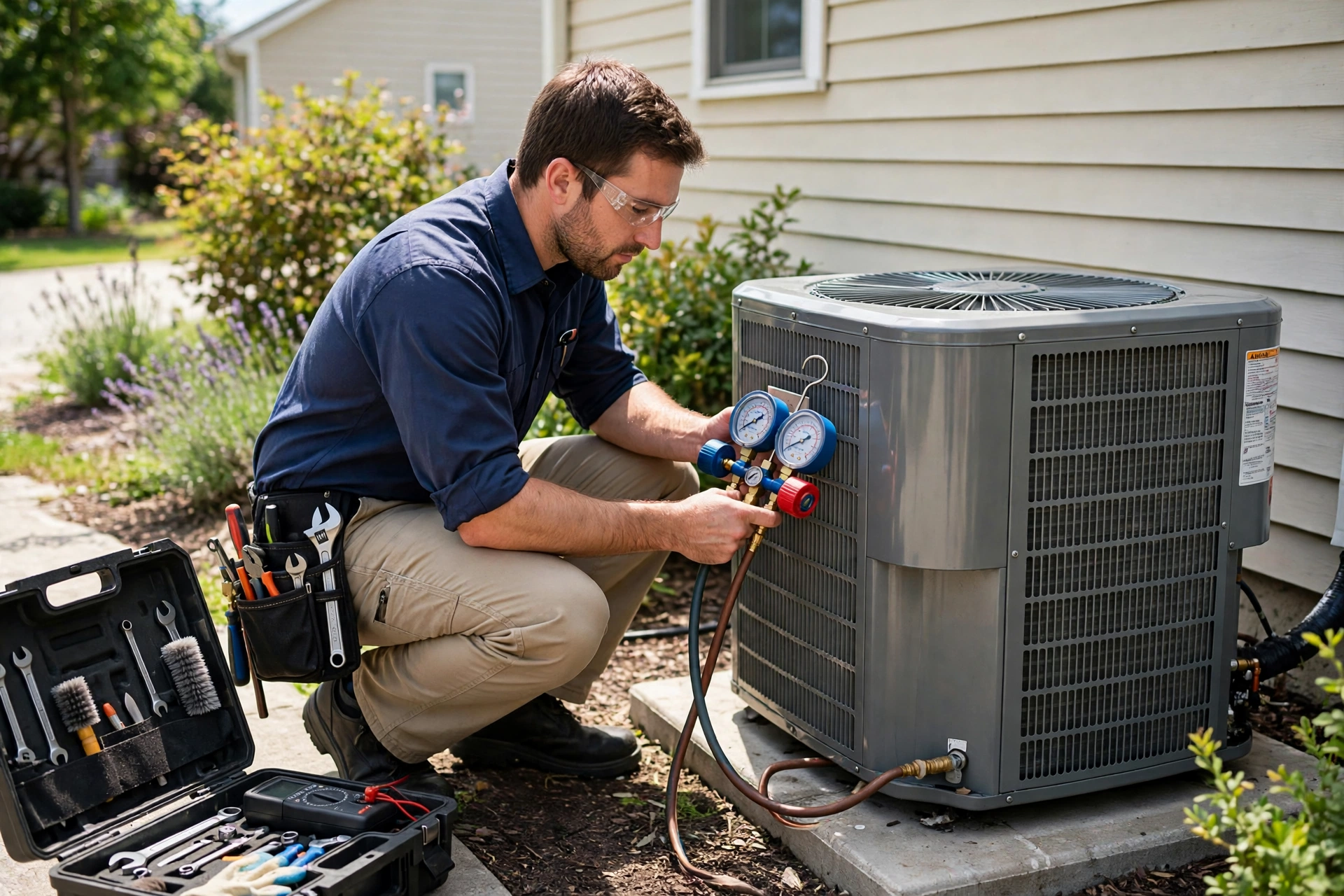
Call a technician for refrigerant work, electrical work, compressor faults, repeated faults, and any repair that needs panel removal beyond the filter slot. Homeowners handle filters, vents, debris, gentle coil rinsing, drain flushing, and thermostat checks. Technicians handle gauges, sealed refrigerant lines, capacitors, motors, and control boards.
Use this decision list before starting any job: filters, vents, debris, and thermostat checks are DIY jobs; coil rinsing, drain flushing, and fin straightening are DIY jobs done gently; ice, leaks, smells, noises, and breaker trips need power off plus a technician; refrigerant, capacitors, motors, and control boards are technician jobs only; and no cooling after filter and thermostat checks needs a technician.
A practical first hand observation helps here: in homes I have helped with summer startups, the most common fix was a filter unchanged for 6 months plus a condenser choked with grass clippings, and both fixes took under 30 minutes with a hose and a new filter. Voice of Wave covers home care topics in this same practical style.
Conclusion
Air conditioner maintenance works when filters stay clean, coils stay clear, drains stay open, and a technician inspects the system once a year. Air conditioner maintenance costs less than emergency repair, and air conditioner maintenance keeps cooling steady through the hottest weeks. Start with the spring jobs: replace the filter, clear the outdoor unit, flush the drain, and book the annual inspection. Follow the monthly filter check through summer, watch for the warning signs in the table, and stop DIY work at the safety boundary.
Explore more home care guides on the Voice of Wave blog for seasonal checklists and practical routines.
FAQs
How often should I replace my air conditioner filter?
Replace the air conditioner filter every 1 to 3 months during the cooling season. Check the filter monthly, and replace it monthly in homes with pets, dust, or heavy cooling use. A clean filter protects airflow, coil condition, and cooling output.
Can I clean air conditioner coils myself?
Yes, you can rinse the outdoor coil gently yourself, and deep indoor coil cleaning belongs to a technician. Switch power off, clear debris, and rinse fins with a garden hose at low pressure. Never use a pressure washer, since high pressure bends fins and blocks airflow.
Why is my air conditioner freezing up?
An air conditioner freezes up from low airflow or low refrigerant. A clogged filter, blocked vents, or a dirty coil restricts airflow, while a refrigerant leak lowers coil temperature. Switch the system off, check the filter, and call a technician if ice returns.
How much does a professional AC tune-up cost?
A professional AC tune-up costs $170 to $752 in national average ranges, and most people pay around $354, based on Thumbtack data from 2026. Basic tune-ups sit lower, full services sit higher, and annual plans cost $150 to $500 per year in widely quoted ranges.
Should I cover my outdoor AC unit in winter?
Cover the outdoor AC unit in winter only if the maker recommends a cover. A tight cover traps moisture and rusts parts, while an open unit sheds rain and snow. Clear leaves and debris from the base, and keep 2 feet of clear space around the unit.
What does SEER mean for my air conditioner?
SEER means seasonal energy efficiency ratio, and SEER rates cooling output over a season against electricity input. Higher SEER ratings mean higher efficiency. Compare SEER2 ratings with SEER2 ratings, since United States testing moved to SEER2 from January 1, 2023.
When should I replace my air conditioner instead of repairing it?
Replace an air conditioner when repairs exceed half the replacement cost, or when the unit is over 15 years old with repeated faults. A new unit with a higher SEER2 rating also cuts energy use, while a single repair on a young unit usually costs less than replacement.