
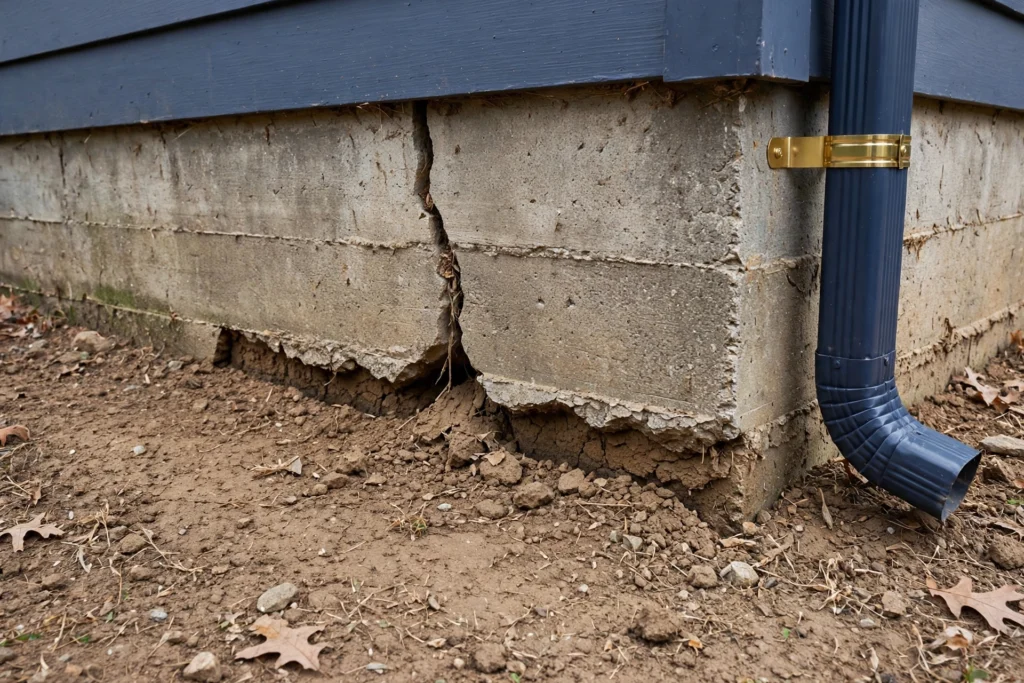
Foundation damage is harm to the load bearing base of a house caused by soil movement, water pressure, poor compaction, or structural overload. Foundation damage shows as cracks, sloping floors, sticking doors, gaps at trim, and bowing walls, and foundation damage needs a cause check first.
Foundation damage covers 5 parts: crack patterns, floor and frame movement, water entry, soil and drainage causes, and repair methods. An early check controls cost: a stable hairline crack needs monitoring and sealing, while a growing horizontal crack needs an engineer. A cause check comes before sealant, because sealant alone leaves water and soil movement in place. The Home Improvement guides on this site cover related house care topics in the same plain style.
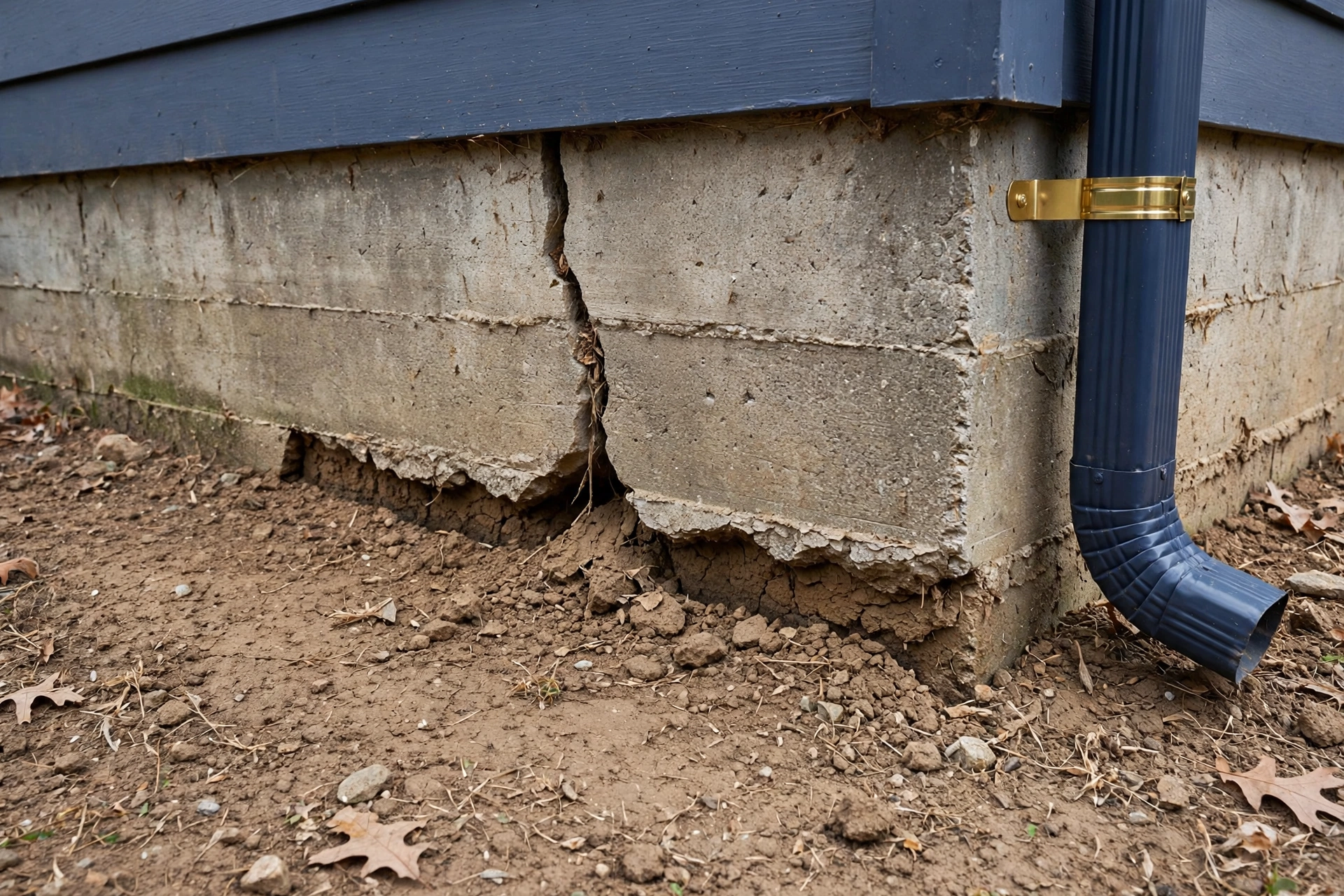
- Match the sign to the cause: crack direction, floor slope, and water entry point to the cause.
- Measure before you act: record crack width, length, and date, then recheck.
- Fix water first: grading, gutters, and downspout discharge stop most movement.
- Call an engineer for structural signs: horizontal cracks and bowing walls need an engineer.
- Compare repair by cause: piers, slab lifting, wall anchors, and drainage each fit a cause.
What Is Foundation Damage?
Foundation damage is movement, cracking, or loss of support in the footings, slab, foundation walls, or piers that carry a house. Foundation damage ranges from hairline shrinkage cracks to settlement that shifts floors and frames, and foundation damage is confirmed when signs grow or pair together.
A foundation spreads the weight of a house over soil, anchors the house against wind and water forces, and gives builders a level base. Shallow foundations sit near the surface and include spread footings and slab-on-grade foundations. Deep foundations reach past weak surface soil to stronger soil or rock and include piles and drilled shafts.
Foundation damage has 4 primary forms: settlement, heave, lateral movement, and material failure. Settlement is downward movement when soil compresses or erodes under load. Heave is upward movement when wet soil swells and lifts a slab or footing. Lateral movement is sideways pressure on a basement wall from saturated soil. Material failure is cracking, spalling, or decay in concrete, masonry, or wood. Differential settlement, where one part moves more than another part, twists frames, opens stair-step cracks in brick, and slopes floors toward the low side.
What Causes Foundation Damage?
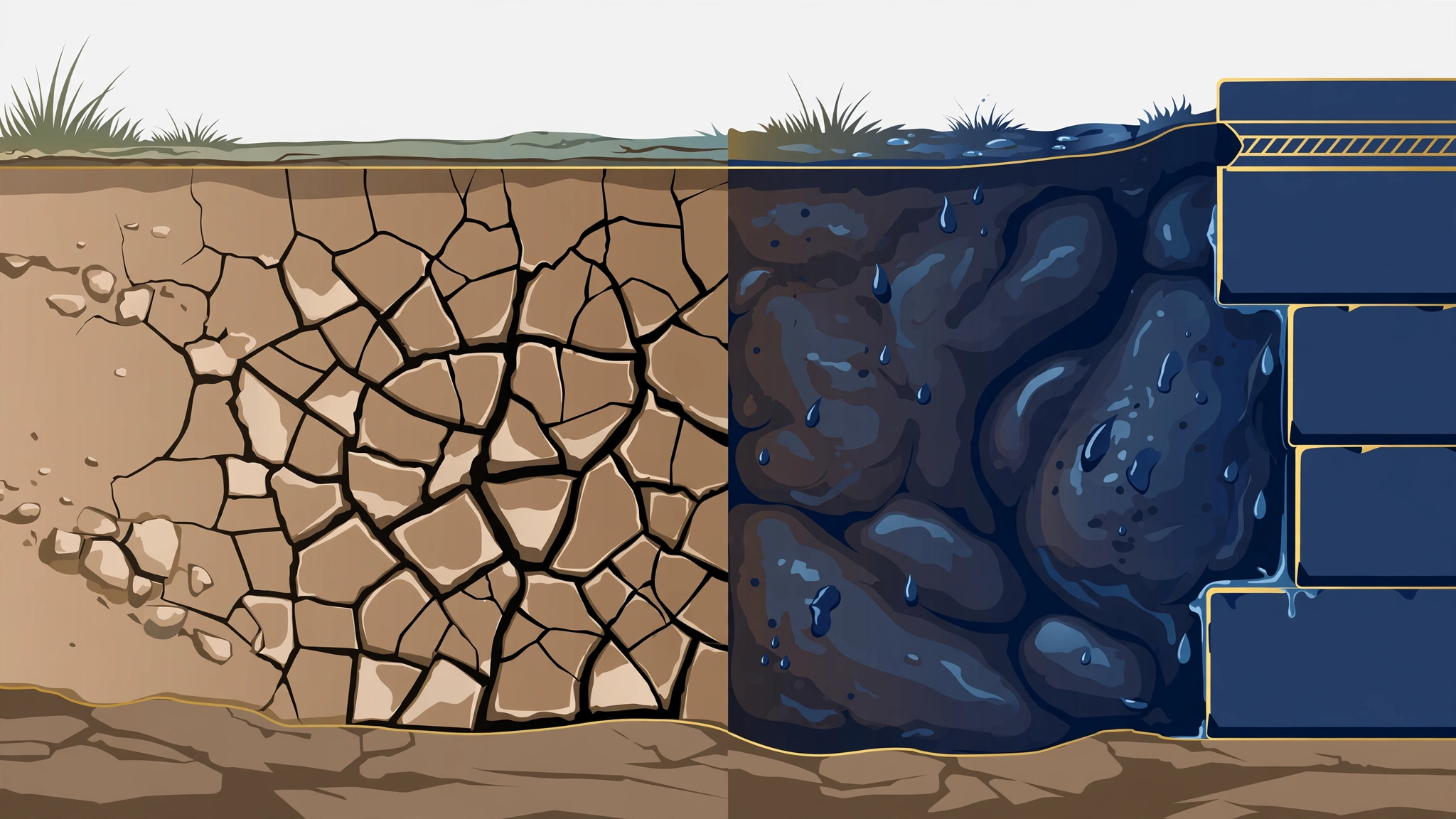
Foundation damage is caused by 5 main forces: expansive soil movement, water pressure and poor drainage, weak or poorly compacted soil, tree roots and vegetation, and construction or load problems. Foundation damage grows fastest when water and soil movement act together.
Expansive clay soil swells when wet and shrinks when dry. Swelling clay pushes up and sideways on slabs, footings, and basement walls. Shrinking clay pulls away from a foundation and leaves voids under slabs and footings. Expansive clay soils contain clay minerals that change volume with water content.
Water causes foundation damage in 4 ways. Surface water pools against a foundation when grading slopes toward the house or gutters discharge at the wall. Groundwater rises against basement walls after heavy rain and pushes water through cracks and joints. Plumbing leaks saturate soil under a slab and wash fine soil from under footings. Hydrostatic pressure is water pressure from saturated soil, and hydrostatic pressure pushes basement walls inward and lifts water through floor cracks.
Poor compaction, trees, and load problems complete the cause list. Fill soil placed in thick layers without compaction settles under the weight of a house, and organic material in fill decays and leaves voids. Large trees draw water from soil in dry months, roots enter cracks in pipes and widen the openings, and removal of a large tree can trigger heave. A footing set above the frost line or on soft soil, and added weight from a second story, add construction and load causes.
What Are the Warning Signs of Foundation Damage?
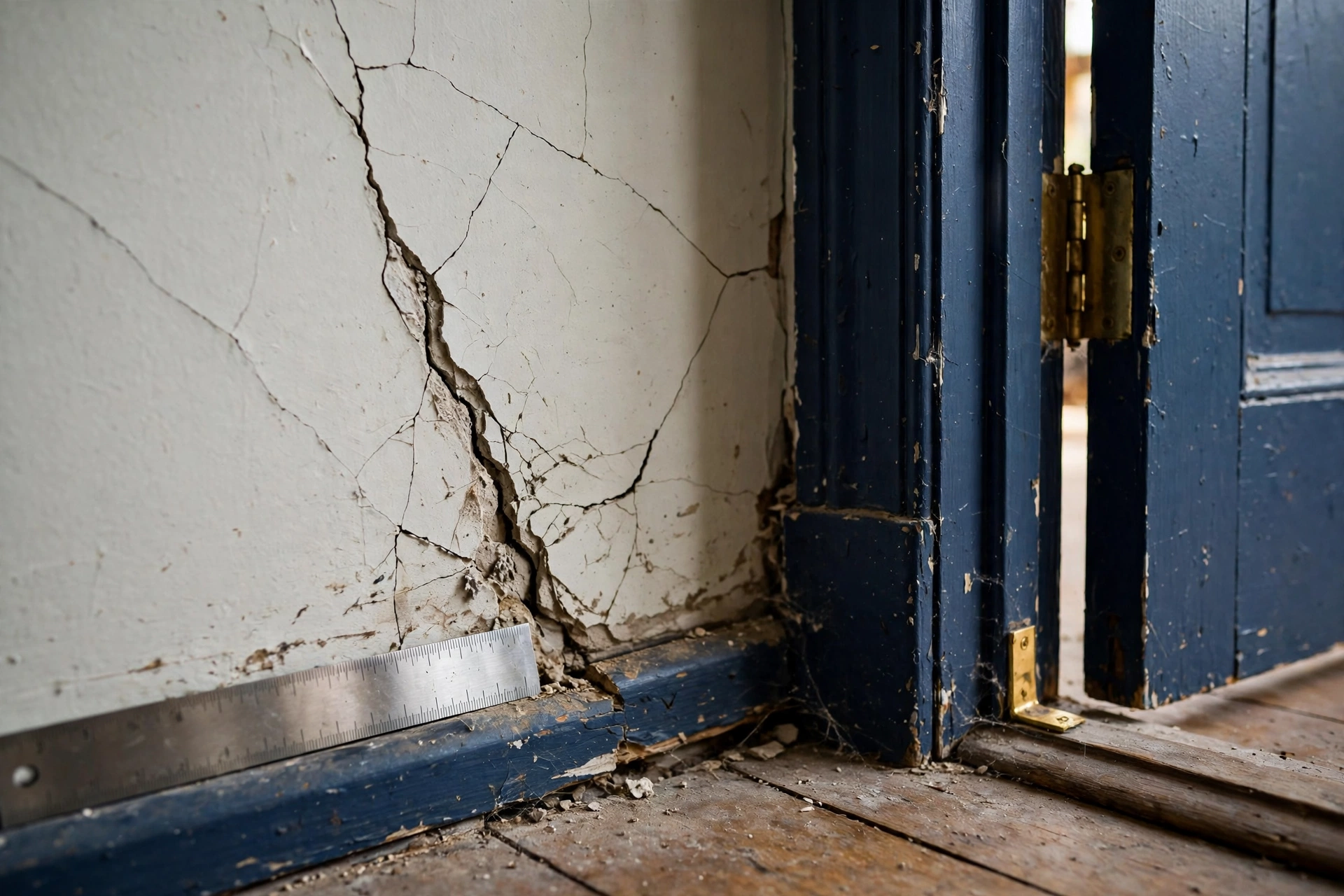
The warning signs of foundation damage are cracks in walls, floors, and brickwork, sloping or bouncing floors, sticking doors and windows, gaps between walls and trim, bowing basement walls, and water entry at floor and wall joints. The warning signs of foundation damage need a date and a measurement before any repair choice.
Cracks give the first clue in most houses. Vertical cracks in a poured concrete wall often come from shrinkage or minor settlement. Horizontal cracks in a basement wall often come from lateral soil pressure. Stair-step cracks in brick follow mortar joints and often come from differential settlement. A crack wider than 1/4 inch, a crack that grows, or a crack that lets water in needs a professional check.
Floors, frames, basements, and outside signs complete the check. A floor that slopes toward one corner and doors that bind harder each month signal steady settlement. Gaps between a wall and baseboard show frame twist. A basement wall that bows inward signals lateral pressure, and efflorescence, a white powdery deposit left when water moves through concrete, marks a water path even when the wall feels dry.
| Sign | Likely cause | First action |
|---|---|---|
| Hairline vertical crack, stable | Shrinkage | Measure, photograph, recheck in 90 days |
| Horizontal basement wall crack | Lateral pressure | Engineer check |
| Stair-step brick crack | Differential settlement | Measure width, check floor slope |
| Sloping floor, one corner low | Settlement | Level check, basement inspection |
| Sticking doors and windows | Frame twist | Check cracks on the same side |
| Bowing basement wall | Hydrostatic pressure | Engineer and drainage check |
| Water at wall and floor joint | Drainage pressure | Gutter and grading check |
How Do You Tell a Cosmetic Crack From a Structural Crack?
A cosmetic crack is a thin, stable, dry surface crack with no frame movement. A structural crack is a wide, growing, or water bearing crack tied to floor slope, sticking doors, or wall movement, and a structural crack needs an engineer check before any sealing or repair work starts.
Width gives the first test. Measure crack width with a ruler at the widest point and record the width, the length, and the date. A hairline crack measures under 1/16 inch, a moderate crack measures 1/16 inch to 1/4 inch, and a wide crack measures over 1/4 inch. Width alone never settles the question: a thin horizontal crack in a bowing wall carries more risk than a wider vertical shrinkage crack in a stable wall.
Growth and pattern give the second and third tests. Mark both ends of a crack with dated marks, photograph the crack from a fixed point with a ruler in the frame, and recheck after 30 days and after 90 days. Growth in length or width signals active movement. A single vertical crack often traces shrinkage, a diagonal crack at a door corner often traces corner settlement, and a horizontal crack in a basement wall often traces lateral pressure.
| Feature | Cosmetic crack | Structural crack |
|---|---|---|
| Width | Under 1/16 inch | Over 1/4 inch, or growing |
| Growth over 90 days | None | Measurable growth |
| Direction | Vertical, short, single | Horizontal, stair-step, diagonal |
| Frame signs | None | Sloping floors, sticking doors |
| Water | Dry | Leaks, damp stains |
| Wall shape | Straight wall | Bowing or leaning wall |
| Next step | Monitor and seal when dry | Engineer assessment |
For another water related home guide, read how drain cleaning clears pipes and stops water backing up before you check floor drains near a damp foundation wall.
How Is Foundation Damage Diagnosed?
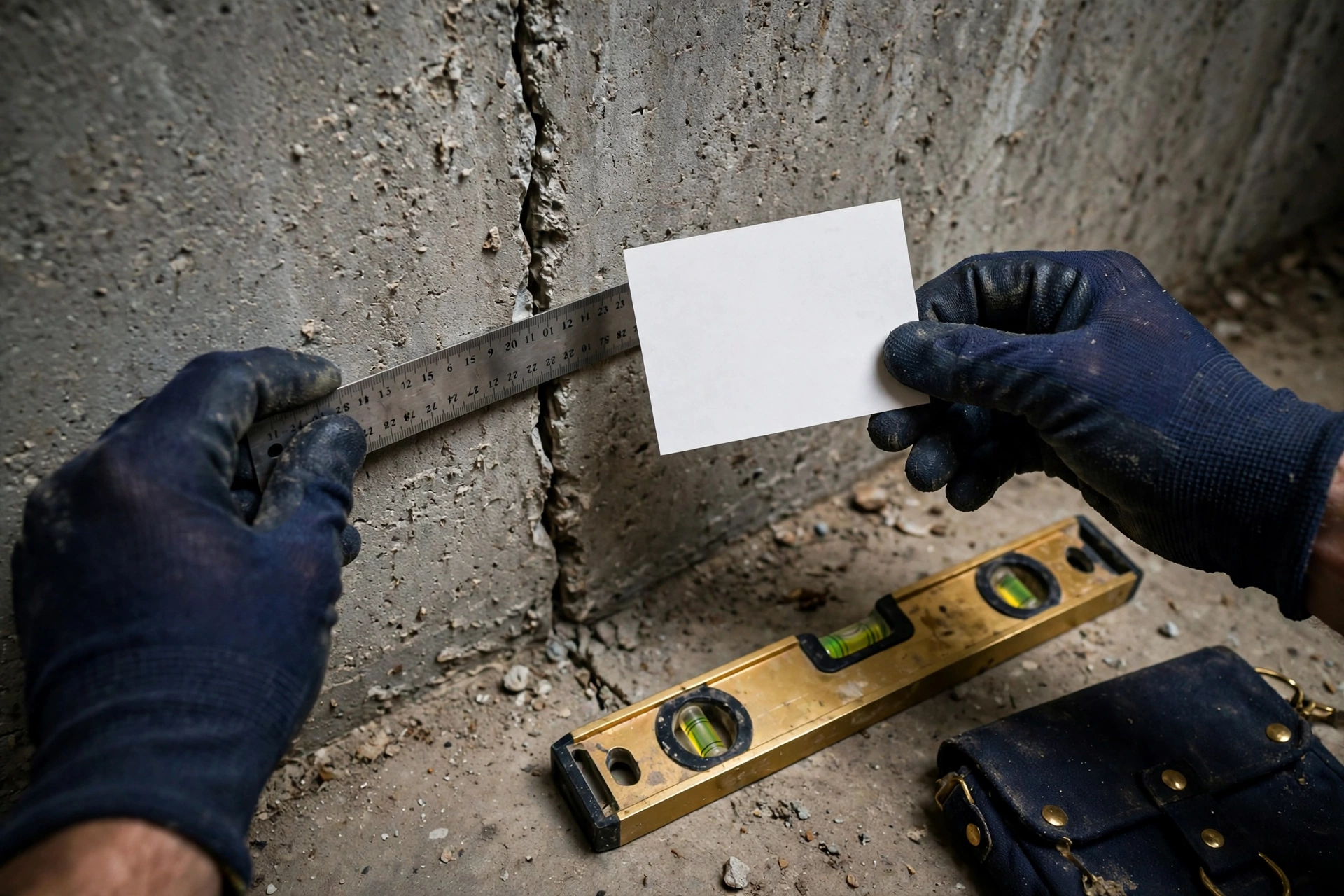
Foundation damage is diagnosed in 4 steps: a visual inspection inside and outside the house, crack and floor measurements with dates, a drainage and plumbing check, and a professional assessment when signs are structural. Foundation damage diagnosis ends with a named cause, not a repair quote alone.
Start with a full visual inspection, then measure floors, cracks, and water sources. Walk every room and look at walls, ceilings, floors, doors, and windows. Walk the outside and look at brick, siding, chimney, steps, and soil lines. Enter the basement or crawl space with a light and look at walls, joists, beams, piers, and soil. Use a level to check floor slope and wall lean, and photograph each crack with a ruler and a date card.
Choose the right professional last. A foundation repair contractor inspects and quotes repair methods. A structural engineer inspects, names the cause, and specifies the repair in a written report. Use a contractor inspection for a single stable crack with a clear drainage cause. Use a structural engineer for horizontal cracks, bowing walls, fast growth, pier failure, or a purchase decision. Ask each professional 3 questions: what caused the movement, what repair fits the cause, and what happens when the repair waits 6 months. In my own checks, the houses with the clearest cause had the shortest repair lists.
What Are the Main Foundation Repair Solutions?
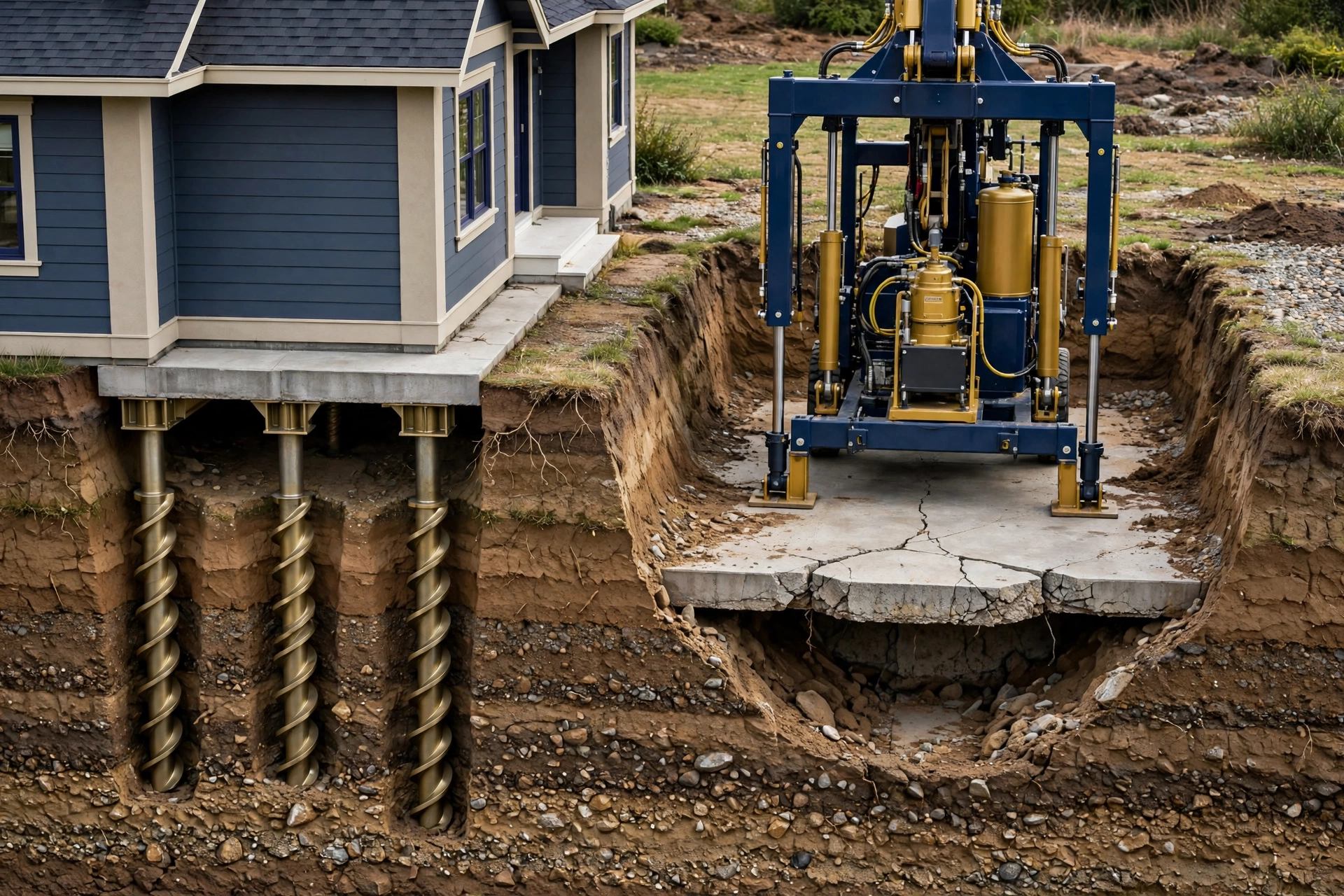
The main foundation repair solutions are steel and helical piers for settlement, slab lifting for sunken slabs, wall anchors and carbon fiber for bowing walls, crack injection for sealing, and drainage and waterproofing for water control. The main foundation repair solutions work only when the method matches the cause.
Piers stop settlement by reaching stable soil. Push piers are steel tubes driven hydraulically under a footing until the pier meets refusal in firm soil or rock. Helical piers are screw-like steel shafts turned into the ground to a torque target in stable soil.
Slab lifting and wall support cover the next cases. Mudjacking pumps a cement grout mix under a slab and lifts the slab as the mix fills voids. Polyurethane foam jacking injects expanding foam under a slab through smaller holes and cures faster with less added weight. Wall anchors connect a bowing wall to stable soil outside, steel I-beams brace a wall from floor to joists, and carbon fiber strips bond to a wall face and resist further bowing.
Crack injection and drainage work complete the list. Epoxy injection bonds crack faces in a crack that has stopped moving, polyurethane injection expands inside a crack and seals the water path, and surface sealants cover hairline cracks. Exterior waterproofing, interior drains, French drains, grading, and gutter work remove the water force. A foundation transfers house loads to the ground, and drainage work protects the soil zone that carries those loads.
How Much Does Foundation Repair Cost?
Foundation repair costs range from 250 to 800 dollars per crack for non-structural crack sealing and from 1,000 to 30,000 dollars or more for structural repair. Foundation repair cost depends on severity, method, pier count, access, and soil conditions, and local rules move a quote inside or beyond each range.
HomeGuide cost data for 2026 puts non-structural crack repair at 250 to 800 dollars or more per crack, minor structural repair at 1,000 to 5,000 dollars, and major structural repair at 10,000 to 30,000 dollars or more (Source: HomeGuide, 2026). This Old House cost data for 2026 puts piering at 1,000 to 3,000 dollars per pier, mudjacking at 550 to 1,300 dollars, and sealing and waterproofing at 2,300 to 7,300 dollars (Source: This Old House, 2026).
| Severity | Typical method | 2026 cost range |
|---|---|---|
| Hairline, stable, dry | Monitor, surface seal | 250 to 800 dollars per crack |
| Moderate crack, no movement | Epoxy or polyurethane injection | 400 to 1,500 dollars per crack |
| Settlement, one corner | Piers, underpinning | 1,000 to 3,000 dollars per pier |
| Sunken slab | Mudjacking or foam jacking | 550 to 1,300 dollars, foam 1,500 to 4,500 dollars |
| Bowing wall | Anchors, beams, carbon fiber | 4,000 to 12,000 dollars |
| Water entry, no movement | Waterproofing, drains, sump | 2,300 to 7,300 dollars |
| Severe structural failure | Full lifting, replacement | 20,000 to 50,000 dollars or more |
Get 3 written quotes for structural work. Each quote should name the method, the pier count or strip count, the depth target, the lift target, the drainage work, the warranty terms, and the permit status. A quote that names only a total price hides the scope. Voice of Wave covers home care topics with the same plain cost and method detail across its guides.
How Can You Prevent Foundation Damage?
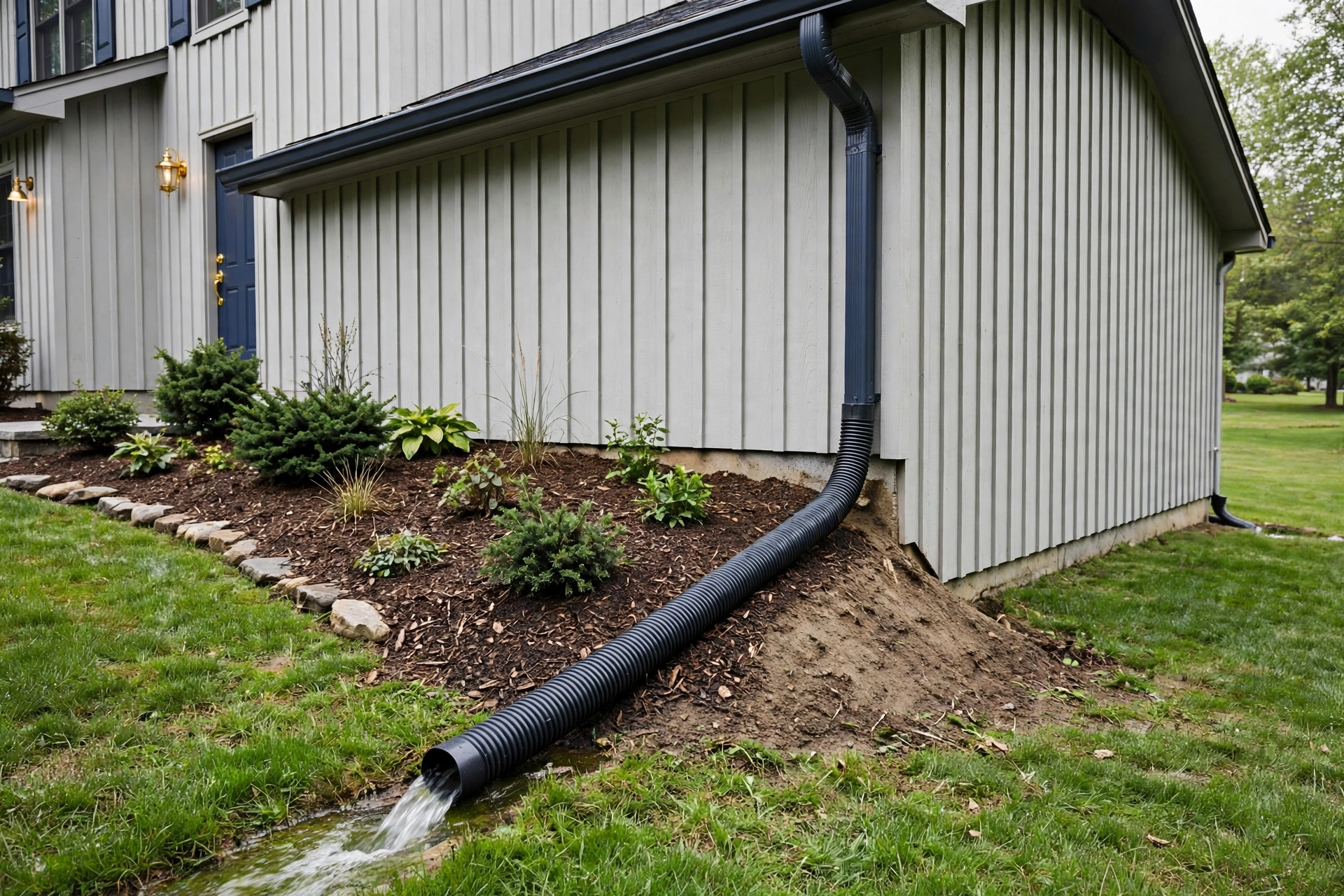
Foundation damage is prevented by 5 habits: keep water moving away from the house, keep soil moisture steady, keep trees at a safe distance, inspect on a schedule, and fix small drainage faults fast. Foundation damage prevention works because soil movement follows water.
Control surface water first, then keep soil moisture steady. Grade soil to slope away from the house for 6 to 10 feet, extend downspouts 4 to 6 feet from the wall, and clean gutters twice a year. Water soil around a foundation evenly in drought, because one dry side shrinks while a watered side stays stable. Use mulch to slow evaporation and set irrigation heads to water beds and not walls.
Manage trees and inspect on a schedule. Plant large trees at a distance equal to mature canopy spread from the house, and keep shrubs 2 to 3 feet from the wall. Talk to an arborist before removing a large tree near a house, because removal changes soil moisture and can trigger heave. Walk the outside each spring and autumn, check cracks with dated photos, and keep a one page log with dates and widths.
Conclusion
Foundation damage starts with soil and water, shows in cracks, floors, and frames, and ends with a repair matched to the cause. Foundation damage stays manageable when checks start early and water control comes first.
Foundation damage needs measurement before repair, an engineer for structural signs, piers or wall support for movement, and drainage work for water pressure. The 2026 cost ranges show the price of delay: sealing a stable crack costs hundreds of dollars, while pier work and lifting cost thousands of dollars. Keep gutters and grading in order, and call a professional when cracks grow, walls bow, or floors slope.
Explore more home guides on the Voice of Wave blog and keep your house check on a set schedule.
Frequently Asked Questions
Can foundation damage be fixed?
Yes, foundation damage can be fixed in most houses with piers, slab lifting, wall anchors, carbon fiber, crack injection, or drainage work matched to the cause. A structural engineer names the cause first, and a contractor then applies the method that fits the soil, the wall type, and the movement pattern.
How do I know if a foundation crack is serious?
A foundation crack is serious when the crack exceeds 1/4 inch, grows over 30 to 90 days, runs horizontally in a basement wall, follows stair-step joints in brick, leaks water, or pairs with sloping floors or sticking doors. A thin, dry, stable crack with no frame movement is usually a monitoring case, not an urgent repair.
How long does foundation repair take?
Foundation repair takes 1 to 3 days for crack injection and slab lifting, 2 to 5 days for pier installation on a typical house, and 1 to 2 weeks for wall anchor, waterproofing, or full lifting work with excavation and curing time. Weather, access, permit waits, and engineer reports add time before and after the on-site work.
Does homeowners insurance cover foundation damage?
No, homeowners insurance usually does not cover foundation damage from settlement, soil movement, or poor drainage, because those causes count as maintenance and earth movement exclusions in most policies. Sudden damage from a covered event, such as a burst pipe or a vehicle impact, may qualify, so read the policy and ask the insurer with the cause in writing.
Can I sell a house with foundation damage?
Yes, a house with foundation damage can be sold when the damage is disclosed, the cause is documented, and repair quotes or completed repair records are shared with buyers. An engineer report, a dated crack log, and a transferable warranty help buyers price the risk, and undisclosed damage creates legal and price problems after the sale.
How often should I inspect my foundation?
Inspect a foundation twice a year, in spring and autumn, and after heavy rain, drought, or nearby excavation work. Check cracks with dated photos, check floors and doors for new binding, check basement and crawl space walls for water, and check gutters and grading at the same visit.