

Memory slips, repeated questions, a familiar street that suddenly feels strange. When families first notice these changes, two words almost always come up together: dementia and Alzheimer’s.
Dementia vs Alzheimer’s, in short: dementia is an umbrella term for symptoms like memory loss and confusion that interfere with daily life, while Alzheimer’s disease is a specific, progressive brain disease that causes dementia. Every case of Alzheimer’s involves dementia, but not every case of dementia is Alzheimer’s. Alzheimer’s accounts for roughly 60 to 80 percent of all dementia cases, according to the Alzheimer’s Association.
This guide explains the difference between dementia and Alzheimer’s in plain language: what each term means, how symptoms and stages compare, whether dementia can be cured, and when to seek help. It is written for information only, not medical advice; if you are worried about memory changes, talk to a doctor. At Voice of Wave, we publish ideas, insights, and stories that matter.
Key Takeaways
- Dementia is a syndrome, a group of symptoms. Alzheimer’s disease is one specific disease that causes dementia, and the most common one.
- Alzheimer’s typically starts with short-term memory loss and progresses through early, middle, and late stages.
- Other dementias start differently: vascular dementia follows strokes, Lewy body dementia brings hallucinations and movement changes, frontotemporal dementia affects personality or language first.
- Some causes of dementia are treatable or reversible, which is why an accurate diagnosis matters.
- There is no cure for Alzheimer’s yet, but new drugs can modestly slow early disease, and 158 therapies are in clinical trials.
Table of Contents
- What Is Dementia?
- What Is Alzheimer’s Disease?
- Dementia vs Alzheimer’s: What’s the Core Difference?
- What Are the Main Types of Dementia?
- How Do the Symptoms Compare?
- Can Dementia Be Cured?
- How Are Dementia and Alzheimer’s Diagnosed?
- What Are the Stages of Alzheimer’s Disease?
- What Are the Early Signs of Alzheimer’s in Your 60s?
- Can Dementia Be Reversed or Prevented?
- When Should You See a Doctor?
- Practical Help for Caregivers
- Frequently Asked Questions
- Conclusion
What Is Dementia?

Dementia is not a single disease. It is a broad term for a decline in memory, thinking, reasoning, judgment, language, and behavior severe enough to interfere with everyday life. For a medical overview, see the dementia article on Wikipedia.
A person has dementia when at least two core mental functions are affected: memory plus judgment, for example. Causes vary enormously, from stroke and reduced blood flow to abnormal protein deposits, head injury, and even vitamin deficiencies. Doctors use the word to describe the symptom pattern, then identify the underlying condition.
This matters practically. “Your father has dementia” names the problem. “Your father has vascular dementia” names the cause, and the cause shapes treatment, expectations, and planning.
What Is Alzheimer’s Disease?

Alzheimer’s disease is a specific, progressive brain disease and the single most common cause of dementia. It begins with abnormal protein deposits: beta-amyloid plaques between brain cells and tau protein tangles inside them, which damage neurons and cut off their communication. For the detailed pathology, see the Alzheimer’s disease article on Wikipedia.
The damage starts in the hippocampus, the brain’s center for forming new memories, which is why early Alzheimer’s shows up as forgetfulness: repeating questions, misplacing things, losing track of conversations. Over years it spreads, affecting language, reasoning, and eventually basic functions like walking and swallowing.
Studies summarized in the 2024 Alzheimer’s disease facts and figures report found that people aged 65 and older survive an average of four to eight years after an Alzheimer’s dementia diagnosis, although some live as long as 20 years.
Dementia vs Alzheimer’s: What’s the Core Difference?
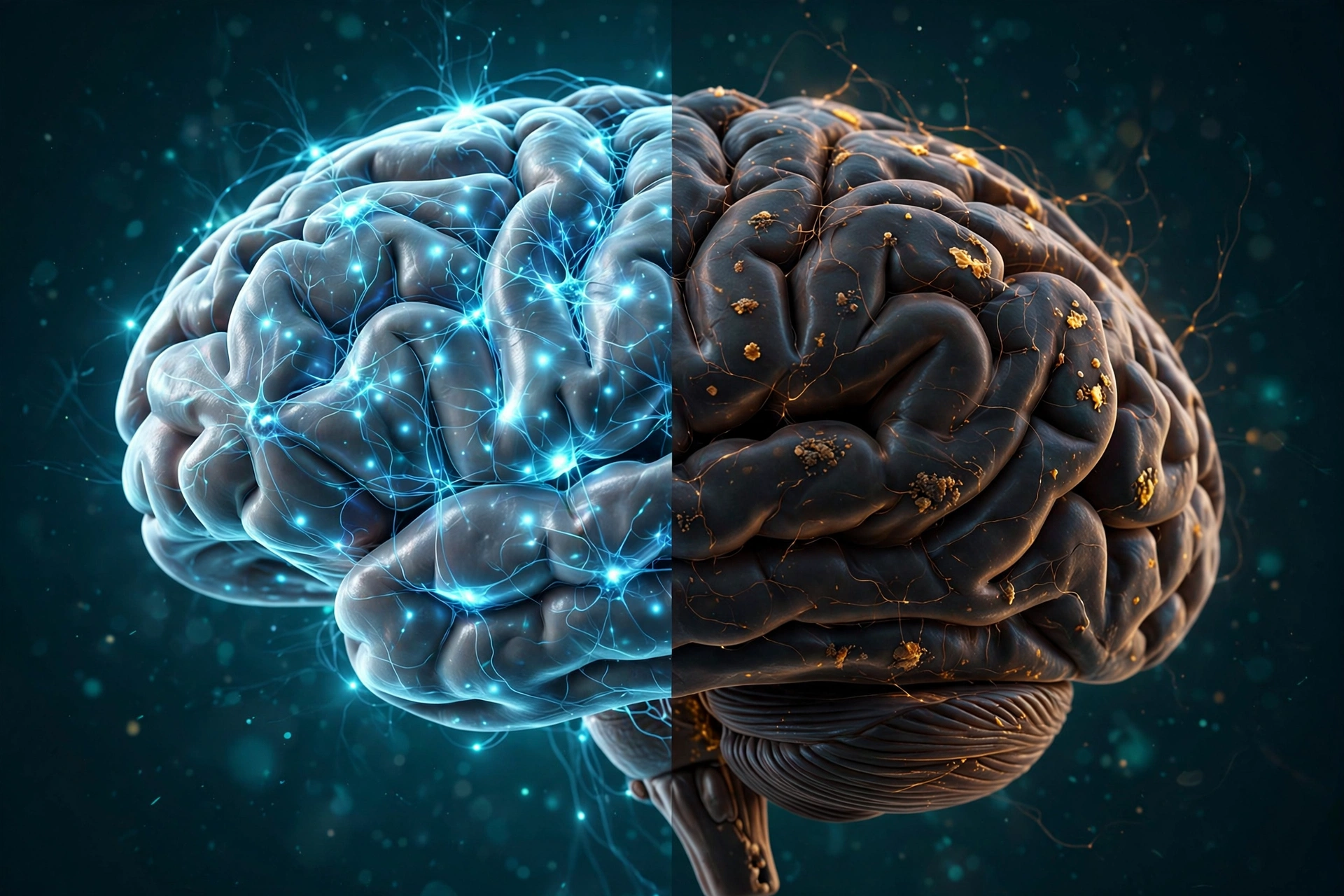
The simplest way to hold the distinction is the umbrella image. Dementia is the umbrella term for the symptoms. Alzheimer’s is one disease under that umbrella, sitting alongside several others. So “is Alzheimer’s dementia?” has a precise answer: Alzheimer’s disease causes dementia, but the words are not interchangeable.
| Aspect | Dementia | Alzheimer’s Disease |
|---|---|---|
| What it is | Umbrella term for a group of symptoms | A specific, progressive brain disease |
| Share of cases | Covers all forms of cognitive decline | Causes roughly 60 to 80 percent of cases |
| First symptoms | Vary by type: language trouble, hallucinations, movement changes, or memory loss | Usually short-term memory loss: repeating questions, forgetting recent conversations |
| Causes | Many: strokes, vascular disease, Lewy bodies, injuries, reversible conditions | Beta-amyloid plaques and tau tangles that damage brain cells |
| Progression | Depends on the type; vascular dementia can worsen in steps | Gradual and fairly predictable through early, middle, and late stages |
| Treatment | Depends on the cause; some forms are treatable or reversible | Medications may ease symptoms; new drugs can modestly slow early disease |
Getting the specific diagnosis right changes real decisions. Vascular dementia may respond to blood pressure control and stroke prevention. Lewy body dementia makes some common medications risky. The exact diagnosis shapes the care plan from day one.
What Are the Main Types of Dementia?
Alzheimer’s disease
The most common type. Starts with short-term memory loss and spreads gradually to language, reasoning, and behavior. Brain changes can begin 15 to 20 years before symptoms appear.
Vascular dementia
The second most common type, caused by reduced blood flow to the brain from strokes or small-vessel disease. For background, see the vascular dementia overview on Wikipedia. Its progression is often stepwise after each vascular event, and controlling blood pressure, diabetes, and cholesterol can slow further damage.
Lewy body dementia
Caused by abnormal Lewy body protein deposits. It often begins with visual hallucinations, fluctuating alertness, vivid dreams acted out during sleep, and Parkinson-like stiffness. People with this type can react badly to certain antipsychotics, another reason the precise diagnosis matters.
Frontotemporal dementia
Involves damage to the frontal and temporal lobes. Unlike Alzheimer’s, it often starts with personality changes, loss of empathy, or language difficulty rather than memory loss, and tends to appear earlier, often between ages 45 and 65.
Mixed dementia
Far more common than most people realize. In older adults, autopsy studies frequently find more than one brain change, most often Alzheimer’s plus vascular damage, and the blended symptoms resist single textbook patterns.
How Do the Symptoms Compare?
The starting point is the biggest clue. Alzheimer’s usually announces itself through memory: the same question three times in an hour, a familiar recipe that suddenly goes wrong. Vascular dementia may begin with slowed thinking. Lewy body dementia may start with hallucinations. Frontotemporal dementia may start with an unfamiliar personality.
As any of these progress, symptoms converge: confusion about time and place, word-finding trouble, poor judgment, and eventually difficulty with daily tasks. That convergence is why early differences matter; advanced disease is much harder to tell apart.
| Symptom area | Alzheimer’s disease | Other dementias |
|---|---|---|
| First warning | Short-term memory loss | Varies: mood, movement, language, or hallucinations |
| Memory | Early and central | May appear later or be less prominent |
| Hallucinations | Usually late, if at all | Early in Lewy body dementia |
| Personality changes | Gradual, later stages | Early in frontotemporal dementia |
| Movement problems | Late stages | Early in Lewy body and Parkinson’s dementias |
| Progression pattern | Gradual decline | Stepwise (vascular) or fluctuating (Lewy body) |
Can Dementia Be Cured?
The honest answer depends on the type. For Alzheimer’s disease, there is currently no cure. But the picture is less bleak than five years ago. The World Alzheimer Report 2026, published by Alzheimer’s Disease International, argues that Alzheimer’s should no longer be described as universally untreatable. Two drugs, lecanemab and donanemab, became the first fully approved treatments shown to modestly slow early disease rather than merely easing symptoms. Researchers are now testing 158 potential dementia therapies across 192 clinical trials.
For dementia as a whole, some causes respond to treatment. Managing vascular risk factors can slow vascular dementia, and several look-alike conditions can be reversed entirely: B12 deficiency, thyroid disorders, medication effects, depression, and fluid buildup around the brain.
How Are Dementia and Alzheimer’s Diagnosed?
There is no single routine blood test for dementia. A diagnosis comes from several pieces together: medical and family history, cognitive and memory testing, a neurological examination, brain imaging such as MRI or CT, and lab tests to rule out reversible causes.
Alzheimer’s is diagnosed the same way, plus ruling out the other causes. In specialized neurology centers, scans that detect amyloid plaques, or spinal fluid and newer blood tests for Alzheimer’s biomarkers, can support the diagnosis. An early, accurate diagnosis gives families more options: treatments that work best early, time to plan, and the chance to join clinical trials.
What Are the Stages of Alzheimer’s Disease?
Clinicians usually describe three broad stages, though the boundaries blur and the timeline differs from person to person.
Early (mild) stage. Memory lapses are noticeable but the person still manages daily life mostly independently: word-finding trouble, losing items, difficulty planning. This stage typically lasts two to four years, and it is when new treatments are most relevant.
Middle (moderate) stage. The longest stage, often two to ten years. Confusion grows, daily tasks need help, and caregiver support becomes essential.
Severe (late) stage. Communication fades, self-care is no longer possible, and round-the-clock care shifts the focus to comfort and dignity.
Before all this lies a silent phase of 15 to 20 years before symptoms appear, which is why prevention research now focuses on midlife.
What Are the Early Signs of Alzheimer’s in Your 60s?
The 60s are the decade when early Alzheimer’s most often becomes noticeable, and also when normal aging causes harmless memory lapses, so telling them apart matters. Losing your keys occasionally is normal aging. Forgetting what keys are for is not.
Watch for patterns rather than single events: repeating questions, difficulty with familiar recipes or bills, confusion about dates or places, withdrawal from social activities, and mood or personality changes. One of these alone may mean nothing; several together, persisting over months, deserve a doctor’s visit. Many causes of memory problems are treatable, and Alzheimer’s treatments work best when started early.
Can Dementia Be Reversed or Prevented?
A small but important subset of dementia-like conditions can be reversed when the underlying problem is treated: vitamin B12 deficiency, an underactive thyroid, depression, medication interactions, and normal pressure hydrocephalus among them. This is one of the strongest arguments for getting memory problems evaluated rather than assuming the worst.
The World Health Organization’s updated 2026 guidance states that up to 45 percent of dementia cases may be preventable or delayed by addressing risk factors across life: blood pressure and diabetes control, physical and social activity, treating hearing loss, and avoiding smoking and excess alcohol. Building healthy daily habits, like the ones in our guide to healthy daily habits, is one of the most practical investments in long-term brain health.
When Should You See a Doctor?
See a doctor when memory or thinking changes interfere with daily life, get worse over months, or worry the people around you. You do not need to wait until things feel severe. Bring a list of current medications, note when the changes began, and if possible bring a family member who has observed the changes; doctors value that outside perspective.
The visit usually starts with conversation and simple memory tests, followed by blood work and possibly a brain scan. Many people leave with a treatable explanation or a clean bill of health.
Practical Help for Caregivers
Caring for someone with dementia is demanding, and practical details matter as much as medical ones. Keep routines consistent, since predictability reduces confusion. Break tasks into single steps: “put on your shirt” works better than “get dressed.” Simplify the home by removing trip hazards and reducing visual clutter, an approach that pairs naturally with minimalist living ideas for a calmer space.
Communicate calmly, one idea at a time, and redirect rather than argue about facts the person can no longer grasp. Protect your own health too: caregiver burnout is common, so accept help early and join a support group. The Alzheimer’s Association runs a 24/7 helpline for caregivers.
Frequently Asked Questions
Is Alzheimer’s the same as dementia?
No. Dementia is the umbrella term for symptoms like memory loss and confusion that interfere with daily life. Alzheimer’s disease is one specific disease that causes those symptoms, and the most common one, responsible for roughly 60 to 80 percent of cases.
What is the main difference between dementia and Alzheimer’s?
Dementia describes what is happening (the symptoms), while Alzheimer’s names why it is happening (the disease). A dementia diagnosis says cognitive decline is present; an Alzheimer’s diagnosis identifies the specific brain disease, beta-amyloid plaques and tau tangles, behind it.
Can dementia be cured?
It depends on the cause. Alzheimer’s has no cure, though new drugs can modestly slow early disease and many more treatments are in trials. Some other causes are treatable or reversible, including vitamin B12 deficiency, thyroid disorders, and medication effects, which is why diagnosis matters.
What are the early signs of dementia vs Alzheimer’s?
Alzheimer’s usually starts with short-term memory loss: repeating questions, forgetting recent conversations, misplacing items. Other dementias may start differently, with personality changes, hallucinations, movement problems, or stepwise confusion after strokes.
Does everyone with dementia have Alzheimer’s?
No. Vascular dementia, Lewy body dementia, frontotemporal dementia, and mixed dementia (usually Alzheimer’s plus vascular damage) account for a large share. Each follows a different course and responds to different care.
Is dementia hereditary?
Most dementia is not directly inherited. A parent with Alzheimer’s raises risk modestly, but age, lifestyle, and vascular health matter more. Rare genes cause early-onset Alzheimer’s in a few families, and genetic counseling is available.
How fast does Alzheimer’s progress?
It varies widely. Brain changes can begin 15 to 20 years before symptoms. After diagnosis, people aged 65 and older live an average of four to eight years, though some live up to 20. The middle stage is typically the longest.
Conclusion
Dementia vs Alzheimer’s is not a contest between two diseases. It is the difference between a symptom pattern and the disease most often behind it, and that distinction guides testing, treatment, expectations, and planning. Alzheimer’s remains the most common cause, alongside vascular, Lewy body, frontotemporal, and mixed dementia, plus treatable look-alikes.
If this topic touched your life, take one concrete step this week. Notice whether the changes you have seen are persistent patterns or passing moments, and if they persist, book the doctor’s appointment. Early answers, whatever they are, are always better than late ones.