

Introduction
What are the most effective daily habits for a healthy life? Research points to seven: move daily, eat mostly whole foods, drink enough water, sleep seven to nine hours, manage stress, avoid smoking, and stay socially connected. Together, these daily habits for a healthy life can add more than a decade to life expectancy.
That sounds like a lot, but here is the good news: you do not need to adopt everything at once. The people who succeed start embarrassingly small, stack new habits onto routines they already have, and forgive the occasional missed day. This guide, prepared by the Voice of Wave Editorial Team, walks you through exactly how to do that: the science of habit formation, a 30-day progressive plan, time-based options for packed schedules, and honest answers to common questions.
Key Takeaways
- Daily habits for a healthy life work through consistency, not intensity: small actions repeated beat heroic efforts abandoned.
- The core seven are movement, whole-food eating, hydration, 7-9 hours of sleep, stress management, no smoking, and social connection.
- Habit stacking, attaching a new habit to an existing routine, is the simplest way to make daily habits for a healthy life stick.
- Every habit here is free and takes between one and thirty minutes.
- Missing a day is normal; the plan below includes a built-in recovery rule.
Table of Contents
- What Are Daily Habits for a Healthy Life, Exactly?
- Why Do Small Habits Work Better Than Big Resolutions?
- What Are the Best Simple Health Habits to Start With?
- How Can Busy People Fit Healthy Lifestyle Habits Into a Packed Day?
- What Should You Eat and Drink Every Day?
- How Do You Build a Wellness Daily Routine That Actually Sticks?
- What Gets in the Way of Healthy Habits (and How Do You Get Back on Track)?
- What Does a Real Day of Healthy Habits Look Like?
- Frequently Asked Questions
- Conclusion
What Are Daily Habits for a Healthy Life, Exactly?
Daily habits for a healthy life are small, repeatable actions that protect your body and mind over time. Researchers at the Harvard T.H. Chan School of Public Health, analyzing data from the Nurses’ Health Study, identified five behaviors with outsized impact: a healthy diet, regular physical activity, healthy body weight, no smoking, and moderate alcohol intake. People practicing all five from age 50 lived more than ten years longer.
The seven pillars
Most experts converge on seven pillars. First, daily movement: at least 30 minutes of moderate activity like brisk walking (the World Health Organization recommends 150 minutes per week). Second, whole-food eating: vegetables, fruits, whole grains, legumes, and lean proteins, with processed food kept occasional. Third, hydration: water throughout the day, starting with a glass in the morning. Fourth, sleep: seven to nine hours on a consistent schedule. Fifth, stress management: one daily practice that calms your nervous system. Sixth, no tobacco. Seventh, social connection: regular contact with people who matter to you.
Notice what is not on the list: expensive supplements, extreme diets, or punishing workouts. The most powerful daily habits for a healthy life are simple, cheap, and repeatable.
Why Do Small Habits Work Better Than Big Resolutions?
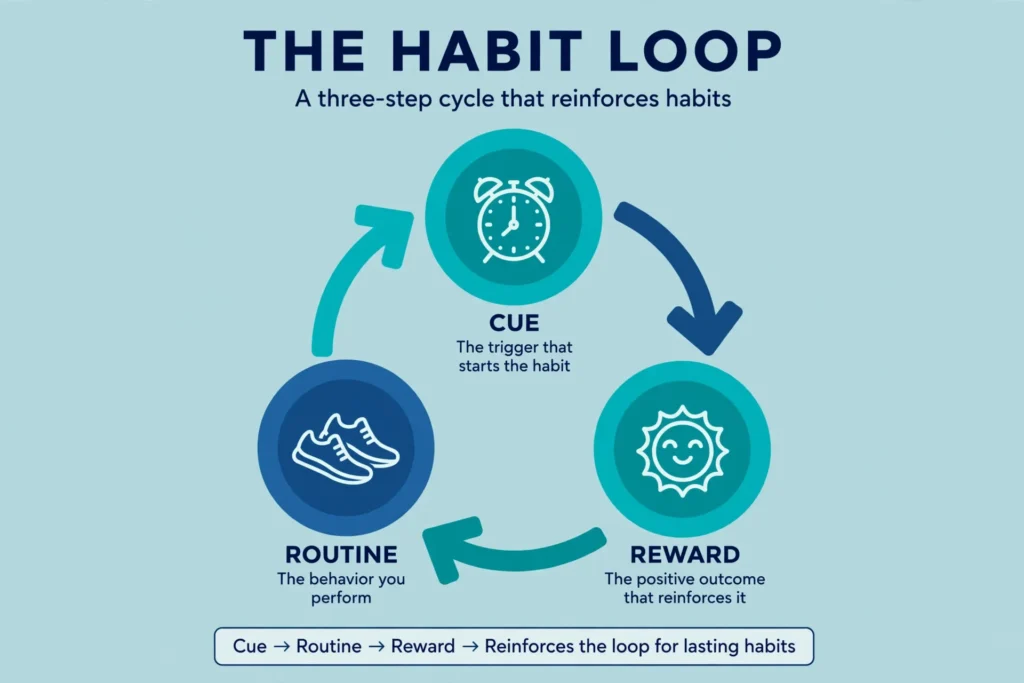
Because your brain is wired for efficiency, not heroics. A habit forms through a loop psychologists describe as cue, routine, reward: the cue triggers the behavior, and the reward tells your brain it was worth doing. Repeat the loop enough and the behavior becomes automatic, needing almost no willpower. Big resolutions fail because they demand enormous willpower daily; small habits succeed because they gradually demand almost none.
Habit stacking: the beginner’s superpower
The American Heart Association highlights a technique called habit stacking: attach a new habit to one you already do without thinking. After you brush your teeth in the morning, do five squats. While your coffee brews, slice vegetables for a snack. After lunch, take a ten-minute walk. The existing habit is the cue, so you never have to remember the new one separately. Habit stacking is one of the fastest ways to install daily habits for a healthy life. Habit researcher Dr. Wendy Wood puts it plainly: the environment you create matters more than motivation. Make good habits easy and visible, and add friction to bad ones. Keep a water bottle on your desk, keep your walking shoes by the door, and keep your phone out of the bedroom at night.
Start embarrassingly small
Stanford’s Behavior Design Lab found that tiny “starter steps” succeed because they fly under the radar of your brain’s resistance. One push-up leads to ten. If a habit feels hard, shrink it until it feels silly. You can always scale up; you cannot scale up a habit you quit.
What Are the Best Simple Health Habits to Start With?
The best simple health habits are the ones you will actually repeat, so start with the highest-impact, lowest-effort options. Below they are organized by time of day, which makes these daily habits for a healthy life easier to slot into a real schedule.
Morning habits
Drink water first. A full glass rehydrates you faster than coffee wakes you up; keep it by your bed. Get daylight early. Morning light sets your circadian rhythm, the clock governing sleep and energy. Move for five minutes. Stretch or walk around the block. Eat protein with breakfast. Eggs, yogurt, lentils, or nuts prevent the mid-morning energy crash.
Daytime habits
Walk after meals. Ten to fifteen minutes aids digestion and steadies blood sugar. Break up sitting with a two-minute stand or stretch every hour. Eat something fresh. One apple or handful of berries crowds out worse choices. Breathe deeply once. Three slow breaths before notifications resets a frazzled nervous system in under a minute.
Evening habits
Dim screens after 8 PM. Evening light delays melatonin, the sleepiness hormone. Stretch briefly. Five minutes eases the day’s muscle tightness. Reflect briefly. Write one win from the day and one thing to improve tomorrow. This tiny journaling habit builds self-awareness, and research links gratitude reflection to greater resilience. Keep a consistent bedtime. Regularity matters as much as duration for sleep quality.
How Can Busy People Fit Healthy Lifestyle Habits Into a Packed Day?
This is the question most lists dodge, so here is a direct answer: healthy lifestyle habits fit into a packed day when you choose them by minutes available, not by ideal routines. Nobody with a full-time job and a family has a spare two hours; almost everyone has five spare minutes, several times a day, which is enough for daily habits for a healthy life.
The under-five-minute menu
| Minutes | Habit | Why it matters |
|---|---|---|
| 1 | Drink a full glass of water | Rehydration, energy |
| 1 | Three slow deep breaths | Calms stress response |
| 2 | Stretch arms overhead, touch toes | Mobility, posture |
| 2 | Step outside for daylight | Mood, sleep timing |
| 3 | Walk briskly around the block | Circulation, digestion |
| 5 | Bodyweight squats and push-ups | Strength maintenance |
| 5 | Write a gratitude list | Mental resilience |
The realism rule
Pick three items from the menu, attach each to an existing routine, and ignore the rest for now. Water after brushing teeth. Deep breaths before opening email. A walk after lunch. Three tiny daily habits for a healthy life, done consistently, outperform an ambitious plan abandoned by February. When the three feel automatic, add one more.
What Should You Eat and Drink Every Day?
You do not need imported superfoods or expensive powders. The healthiest daily eating pattern, and one of the most important daily habits for a healthy life, is built from ordinary foods: vegetables, fruits, legumes, whole grains, nuts, and lean proteins. The Harvard healthy-eating research emphasizes vegetables and fruits, whole grains, healthy fats, and limited red meat, sugary drinks, and sodium. A practical translation: fill half your plate with vegetables, a quarter with whole grains or legumes, and a quarter with protein.
Daily eating habits that matter most
Cook more than you order. Home cooking controls salt, sugar, and oil in ways restaurant food never will. Reduce liquid sugar first. Sugary drinks are the easiest calories to cut; swap them for water or unsweetened tea. Eat protein at every meal. It preserves muscle, steadies energy, and keeps hunger in check. Keep healthy snacks visible. Fruit on the counter gets eaten, so make the healthy choice the easy one.
Drinking habits
Water is the default all day. Two to three cups of coffee is fine for most people, but keep it before noon. Alcohol, if you drink at all, stays moderate, and less is better. Herbal teas like chamomile make good evening rituals.
How Do You Build a Wellness Daily Routine That Actually Sticks?

A wellness daily routine sticks when designed around real life. The flexible “menu, not schedule” approach works best for daily habits for a healthy life: habits you mix and match across morning, afternoon, and evening. Rigidity is the number one routine killer; permission to do the short version keeps you consistent.
The 30-day progressive plan
Week 1: Foundation. Pick just two habits: morning water and a ten-minute walk. Week 2: Add nourishment. Add one fresh food item daily and a consistent bedtime. Week 3: Add recovery. Add three deep breaths before bed and a two-minute hourly movement break. Week 4: Add reflection. Add the one-win journal line each evening. Seven habits, built gradually enough to last.
Track simply, adjust kindly
Mark an X on a paper calendar for each day you complete your habits; visible streaks are remarkably motivating. Review weekly: which habit felt easy, which felt like a chore? Keep the easy ones, shrink or swap the hard ones. For more structured guidance like this, explore the practical articles on the Voice of Wave homepage.
What Gets in the Way of Healthy Habits (and How Do You Get Back on Track)?
Three obstacles derail most people: all-or-nothing thinking, an unsupportive environment, and confusing a missed day with failure. All-or-nothing thinking says one skipped workout ruins the week; it does not. Fix the environment instead of relying on willpower, and treat a missed day as data, not a verdict.
The never-miss-twice rule
This single rule rescues more routines than any app: miss one day, never two in a row. What matters is the speed of the return, not the perfection of the streak. Research on habit formation shows occasional misses do not erase progress; extended breaks do. This mindset keeps daily habits for a healthy life alive through real-world chaos.
Watch for these traps
The supplement trap. No pill replaces sleep, movement, and real food. The comparison trap. Someone else’s marathon training is irrelevant to your ten-minute walk. The information trap. Reading about health is not a health habit; at some point, close the article and drink the water.
What Does a Real Day of Healthy Habits Look Like?

Theory is nice; here is what daily habits for a healthy life look like on an ordinary Tuesday. 6:30 AM: glass of water, five-minute stretch, daylight from the kitchen window. 7:00 AM: protein breakfast. 8:00 AM: three deep breaths before email. 12:30 PM: lunch, half plate vegetables, then a fifteen-minute walk. 3:00 PM: water refill, two-minute stretch, an apple. 6:00 PM: home-cooked dinner, screens off at the table. 8:30 PM: screens dim, herbal tea. 9:30 PM: one gratitude line. 10:00 PM: lights out.
Nothing heroic. Nothing expensive. Total active time: under an hour, scattered across the day. This is the quiet compound interest of daily habits for a healthy life, and it is available to anyone willing to start small.
Frequently Asked Questions
How many daily habits should I start with at once?
Start with two or three at most. Research on behavior change consistently shows that small numbers succeed where long lists fail. Pick the easiest high-impact daily habits for a healthy life first, such as morning water and a short walk. Add one new habit every one to two weeks only after the current ones feel automatic.
How long does it take to form a healthy habit?
It varies widely, from about three weeks for simple habits to several months for complex ones. The popular “21 days” claim is a myth. Focus on consistency of repetition rather than counting days, and use habit stacking to speed things up.
What is the single most important healthy habit?
If forced to pick one, most researchers would choose not smoking. Among positive daily habits for a healthy life to add, daily movement wins: 20 to 30 minutes of brisk walking is linked to lower risks of heart disease and diabetes. Sleep is a close second.
Can I be healthy without going to the gym?
Absolutely. The World Health Organization’s activity guidelines can be met entirely with brisk walking, bodyweight exercises, and active daily tasks like climbing stairs or gardening. These count fully as daily habits for a healthy life. Consistency of moderate movement matters far more than gym membership. Strength work twice weekly with push-ups and squats covers the muscle-maintenance base.
Do I need to give up all junk food?
No. Nutrition researchers emphasize overall dietary patterns over individual foods, so one treat does not ruin anything. Keep treats occasional and portions sane, and make whole foods the default. Rigid restriction usually backfires into bingeing, so aim for sustainable balance instead of perfection.
What if I miss several days in a row?
Restart immediately with the smallest version of your routine, even just one habit for one day. Review what interrupted you and adjust: smaller habits, better cues, or a more forgiving schedule. A break does not erase the pathways you built; they reactivate faster the second time.
Conclusion
Daily habits for a healthy life are not a project with a finish line; they are a way of operating. Move a little every day, eat mostly real food, drink water, sleep enough, calm your nervous system, skip tobacco, and stay close to your people. Start with two tiny habits, stack them onto routines you already have, follow the 30-day plan above, and apply the never-miss-twice rule when life intervenes. These daily habits for a healthy life compound quietly over months and years.
You do not need perfect conditions, expensive gear, or massive willpower. You need a glass of water, a pair of walking shoes, and the decision to begin today. Pick your two starter habits right now, and let consistency do the rest.
If you found this day plan useful, you may also enjoy our guides on 10 Essential Tech Gadgets for 2026 and Minimalist Living: Less Stuff, More Life.