


To hire a roofing contractor, shortlist three local companies, verify each license number on your state licensing board site, confirm general liability and workers’ compensation insurance directly with the insurer, compare three itemized written estimates, and sign a contract that names materials, timeline, payment milestones, and both warranties before anyone climbs on your roof.
A roof is one of the most expensive parts of your home to fix, and roofing scams are common because the work happens where you cannot watch it. This guide from Voice of Wave walks through the hiring process in order: preparing before you call, finding and shortlisting contractors, asking the right questions, verifying license and insurance yourself, comparing estimates line by line, choosing between an independent roofer and a roofing company, spotting red flags, writing a solid contract, and handling payments and warranties. Follow these steps and you get fair work at a fair price with paperwork that protects you.
Key Takeaways
- To hire a roofing contractor safely, verify the license and insurance yourself; never take the contractor’s word for it.
- Get three written, itemized estimates covering the same scope, then compare them line by line.
- Keep upfront payments small, tie the rest to visible milestones, and hold the final payment until the walkthrough and lien waiver are done.
- Two warranties matter: the contractor’s workmanship warranty and the manufacturer’s material warranty. Get both in writing.
- Walk away from door-knockers, large cash deposits, and anyone who asks you to pull the permit.
Table of Contents
- What Should You Do Before You Call a Roofing Contractor?
- How Do You Find and Shortlist Roofing Contractors?
- What Questions Should You Ask a Roofing Contractor?
- How Do You Verify a Roofing Contractor’s License and Insurance?
- How Do You Compare Roofing Estimates the Right Way?
- Independent Roofer vs Roofing Company: Which Should You Hire?
- What Are the Red Flags When You Hire a Roofing Contractor?
- What Should a Roofing Contract Include?
- How Do Payments and Warranties Work?
- What Happens After You Sign the Contract?
What Should You Do Before You Call a Roofing Contractor?
Before you call anyone, document what you see, decide whether you need a repair or a full replacement, and learn the basics of your own roof. Photograph problem areas from the ground: missing or curling shingles, stains on ceilings, and granules collecting in gutters. Note the roof’s age and material, since asphalt shingles typically last 20 to 25 years and a roof near that age may need replacement rather than another repair. This record helps the inspector and supports any insurance claim.
Decide the scope before contractors start selling you one. A single leak around a flashing is usually a repair. Recurring leaks, widespread shingle damage, or a roof near the end of its life point to replacement. If you are unsure, an independent roof inspection (not tied to a sales quote) gives you a neutral baseline. For more prep checklists and project guides, browse the Home Improvement section for related homeowner topics.
How Do You Find and Shortlist Roofing Contractors?
Build a shortlist of three local roofing contractors from referrals, reviews, and manufacturer directories, and drop anyone without a verifiable local address. Start with neighbors and friends who had roofing work done in the last two years; ask what went well and what did not. Check Google reviews and the Better Business Bureau for patterns, not just star ratings: look for mentions of your town, on-time completion, and how the company handled complaints. Manufacturer websites for brands like GAF, Owens Corning, and CertainTeed list certified contractors by zip code, which is a useful extra filter.
Favor companies with a physical local office, a local phone number, and a history in your area. Roofing is seasonal and storm-driven, which attracts out-of-town operators. A contractor who has worked your county for years has a reputation to protect; one who arrived last week does not. Narrow the list to three before requesting estimates.

What Questions Should You Ask a Roofing Contractor?
Ask every contractor the same 12 questions and compare the answers in writing. Consistent questions turn sales pitches into comparable data. Ask:
- What is your legal business name and physical address?
- What is your roofing license number, and where can I verify it?
- Can I see your general liability and workers’ compensation certificates?
- How long have you worked in this area?
- Will your own crew do the work, or will you use subcontractors?
- Who supervises the job, and who is my point of contact?
- What exactly is included in the estimate, and what is excluded?
- Which material brands and product lines will you install?
- Who pulls the building permit and schedules inspections?
- What warranties cover the work, and can I read the terms before deciding?
- What is the payment schedule, and how are extra charges approved?
- Can you share recent local references I can call?
Listen for specifics. “We have been here twelve years” beats “a long time.” “Our foreman, who you will meet, supervises every job” beats “we have great crews.” Vague answers to concrete questions are themselves an answer.
How Do You Verify a Roofing Contractor’s License and Insurance?
Verify the license number on your state or local licensing board’s official website, then confirm insurance directly with the insurer. Take the license number from the contractor’s card or quote and enter it on the board’s lookup page. Check that the license is active, that it covers roofing work (not just general handyman work), and that the record shows no unresolved disciplinary actions. In the United States, roofing trade licensing rules are set at the state or local level, so requirements differ: some states license roofers directly, while others leave it to cities and counties.
For insurance, ask for a certificate of insurance sent to you directly from the insurance agent, not a photocopy from the contractor. Confirm two policies: general liability (covers damage to your property) and workers’ compensation (covers crew injuries). Roofing is hazardous work: U.S. Bureau of Labor Statistics data put the 2021 fatal injury rate at 59.0 per 100,000 full-time roofers (Source: U.S. Bureau of Labor Statistics, 2021), far above the national average. If an uninsured worker is hurt on your property, you can face serious liability, which is why this verification matters more than any sales promise.
How Do You Compare Roofing Estimates the Right Way?
Compare three itemized estimates line by line, and force every bid onto the same scope before judging the price. A proper estimate lists each cost separately: tear-off and disposal, underlayment type, flashing replacement, ventilation work, material brand and product line, decking-repair pricing per sheet, permit fees, labor, and cleanup. When one bid is much cheaper, the gap usually hides in a missing line: no underlayment named, flashing listed as “re-use,” or decking repairs left unpriced.
Send every contractor the same written scope and ask for the same line items. Then build your own comparison sheet with one column per contractor and one row per line item. Compare material grades first, then labor, then warranty terms. The cheapest bid on different materials is not a bargain; it is a different product. The most expensive bid is not automatically the best either. Choose the contractor whose scope is complete, whose materials are named, and whose price sits in the middle of the range with the strongest warranty.
Independent Roofer vs Roofing Company: Which Should You Hire?
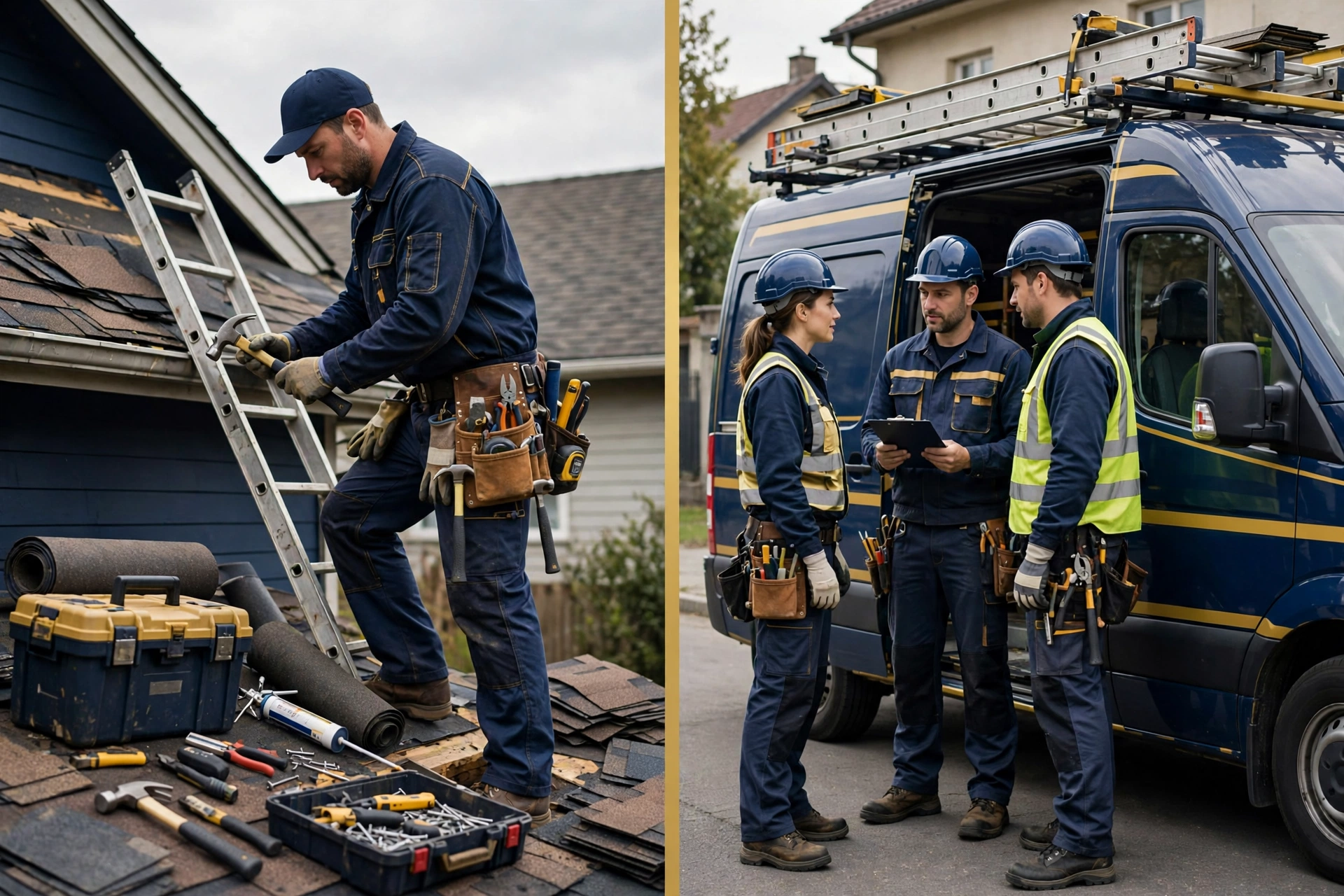
Choose an independent roofer for small, simple jobs and a roofing company for full replacements and complex roofs. The right choice depends on the size and risk of the job, not on price alone. The U.S. roofing trade is mostly small businesses: about 129,300 people worked as roofers in 2022, and most were contractors for building-exterior projects (Source: U.S. Bureau of Labor Statistics, 2022).
| Factor | Independent roofer | Roofing company |
|---|---|---|
| Crew size | 1 to 4 people, often the owner on site | Larger crews with a foreman and office staff |
| Price | Often lower overhead, lower bids | Higher overhead, but more capacity |
| Scheduling | Flexible, but one delay stalls the job | Multiple crews can start sooner and finish faster |
| Warranty backing | Depends on one person’s business surviving | A company is more likely to be around to honor a 10-year workmanship warranty |
| Best for | Repairs, small sections, simple roofs | Full replacements, steep or complex roofs, insurance-claim jobs |
An independent roofer with deep local roots can be excellent for repairs. For a full replacement, the roofing company’s office staff, documented processes, and longer business history usually justify the higher bid.
Planning a full replacement too? Read Voice of Wave’s Roof Replacement: Homeowner’s Guide for costs and materials.
What Are the Red Flags When You Hire a Roofing Contractor?
Walk away from door-knockers, large upfront cash demands, deductible games, and any contractor who resists putting things in writing. The most common scam pattern is the storm chaser: an out-of-town crew that knocks on doors after hail or wind damage, offers a fast cheap roof, collects a deposit, and leaves town before problems surface. Other red flags: a demand for most of the payment in cash before work starts, an offer to “cover your deductible” or inflate an insurance claim (that is insurance fraud, and it can get your claim denied), a “today only” price that pressures you to sign immediately, no verifiable local address, and a request that you pull the building permit yourself.
A legitimate contractor gives you time, answers in writing, names material brands, and pulls the permit under their own license. If you already signed with a door-knocker, check your cancellation rights before work starts: federal consumer rules in the U.S. give buyers a short cooling-off window to cancel most contracts signed at their front door (Source: U.S. Federal Trade Commission).
What Should a Roofing Contract Include?
A roofing contract must name the parties, the full scope, the materials, the price, the payment schedule, the dates, the permit responsibility, the warranties, and the cleanup. Insist on these items in writing:
- Legal business name, address, and license number of the contractor.
- Exact scope: tear-off or overlay, square footage, and every included task.
- Materials with brand names, product lines, and colors.
- Total price and a payment schedule tied to milestones.
- Start date, completion date, and what happens if the schedule slips.
- Who pulls the permit and schedules inspections.
- Workmanship warranty terms: length, coverage, transferability, and exclusions.
- Manufacturer warranty registration details.
- Cleanup standards, including nail and debris removal.
- How change orders are priced and approved in writing.
- Your right to cancel and the process for doing so.
Never sign a contract with blank spaces, vague “miscellaneous” line items, or verbal promises the paperwork does not repeat. The contract is the only version of the deal that counts.

How Do Payments and Warranties Work?
Tie payments to visible milestones, keep the final payment until the final walkthrough, and get both warranties in writing. A safe payment structure looks like this: a small deposit or none at all, a payment when materials are delivered, a payment at an agreed midpoint (such as tear-off complete), and the final payment only after the final walkthrough, cleanup, and receipt of the lien waiver. A lien waiver is a signed document stating the contractor has been paid and gives up the right to place a mechanic’s lien on your home. Collect it before the last check clears.
Two warranties protect you, and they cover different things. The workmanship warranty comes from the contractor and covers installation errors, which cause most early roof failures. The manufacturer warranty comes from the shingle or panel maker and covers defects in the materials; asphalt shingle roofing is the most common residential roofing material in the United States, and its manufacturer warranties vary by product tier. Read both sets of terms before signing: note the length, what voids them (improper ventilation and unauthorized repairs are common exclusions), and whether they transfer if you sell the home.
What Happens After You Sign the Contract?
After signing, confirm the permit, prepare your property, and do a careful final walkthrough before the last payment. Ask the contractor for the permit number once it is pulled, and confirm the inspection schedule. Before the crew arrives, move vehicles, clear patio furniture, cover items in the attic (dust falls through during tear-off), and take pictures off the walls, since hammering vibrates through the house. One habit that has saved me trouble on my own projects: I photograph the driveway, siding, and gutters before the crew arrives, so there is no argument later about which dent was already there.
On the final day, walk the property with the foreman: check flashing at chimneys and walls, sealed vents, and a yard and driveway clear of nails and debris. Collect the warranty paperwork, the paid-in-full receipt, and the lien waiver now, not weeks later. Only then release the final payment.
Hiring a roofing contractor is a process, not a gamble. Shortlist local companies, verify license and insurance yourself, compare three itemized estimates, sign a contract that names everything, and pay in milestones with a lien waiver at the end. Homeowners who follow these steps rarely get scammed and rarely overpay. For more homeowner guides like this one, Voice of Wave publishes practical home improvement coverage every week.
Browse the latest articles on Voice of Wave for more homeowner guides and checklists.
Frequently Asked Questions
How much deposit should I pay a roofing contractor?
Pay as little as possible before work starts. Reputable local contractors often ask for no deposit or a small one, then take progress payments as materials arrive and work milestones are completed. Refuse any demand for most of the total in cash upfront, and keep the final payment until the final walkthrough and lien waiver are done.
How do I check if a roofing contractor is licensed?
Ask the contractor for the full legal business name and license number, then enter it on your state or local licensing board’s official website. Confirm the license is active, covers roofing work, and shows no unresolved disciplinary actions. If your state does not license roofers, check the city or county requirements instead, and always verify insurance separately.
Should I hire a roofer who knocks on my door after a storm?
No. Door-to-door roofers who appear right after storms are often out-of-town storm chasers with no local office, no local references, and no plan to honor warranties. Choose a contractor with a verifiable local address and a track record you can check. If you already signed with a door-knocker, you may have a cooling-off window to cancel under federal consumer rules.
Is a general business license enough for roofing work?
No. A general business license only registers the company to operate; it does not prove the company is licensed for roofing work. Many states and cities require a separate trade license or registration for roofing contractors. Always confirm the specific roofing credential on the licensing board’s site, not just a business tax receipt.
Who should pull the roofing permit, you or the contractor?
The contractor should pull the permit. A licensed roofing contractor knows the local code requirements and takes responsibility for scheduling inspections. If a contractor asks you to pull the permit yourself, treat it as a red flag: it can signal an unlicensed operator trying to keep their name off the official record.
What is the difference between a workmanship warranty and a manufacturer warranty?
A workmanship warranty comes from the contractor and covers installation errors, which cause most early roof failures. A manufacturer warranty comes from the shingle or panel maker and covers defects in the materials themselves. Get both in writing, note the length and transfer terms of each, and ask what actions void them.
How many estimates should I get before hiring a roofer?
Get three written, itemized estimates. Three bids are enough to reveal the real price range and expose a bid that is suspiciously low or padded. Make sure every estimate covers the same scope: tear-off, materials, underlayment, flashing, ventilation, permits, and cleanup, so you compare the contractors instead of comparing different jobs.