
Introduction
Heat pump replacement is the removal of an old heat pump and the install of a new unit that heats and cools a home, and most homeowners replace a heat pump at 10 to 15 years of age, when a repair costs more than half the price of a new unit, or when energy bills climb while comfort falls. A heat pump moves heat instead of making heat, so it heats in winter and cools in summer from one outdoor unit and one indoor unit. Heat pump replacement restores even temperatures, cuts energy use by 20% to 40% against a unit over 10 years old (Source: U.S. Department of Energy, 2026), and ends repeat repair calls. This guide covers the 7 signs, the best season to buy, 2026 costs, the repair or replace test, sizing, and the install day steps.
Key Takeaways
- Replace a heat pump at 10 to 15 years of age, or sooner when a repair costs more than half the price of a new unit.
- Rising bills, uneven rooms, long run times, and repeat repairs are the 4 most common warning signs.
- Spring and autumn are the best seasons to replace, since mild weather and short lead times cut cost and delay.
- A new air-source heat pump costs $4,200 to $7,600 installed on average (Source: Angi, 2026), with full ranges from $6,000 to $25,000 (Source: Bryant, 2026).
- The federal tax credit of up to $2,000 expired on December 31, 2025, so check state and utility rebates instead.
Table of Contents
- What Is Heat Pump Replacement?
- How Long Does a Heat Pump Last?
- What Are the 7 Signs You Need a Heat Pump Replacement?
- When Is the Best Time to Replace a Heat Pump?
- How Much Does Heat Pump Replacement Cost?
- Should You Repair or Replace Your Heat Pump?
- Heat Pump Replacement vs Repair: Which Option Fits Your Home?
- How Do You Choose a New Heat Pump?
- What Happens During a Heat Pump Replacement?
- How Do You Make a New Heat Pump Last Longer?
- Conclusion
- Frequently Asked Questions
What Is Heat Pump Replacement?
Heat pump replacement is the removal of a worn heat pump and the install of a new heat pump in its place, and the job covers the outdoor unit, the indoor unit, refrigerant lines, controls, and a full test of heating and cooling. A heat pump moves heat from outdoor air into a home in winter and reverses the flow in summer, so one system covers both seasons. The heat pump moves heat through a refrigerant cycle: a compressor raises the temperature of refrigerant gas, the indoor coil releases that heat, and the cycle repeats. Replacement differs from repair: repair fixes one part, replacement swaps the whole system. A full heat pump replacement also covers disposal of the old unit and a check of ducts and wiring. The Home Improvement guides on this site cover related house care topics in the same plain style.
A heat pump has 3 main types, and the type sets the cost and the install work. An air-source heat pump is the most common type in homes, with one outdoor unit and one indoor air handler joined by refrigerant lines. A ductless mini-split heat pump serves one room or one zone with a wall-mounted indoor head and no ducts. A ground-source heat pump draws heat from the ground through buried loops and costs far more to install.
How Long Does a Heat Pump Last?
An air-source heat pump lasts 10 to 15 years in most homes, a ductless mini-split lasts 15 to 20 years, and a ground-source heat pump lasts 20 to 25 years or more, with the ground loop lasting far longer than the indoor unit. The U.S. Department of Energy plans on 15 years for an air-source heat pump (Source: U.S. Department of Energy, 2026), and ENERGY STAR advises homeowners to weigh replacement once a unit passes 10 years (Source: ENERGY STAR, 2026). A heat pump runs in both seasons, so it wears faster than an air conditioner. Twice-yearly care adds years: change filters, clear the outdoor unit, and book a professional tune-up each spring and autumn.
| Heat pump type | Typical life | Main wear factors |
|---|---|---|
| Air-source, ducted | 10 to 15 years | Year-round use, compressor wear, coil corrosion |
| Ductless mini-split | 15 to 20 years | Smaller loads per head, less duct stress |
| Ground-source (geothermal) | 20 to 25 years or more | Indoor unit wears first, ground loop lasts decades |
| Air-to-water | 12 to 18 years | Pump and water-side parts add wear points |
A heat pump that runs in both seasons wears faster than an air conditioner that runs in one season. Age alone does not force a replacement, since a 12 year old unit with a clean service record can still run well. Age plus one more sign, such as rising bills or repeat repairs, is the point where replacement planning should start.
What Are the 7 Signs You Need a Heat Pump Replacement?
The 7 signs you need a heat pump replacement are age over 10 years, rising energy bills, uneven room temperatures, long run times, strange noises, frequent repairs, and weak airflow, and 2 or more signs together point to replacement rather than another repair. Each sign on its own can have a simple cause, such as a dirty filter. Two or more signs at once point to a system that is wearing out across several parts.

- Age past 10 years. A heat pump over 10 years old runs on older efficiency ratings and older parts, and its efficiency falls each year. Replacing a heat pump unit that is more than 10 years old can save 20% to 40% on energy costs (Source: U.S. Department of Energy, 2026). Age past 15 years with any other sign means replacement planning should start now.
- Energy bills climbing. Compare the bill with the same month last year. A rise of 15% to 30% with no change in thermostat settings or home use points to lost efficiency. A heat pump that works harder for the same heat draws more power, and the bill shows it before comfort drops.
- Uneven room temperatures. Rooms over a garage or upstairs bedrooms that stay cold in winter or warm in summer point to lost capacity. A heat pump that once held even temperatures and now leaves hot and cold spots has lost heating or cooling output.
- Long run times. A healthy heat pump reaches the set temperature and cycles off. A worn heat pump runs near nonstop on a mild day, takes hours to drop humidity in summer, or calls for auxiliary heat on cool days. Long run times raise bills and wear the compressor faster.
- Strange noises. A smooth heat pump hums quietly. Grinding points to motor bearing wear, rattling points to loose parts or fan damage, and squealing points to belt or motor trouble. New noises that grow louder over weeks point to a part that is failing, not to normal age.
- Frequent repairs. Two or more major repairs in 2 years point to a system at the end of its service life. A failed compressor is the clearest case, since a compressor swap often costs more than half the price of a new unit.
- Weak airflow and refrigerant leaks. Low airflow from vents points to a failing blower or a blocked coil. A heat pump that needs a refrigerant top-up every year has a leak, since heat pumps are sealed systems. Old units that run on R-22 refrigerant face a hard stop, since R-22 production ended in 2020 (Source: U.S. Environmental Protection Agency, 2020), and the remaining supply is scarce and costly.
When Is the Best Time to Replace a Heat Pump?
Spring and autumn are the best times to replace a heat pump, since mild weather lets a home go without heating or cooling for a day, installers have open schedules, and lead times run days instead of weeks. A spring install gets tested in summer cooling, and an autumn install gets tested in winter heating. Summer is the worst season to plan a replacement, since peak demand brings long waits and higher prices.
| Season | Lead time | Price pressure | Best for |
|---|---|---|---|
| Spring (March to May) | Short, days to 1 week | Low | Testing cooling before summer |
| Summer (June to August) | Long, 2 to 4 weeks | High, peak demand | Emergency swaps only |
| Autumn (September to November) | Short, days to 1 week | Low | Testing heating before winter |
| Winter (December to February) | Varies, weather delays | High for emergency calls | Emergency swaps only |
Plan 2 to 4 weeks ahead, and get 3 written quotes with the same size and efficiency rating so the quotes compare fairly. Never wait for a full breakdown: a heat pump that fails in a heat wave or a cold snap forces an emergency install at the highest price and the longest wait.
How Much Does Heat Pump Replacement Cost?
Heat pump replacement costs $4,200 to $7,600 installed on average for a standard air-source unit (Source: Angi, 2026), while Bryant puts the full installed range at $6,000 to $25,000 depending on size, efficiency, brand, and ductwork (Source: Bryant, 2026). The gap comes from home size and system type: a small mini-split sits at the low end, and a large cold-climate or geothermal system sits at the high end.

| System type | Installed cost range | Best for |
|---|---|---|
| Single-zone mini-split | $2,000 to $7,000 | One room or addition, no ducts |
| Central air-source, ducted | $4,500 to $20,000 | Whole home with existing ducts |
| Multi-zone mini-split, 2 to 3 zones | $6,500 to $11,500 | Whole home without ducts |
| Cold-climate air-source | $6,000 to $11,000 | Cold winters, no backup furnace |
| Ground-source (geothermal) | $20,000 to $50,000 or more | Long-term ownership, large lots |
Five cost drivers decide where a quote lands. Size is first: a 3 ton unit for a 2,000 square foot home costs more than a 2 ton unit for a 1,200 square foot home, and the right size comes from a load calculation, not from the old unit label. Efficiency rating is second: a variable-speed unit with a high SEER2 rating costs more up front and less to run. Ductwork is third: leaky or undersized ducts add repair cost. Electrical work is fourth: a heat pump needs a dedicated 240 volt circuit, and a home on 100 amp service may need a panel upgrade to 200 amps. Permits, removal, and disposal are fifth, and they vary by town.
The federal Section 25C tax credit of up to $2,000 for air-source heat pumps expired on December 31, 2025 (Source: U.S. federal tax guidance, 2026), so no quote in 2026 should count that credit. State and utility rebates still apply in many areas, so ask the installer for a rebate list in writing before signing. Heat pump demand keeps growing: heat pump shipments exceeded gas furnace shipments for the third consecutive year in 2025 (Source: Air-Conditioning, Heating, and Refrigeration Institute, 2026).
Read the Heating System Repair Guide for the checks to run before you book a replacement quote.
Should You Repair or Replace Your Heat Pump?
Repair your heat pump when it is under 10 years old and one contained part has failed, and replace it when it is over 10 years old, a major part has failed, or a repair costs more than half the price of a new unit (Source: Bryant, 2026). The 50% rule says replace when a single repair costs more than half the price of a new system. The $5,000 rule says multiply the system age by the repair cost, and replace when the result passes $5,000 (Source: Bryant, 2026). A $600 repair on a 9 year old unit gives 5,400, so replacement wins, while a $200 repair on a 6 year old unit gives 1,200, so repair wins.

| Situation | Repair or replace | Reason |
|---|---|---|
| Under 10 years, first major fault | Repair | Long service life remains after the fix |
| Repair cost under half of replacement cost | Repair | The fix buys years at a lower cash cost |
| Over 10 years with repeat faults | Replace | Repeat labor costs erase repair savings |
| Failed compressor on a unit over 10 years | Replace | High part cost plus age |
| R-22 refrigerant leak on an old unit | Replace | Refrigerant is scarce and costly since 2020 |
| Third major repair in 2 years | Replace | Faults point to wear across the system |
A repair buys time, while a replacement buys a new warranty and a new efficiency rating. Ask the technician for both prices in writing at the same visit: the repair quote with parts and labor, and the replacement quote with equipment, labor, and warranty.
Heat Pump Replacement vs Repair: Which Option Fits Your Home?
Heat pump replacement fits a home when age, repair cost, and efficiency loss stack together, while repair fits a home when one part fails on a young unit with years of service left. The table below compares the two paths on the 6 factors that matter most.
| Factor | Repair | Replacement |
|---|---|---|
| Cost now | $150 to $2,000 per repair | $4,200 to $7,600 on average installed |
| Cost over 5 years | Rises with each new fault | Fixed, plus lower energy bills |
| Efficiency | Stays at the old rating | New SEER2 and HSPF2 ratings, 20% to 40% savings possible |
| Warranty | Parts warranty only, often 1 year | 10 year parts warranty is common on new units |
| Comfort | Restores the old performance level | Even temperatures, quieter run, better humidity control |
| Risk | Another fault can follow within months | Low risk for 10 years or more with care |
A repair buys time; a replacement buys a new warranty and a new efficiency rating. Homeowners who plan to stay in the home for 5 years or more gain the most from replacement, since energy savings and a fresh warranty pay back the higher upfront cost over time.
How Do You Choose a New Heat Pump?
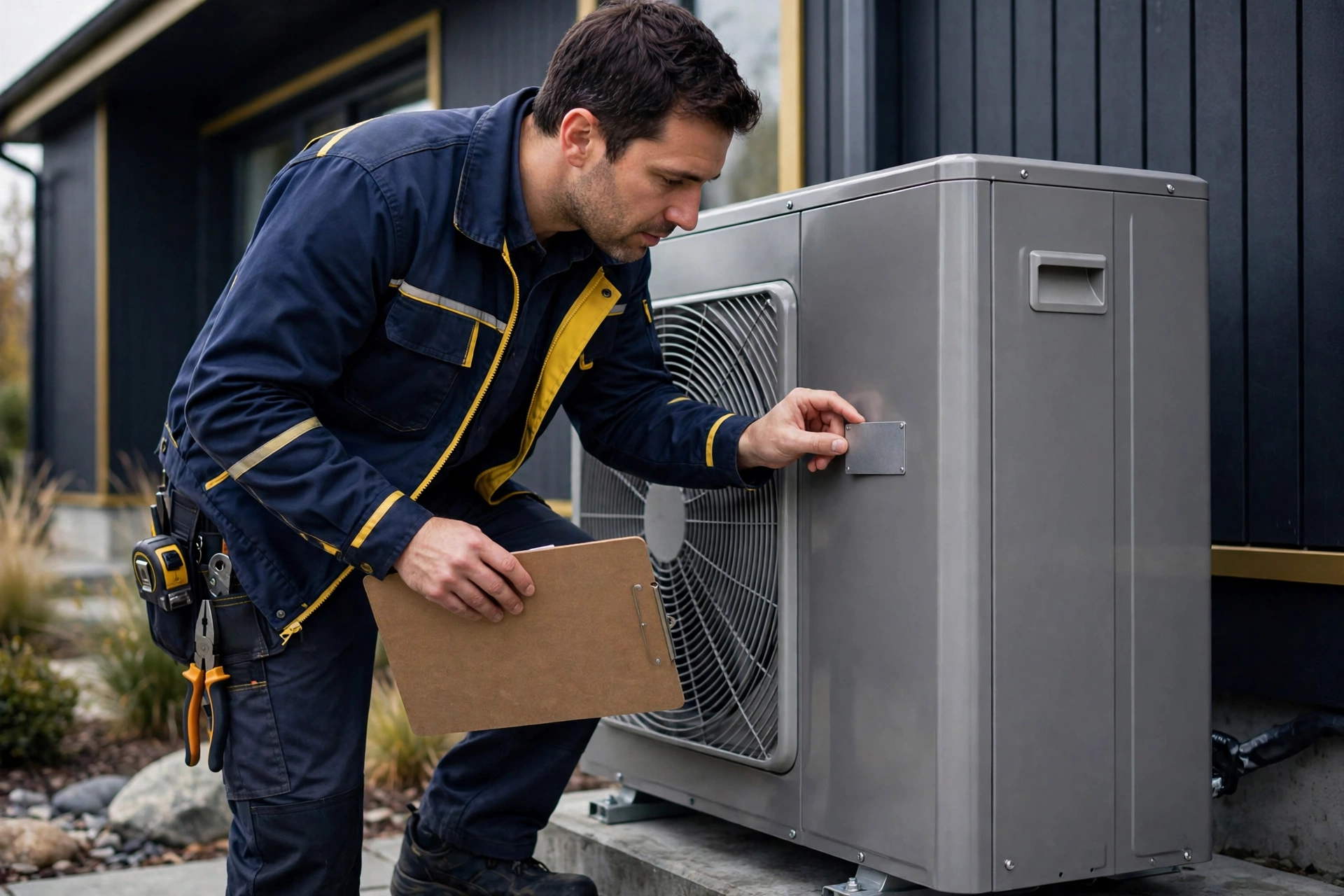
Choose a new heat pump by matching size to the home with a Manual J load calculation, picking SEER2 of 15 or higher and HSPF2 of 9 or higher for strong efficiency, and checking cold-climate ratings when winters drop below freezing. Size matters more than brand: an oversized unit short-cycles, while an undersized unit runs nonstop and never reaches the set temperature. Ask for the load calculation in writing, and do not accept a quote sized from the old unit label alone.
The U.S. Department of Energy sets the minimum for a new split-system heat pump at 14.3 SEER2 for cooling and 7.5 HSPF2 for heating (Source: U.S. Department of Energy, 2026). A unit above those minimums costs more and runs cheaper, so weigh the payback against how long you plan to stay in the home. A variable-speed compressor holds a steady temperature and runs quieter than a single-stage unit. Cold-climate models hold heat output down to minus 15 degrees Fahrenheit or lower, so they fit northern winters without a backup furnace. The air source heat pump types page lists air-to-air and air-to-water models and explains how each type moves heat. New systems now use lower global warming potential refrigerants as R-410A phases down, so ask the installer which refrigerant the quoted unit uses.
What Happens During a Heat Pump Replacement?
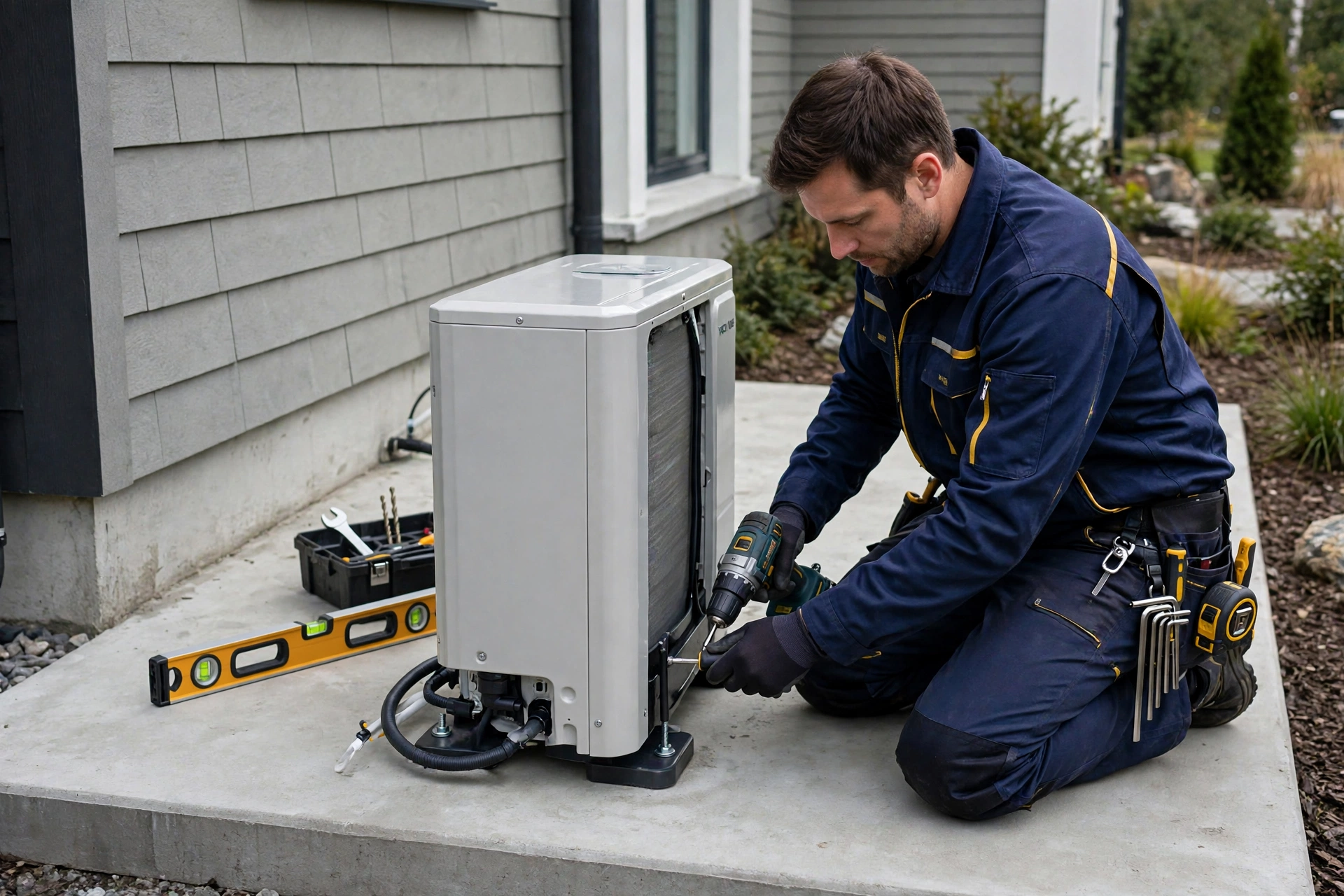
A heat pump replacement takes 1 day for a like-for-like swap and 2 to 3 days when ductwork, wiring, or a panel upgrade is added, and the day runs through removal, install, refrigerant charge, and a full heating and cooling test. Most homes stay without heating or cooling for most of that day, so pick a mild-weather date when possible.
- Site check and quote: the installer measures the home, checks ducts and wiring, and gives a written quote.
- Permits: the installer files the local permit and books the inspection.
- Old unit removal: the crew recovers refrigerant, disconnects the old units, and hauls them away.
- New unit install: the crew sets the outdoor unit on a level pad and mounts the indoor unit.
- Line set, wiring, and drain: the crew runs new refrigerant lines, a 240 volt circuit, and a drain.
- Vacuum, charge, and leak test: the crew pulls a vacuum, charges refrigerant to spec, and tests for leaks.
- Thermostat setup and full test: the crew sets up the thermostat, tests heating and cooling, and explains the controls.
Clear a path to the indoor unit, the outdoor unit, and the breaker panel before the crew arrives. Keep pets and children away from the work area. Ask for the old filter size, the refrigerant type, and the warranty papers before the crew leaves, since those 3 items set up the first year of care.
How Do You Make a New Heat Pump Last Longer?
A new heat pump lasts longer with filter changes every 1 to 3 months, 2 feet of clear space around the outdoor unit, and a professional tune-up each spring and autumn, since clean coils and correct refrigerant charge cut wear on the compressor. Change the filter on a fixed date, since a clogged filter raises run time and energy use. Hose the outdoor coil gently each spring and trim plants back 2 feet. A tune-up covers coil cleaning, refrigerant charge, and electrical checks.
I keep a notebook by the thermostat with filter change dates and monthly meter readings, and the notes show a failing unit months before comfort drops. A steady rise in meter readings across 3 months, with no change in weather or use, is the earliest warning a homeowner can catch alone. Voice of Wave covers home care guides in the same plain style, with checklists that pair with this article.
Conclusion
Heat pump replacement is the removal of an old heat pump and the install of a new unit that heats and cools a home, and the right time to act is when the 7 signs stack up: age past 10 years, rising bills, uneven rooms, long run times, strange noises, frequent repairs, and weak airflow. Spring and autumn give the shortest lead times and the lowest prices. A standard air-source heat pump costs $4,200 to $7,600 installed on average (Source: Angi, 2026), and the 50% rule plus the $5,000 rule turn the repair-or-replace choice into a number. Match the new unit to the home with a load calculation, pick SEER2 of 15 or higher and HSPF2 of 9 or higher, and keep filters and tune-ups on schedule.
Find more home care guides: Browse the latest articles on the Voice of Wave blog.
Frequently Asked Questions
How long does a heat pump last?
An air-source heat pump lasts 10 to 15 years, a ductless mini-split lasts 15 to 20 years, and a ground-source heat pump lasts 20 to 25 years or more. The U.S. Department of Energy plans on 15 years for an air-source unit. Twice-yearly tune-ups and regular filter changes add years to any type.
How much does it cost to replace a heat pump in 2026?
Heat pump replacement costs $4,200 to $7,600 installed on average for a standard air-source unit (Source: Angi, 2026), with a full range of $6,000 to $25,000 (Source: Bryant, 2026). Single-zone mini-splits start near $2,000, and geothermal systems run $20,000 to $50,000 or more.
Is it better to repair or replace a 15 year old heat pump?
Replace a 15 year old heat pump in most cases, since its efficiency has fallen, parts are harder to find, and a major repair often costs more than half the price of a new unit. A small repair under $300 can still make sense when the unit runs well and faults are rare.
What is the best time of year to replace a heat pump?
Spring and autumn are the best times to replace a heat pump, since mild weather, open installer schedules, and short lead times cut cost and delay. A spring install gets tested in summer cooling, and an autumn install gets tested in winter heating.
Can I replace just the outdoor unit of my heat pump?
Yes, you can replace only the outdoor unit, but a matched indoor and outdoor set works better, since mismatched coils cut efficiency and can void the warranty. Replace both units together when the indoor unit is over 10 years old.
Does a new heat pump need new ductwork?
No, a new heat pump does not need new ductwork in most cases, since sound ducts can serve the new unit with a cleaning and a leak check. Replace ducts only when they leak badly, are undersized, or show mold or damage.