

Introduction
Yes, you should hire a licensed plumber for a remodel that moves pipes, drains, or fixtures, because a license proves training, code knowledge, and the right to pull permits and pass inspection. A licensed plumber installs supply lines, drains, vents, and fixtures to local code, so the work passes inspection and holds up under daily use.
This guide defines what a license means, lists 7 reasons a remodel needs a licensed plumber, covers cost factors, compares a licensed plumber with an unlicensed handyman, maps the plumbing scope, gives a 6-step license check, sets the right timing, and lists the hiring mistakes that cause rework. The main value is simple: code-correct work, a passed inspection, and a remodel that stays dry and sellable for years.

Key Takeaways
- A license proves an apprenticeship, an exam pass, and the right to pull plumbing permits.
- A licensed plumber keeps remodel work code-correct, so inspections pass on the first visit.
- Get 3 written quotes that list labor, materials, permit fees, and warranty terms.
- Check the license number on the state board site and ask for insurance proof before work starts.
- Bring the plumber in during planning, before demolition, so pipe moves and fixture spots are set early.
Table of Contents
- What Does It Mean to Hire a Licensed Plumber?
- Why Does a Remodel Need a Licensed Plumber?
- How Much Does It Cost to Hire a Licensed Plumber for a Remodel?
- Licensed Plumber vs Unlicensed Handyman: What Is the Difference?
- What Plumbing Work Does a Remodel Include?
- How Do You Check a Plumber License Before Hiring?
- When Should You Bring the Plumber Into the Project?
- What Mistakes Do Homeowners Make When Hiring a Plumber?
- Conclusion
- FAQs
What Does It Mean to Hire a Licensed Plumber?
To hire a licensed plumber means to hire a tradesperson who holds a state or local license to install, repair, and alter plumbing systems. A license proves the plumber completed an apprenticeship, passed a written exam, and meets local rules for plumbing work in remodels. The plumber trade covers potable water, hot water, sewage, and drainage systems, and a license shows the plumber trained in each of those areas.
A plumbing license has 3 levels. An apprentice trains under a licensed plumber and cannot work alone. A journeyman passed the license exam and can work alone on most jobs. A master plumber holds the highest license, can run a business, pull permits, and supervise other plumbers. A plumber apprenticeship commonly runs 4 to 5 years before the journeyman exam (Source: U.S. Bureau of Labor Statistics, 2025).
License rules change by state and city. Some states license journeyman and master plumbers as separate levels, while other states license only master plumbers. There is no federal plumbing license in the United States, so check the license where the remodel takes place.
Why Does a Remodel Need a Licensed Plumber?
A remodel needs a licensed plumber because plumbing work must meet local code, pass inspection, and connect to water, drain, and vent systems that a wrong joint can damage. A licensed plumber sizes pipes, sets drain slope, vents fixtures, and tests joints under pressure, so hidden leaks do not soak new tile and drywall. For more guides in this category, browse the Home Improvement guides on this site.
Permits form the second reason. A remodel that moves a drain, adds a fixture, or changes a water line needs a plumbing permit in most cities, and only a licensed plumber can pull that permit in many areas. The permit triggers an inspection of rough-in work before walls close and finish work before handover. Unpermitted plumbing can fail a buyer inspection at sale time, and the fix then means opening finished walls.
Code knowledge forms the third reason. Plumbing codes set pipe sizes, vent distances, trap types, and backflow rules, and those rules protect drinking water from drain water. A licensed plumber works with those rules daily, while a general handyman may know only one local code version or none. A failed inspection costs days of delay and a rework fee.
How Much Does It Cost to Hire a Licensed Plumber for a Remodel?
The cost to hire a licensed plumber for a remodel has no single price, because cost depends on scope, fixture count, pipe moves, region, and permit fees. A small fixture swap costs far less than a full bathroom move with new drains, vents, and supply lines. Get 3 written quotes on the same scope, so price differences show labor and material choices rather than missing work.
A licensed plumber costs more per hour than an unlicensed worker, and the total depends on fixture count, pipe moves, materials, and permit fees. A mid-range minor kitchen remodel cost $28,458 nationally in 2025, and a mid-range major kitchen remodel cost $82,793 nationally in 2025 (Source: Cost vs Value, 2025). Plumbing forms one block inside those totals, next to cabinets, countertops, appliances, and electrical work.
Labor rates track the trade. The median annual wage for plumbers, pipefitters, and steamfitters was $63,800 in May 2025, and employment is projected to grow 7 percent from 2025 to 2035, with about 42,000 openings each year (Source: U.S. Bureau of Labor Statistics, 2025). Licensed labor costs more per hour than unlicensed labor, and the gap pays for code knowledge, insurance, and warranty cover.
| Cost factor | How it changes the quote |
|---|---|
| Fixture count | More fixtures mean more supply lines, drains, and install time |
| Pipe moves | A moved toilet or shower drain adds labor, materials, and permits |
| Pipe material | Copper, PEX, and cast iron differ in material cost and install time |
| Access | Open framing costs less than cutting concrete slab or finished walls |
| Permits and inspection | Permit fees and inspection visits add fixed costs to the job |
| Region | Labor rates and permit fees change by city and state |
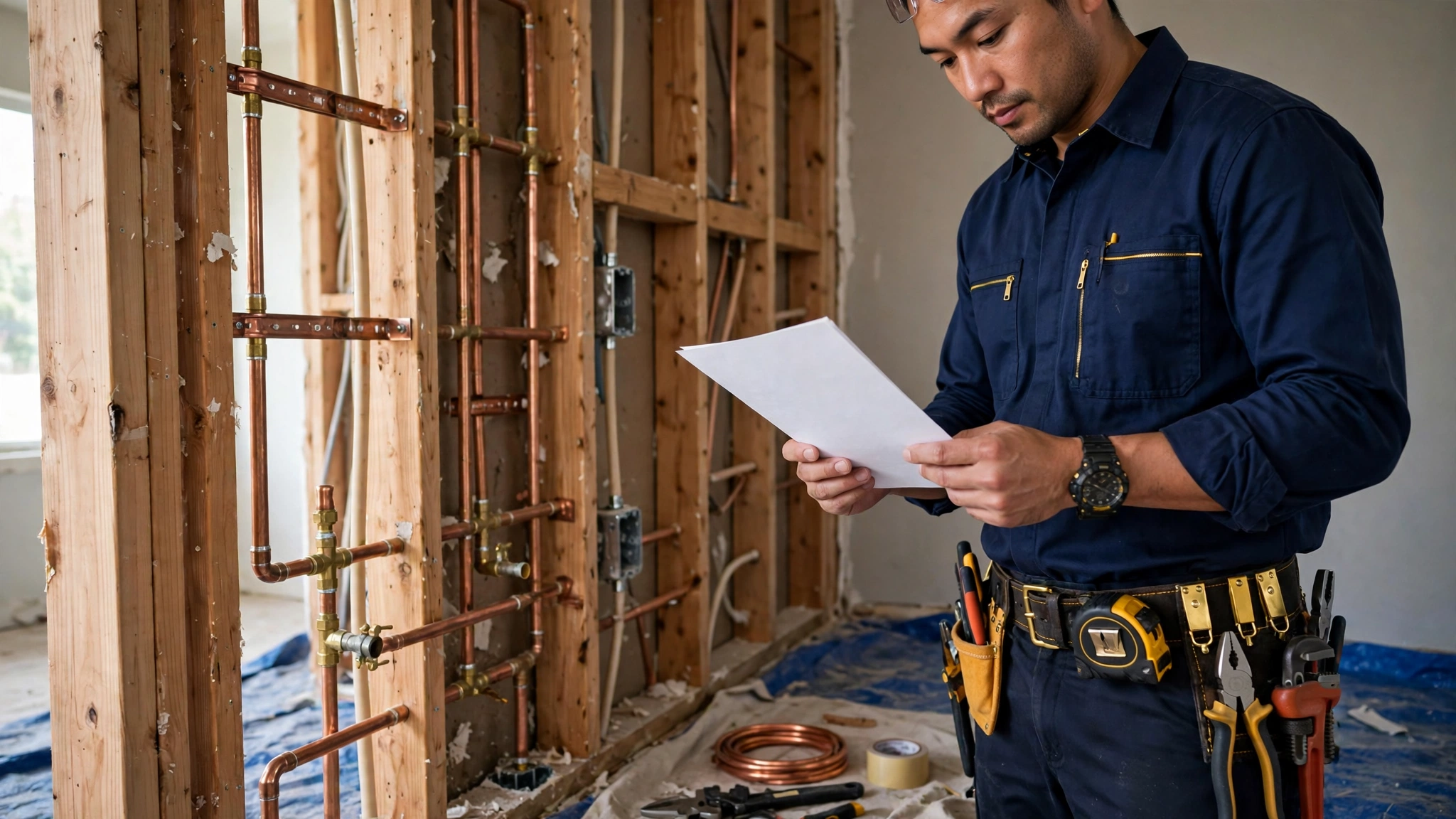
Pay in stages tied to finished work, and hold final payment until the punch list is complete.
Licensed Plumber vs Unlicensed Handyman: What Is the Difference?
A licensed plumber differs from an unlicensed handyman in license, insurance, permit rights, code training, warranty, and inspection risk. A licensed plumber passed a state exam and carries insurance, while an unlicensed handyman may hold neither, so the homeowner carries the risk when work fails.
| Factor | Licensed plumber | Unlicensed handyman |
|---|---|---|
| License | State or local license, verified on a board site | No license or no proof of one |
| Insurance | Liability insurance and workers compensation | Often none, homeowner pays for damage |
| Permits | Can pull plumbing permits in most areas | Cannot pull permits in most areas |
| Code knowledge | Trained and tested on current plumbing code | Informal knowledge, may miss code rules |
| Warranty | Written labor warranty in most cases | Verbal promise or none |
| Inspection | Work is built to pass inspection | Work may fail inspection and need rework |
| Liability | Insured for on-site injury and property damage | Homeowner may pay for injury or damage |
An unlicensed worker can change a faucet washer or a showerhead in many areas, and that small job needs no permit. A remodel that moves drains, vents, or supply lines needs a license, because the work hides inside walls and a leak shows up months later as mold or rot. A cheap handyman quote can cost more after a failed inspection and a rework bill.
Insurance marks the widest gap. A licensed plumber carries liability insurance and workers compensation, while an unlicensed worker with no cover leaves the homeowner to pay for a flooded floor or an injured worker. Ask for a current insurance certificate and check the dates before work starts.

What Plumbing Work Does a Remodel Include?
Plumbing work in a remodel includes rough-in piping, supply lines, drain-waste-vent runs, fixture installation, water heater work, gas lines where fitted, and pressure and leak testing. Each stage needs the right pipe size, slope, and vent path. Plumbing systems convey water, waste, and gas through pipes, valves, fixtures, and tanks, and a remodel touches each of those parts in turn.
Rough-in work comes first. The plumber runs new supply lines, drain lines, and vent stacks inside open framing, sets fixture positions, and caps lines for inspection. Drain lines need a set slope so waste flows by gravity, and vent stacks need a clear path to the roof so traps hold water and sewer gas stays out of rooms. A drain moved by a few inches changes the vent path, so layout changes need a plumber check before cabinets are ordered.
Finish work comes last. The plumber sets toilets, sinks, faucets, showers, tubs, dishwashers, and laundry hookups, connects traps and supply stops, and tests each joint under pressure. A water heater move needs a gas or electric check and a vent check, and gas lines need a leak test before the line goes live.
Hidden conditions shape the scope. Old galvanized steel pipe, corroded cast iron drains, and lead supply lines still sit in older homes, and a remodel exposes them at demolition. A licensed plumber prices the replacement and gets written approval before the fix.
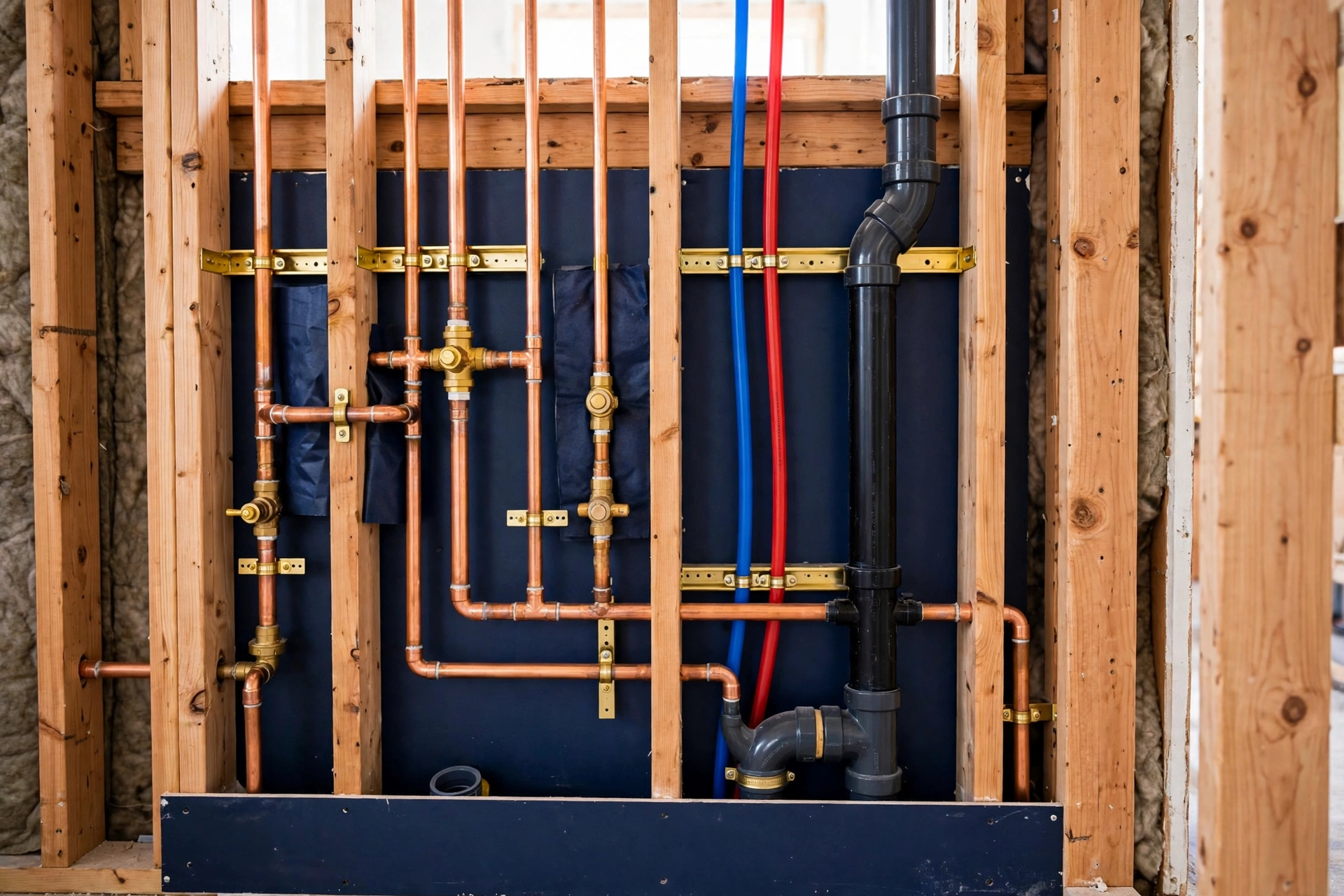
Planning a kitchen update too? Read our kitchen remodeling guide for layout, cabinets, and finish order.
How Do You Check a Plumber License Before Hiring?
To check a plumber license before hiring, verify the license number on the state board site, check insurance proof, and call recent remodel clients. A license check takes 10 minutes and stops most hiring risk before money changes hands. Run these 6 steps in order.
- Ask for the plumber full legal name and license number.
- Search the number on the state licensing board website.
- Check that the license is active and covers plumbing work.
- Ask for proof of liability insurance and workers compensation.
- Call 2 recent remodel clients and ask about schedule and cleanup.
- Get the quote, scope, schedule, and warranty terms in writing.
Red flags end the talk fast. A plumber who gives no license number, asks for cash only, gives no written quote, or urges you to skip permits is a risk to the remodel. Full payment before work starts is also a risk, because staged payments tied to finished work protect both sides. A license number that shows as expired or suspended on the board site means no hire until the board shows active status.
Keep a file for the job. Save the license printout, the insurance certificate, the written quote, the permit receipt, and the inspection sign-off in one folder. Those papers support a warranty claim and a sale disclosure if a leak appears later.

When Should You Bring the Plumber Into the Project?
Bring the plumber into the project during planning, before demolition, so pipe moves, fixture spots, and vent paths are set while changes cost little. A plumber who sees the plan early can flag a drain move that needs a permit, a vent stack that blocks a window, or a supply line that runs through a planned beam. A plumber who arrives after demolition can only work around choices that are already locked.
A practical check from real remodel planning is to photograph every exposed pipe, valve, and drain before drywall goes up, because those photos save hours when a later repair needs the exact pipe route. Mark the set with the room name and date, and keep it with the permit papers.
The plumber visit runs in 4 stages: plan review before demolition, rough-in work with open walls plus a rough-in inspection, a pressure test and wall-close sign-off, and fixture install with a final leak test and final inspection. Each stage needs a date on the schedule, so other trades do not cover work that still needs an inspection.
Fixture lead times matter too. Order fixtures before demolition where possible, because a 4 to 12 week lead time on a tub or shower valve can stall the finish stage. The plumber should confirm the rough-in dimensions for each fixture, so a valve that needs a different wall depth does not arrive after the wall is closed.

What Mistakes Do Homeowners Make When Hiring a Plumber?
Homeowners make 5 hiring mistakes that cause rework: hiring on price alone, skipping the license check, signing a vague scope, paying in full upfront, and moving fixtures after rough-in. Each mistake costs more to fix than the step it skipped.
Hiring on price alone is the first mistake. The lowest quote often leaves out permits, inspection visits, or named fixtures, and those gaps appear as extra bills later. Compare 3 quotes on the same written scope.
Skipping the license check is the second mistake. A friendly referral is not a license check, and a business card is not proof of a license. Run the 6-step check above for every plumber, even one a friend used, because licenses lapse and coverage changes.
Signing a vague scope is the third mistake. A scope that says “plumbing work” with no fixture list, no pipe material, and no permit line invites disputes. Write the scope with product names, model numbers, pipe material, permit fees, and inspection visits.
Paying in full upfront is the fourth mistake. A deposit of 10 to 30 percent is common, with staged payments after rough-in and after fixture install, and final payment after the punch list. Full upfront payment removes the leverage that keeps the job on schedule.
Moving fixtures after rough-in is the fifth mistake. A toilet moved by one foot after rough-in means a new drain cut, a new vent path, and a new inspection. Set fixture spots on the plan and tape the footprint on the floor before rough-in starts.
Conclusion
To hire a licensed plumber for a remodel is to buy code-correct work, a passed inspection, and a warranty that stands behind the pipes inside your walls. A license proves training and exam success, a permit keeps the work legal, and an inspection proves the work meets code before walls close. Check the license, compare 3 written quotes, bring the plumber in before demolition, and pay in stages. Voice of Wave covers practical home guides in this style, so readers can plan a remodel with clear steps and honest cost context. A remodel with licensed plumbing costs more on day one and less over the life of the home, because dry walls and a passed inspection hold their value at sale time.
Explore more practical home guides on the Voice of Wave blog.
Frequently Asked Questions
Does a bathroom remodel need a licensed plumber?
Yes, a bathroom remodel needs a licensed plumber when it moves drains, vents, supply lines, or fixtures, because that work needs a permit and an inspection in most areas. A simple faucet or showerhead swap needs no license, but a moved toilet, shower, or vanity needs licensed work to pass inspection.
How much does a licensed plumber cost for a remodel?
A licensed plumber costs more per hour than an unlicensed worker, and the total depends on fixture count, pipe moves, materials, and permit fees. A mid-range minor kitchen remodel cost $28,458 nationally in 2025 (Source: Cost vs Value, 2025). Get 3 written quotes on the same scope to compare real prices.
Can a general contractor do the plumbing in a remodel?
No, a general contractor usually subcontracts plumbing to a licensed plumber, because plumbing needs a separate license, permit, and inspection in most areas. Ask the contractor for the plumber name and license number, then verify the license on the state board site before work starts.
How do I check if a plumber is licensed?
Check a plumber license by asking for the full legal name and license number, then searching that number on the state licensing board website. Check that the license is active and covers plumbing work, and ask for proof of liability insurance and workers compensation before signing a contract.
What happens if unlicensed plumbing work fails inspection?
Unlicensed plumbing work that fails inspection must be redone to code, which means opening finished walls, paying a rework bill, and delaying other trades. A failed inspection can also flag unpermitted work at sale time, so a buyer inspection may ask for permits and proof of licensed work.
Does a licensed plumber offer a warranty?
Yes, most licensed plumbers offer a written labor warranty, and many fixture makers add a product warranty on parts. Ask for the warranty length, what it covers, and what voids it in writing before work starts, and keep the warranty paper with the permit and inspection records.