
Introduction
To protect home from rainwater, route roof water away from walls, keep gutters and downspouts clear, seal gaps at windows and doors, slope soil away from the foundation, and add a drain system only when grading alone cannot move water to a safe outlet. Rainwater protection is the set of roof, gutter, sealing, grading, and drainage steps that keep rain outside a house. The main value is dry walls, dry floors, and a foundation free of standing water. The main parts are the roof cover, gutters, downspouts, wall seals, soil slope, drains, and basement defences, and each part needs a clear outlet for water. Readers who browse the Home Improvement guides will find related house care topics in the same plain style.
Key Takeaways
- Fix the source first: roof water and gutter faults cause most wall and foundation wet spots.
- Move water at least 6 feet from walls: short downspouts dump roof water into the danger zone.
- Slope soil away from the house: a fall of 6 inches over the first 10 feet keeps water off the foundation.
- Seal small gaps early: caulk and weatherstripping stop slow leaks that rot frames and feed mould.
- Match the drain to the problem: swales move surface water, French drains collect subsurface water, pumps lift water out.
- Recheck after rain: a dated walk after a storm shows whether a fix holds.
Table of Contents
- How Does Rainwater Damage a Home?
- How Do You Keep Gutters and Downspouts Working?
- What Slope Should Soil Have Around a House?
- How Do You Seal Windows, Doors, and Walls Against Rain?
- Which Drainage System Fits Your Yard?
- How Do You Protect a Basement or Crawl Space?
- What Should You Check Before, During, and After Heavy Rain?
- When Should You Call a Professional?
- Frequently Asked Questions
- Conclusion
How Does Rainwater Damage a Home?
Rainwater damages a home when roof water, surface flow, or rising ground water finds a gap, a crack, or a flat spot and stays against walls, floors, or foundations long enough to soak in, stain, rot, or weaken the material. Rainwater damage is water harm caused by rain that enters or pools against a house. The harm starts small, with a damp stain or a musty smell, and grows into rot, mould, warped floors, and cracked walls when the same wet spot returns after each storm.
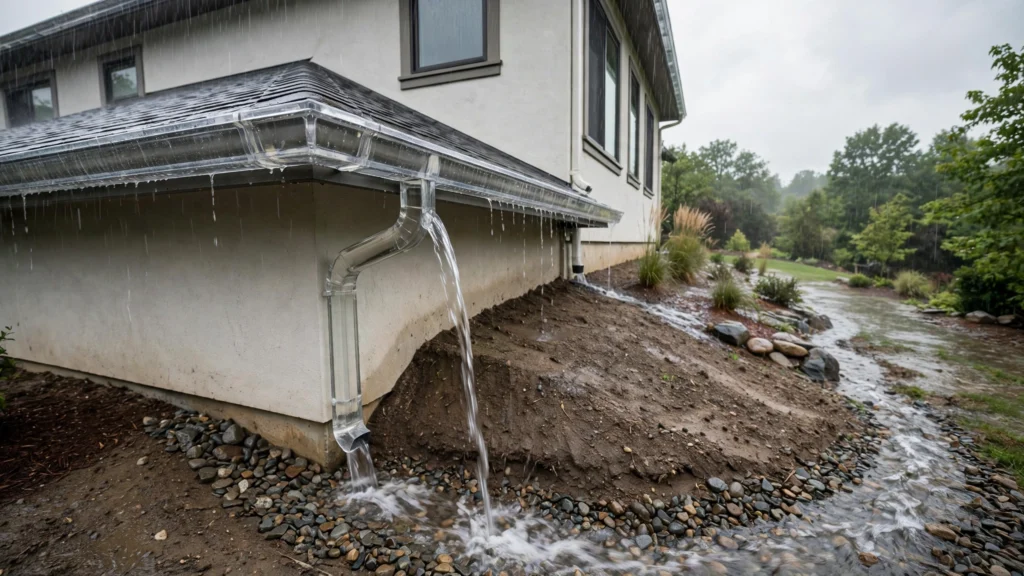
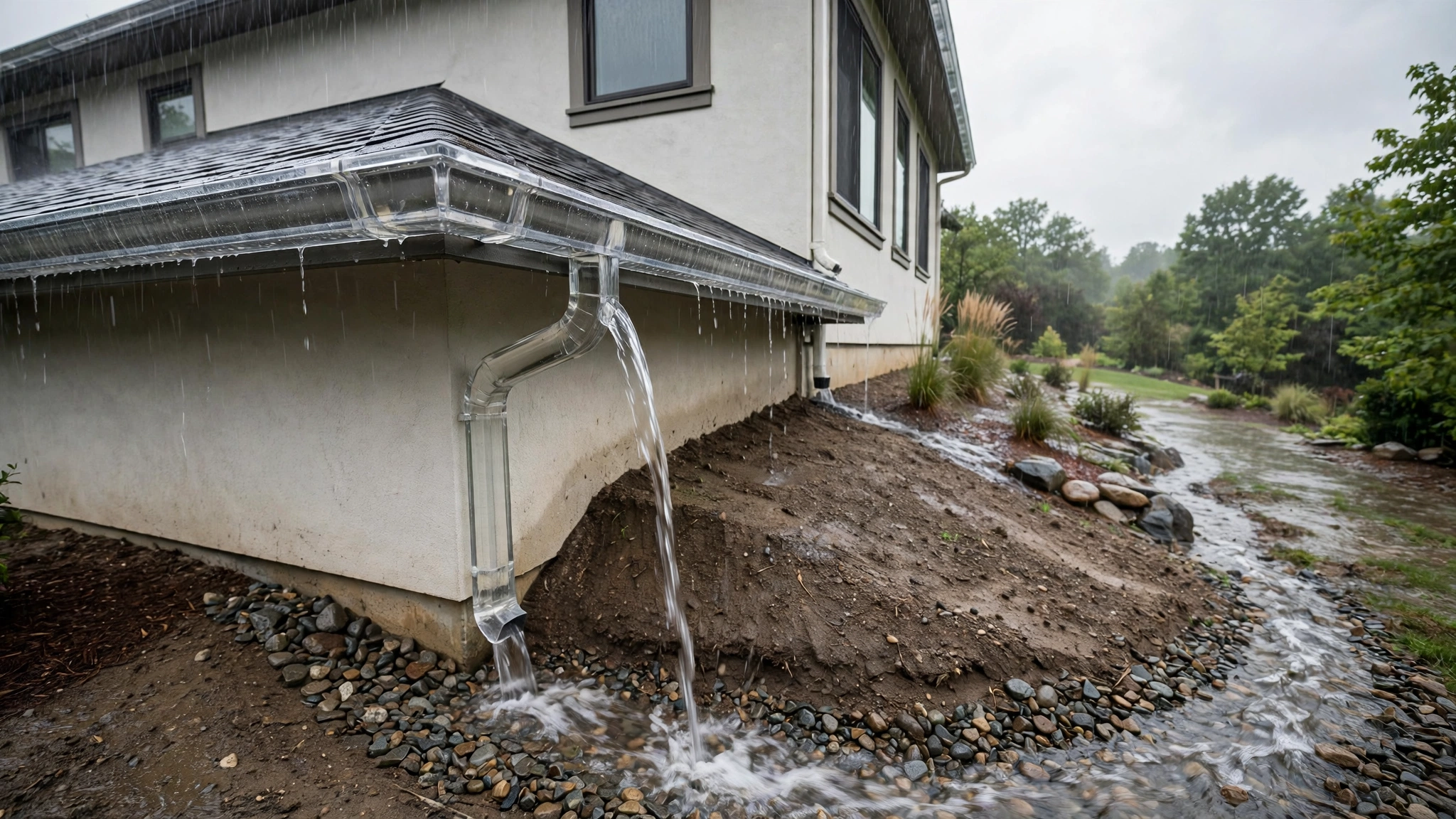
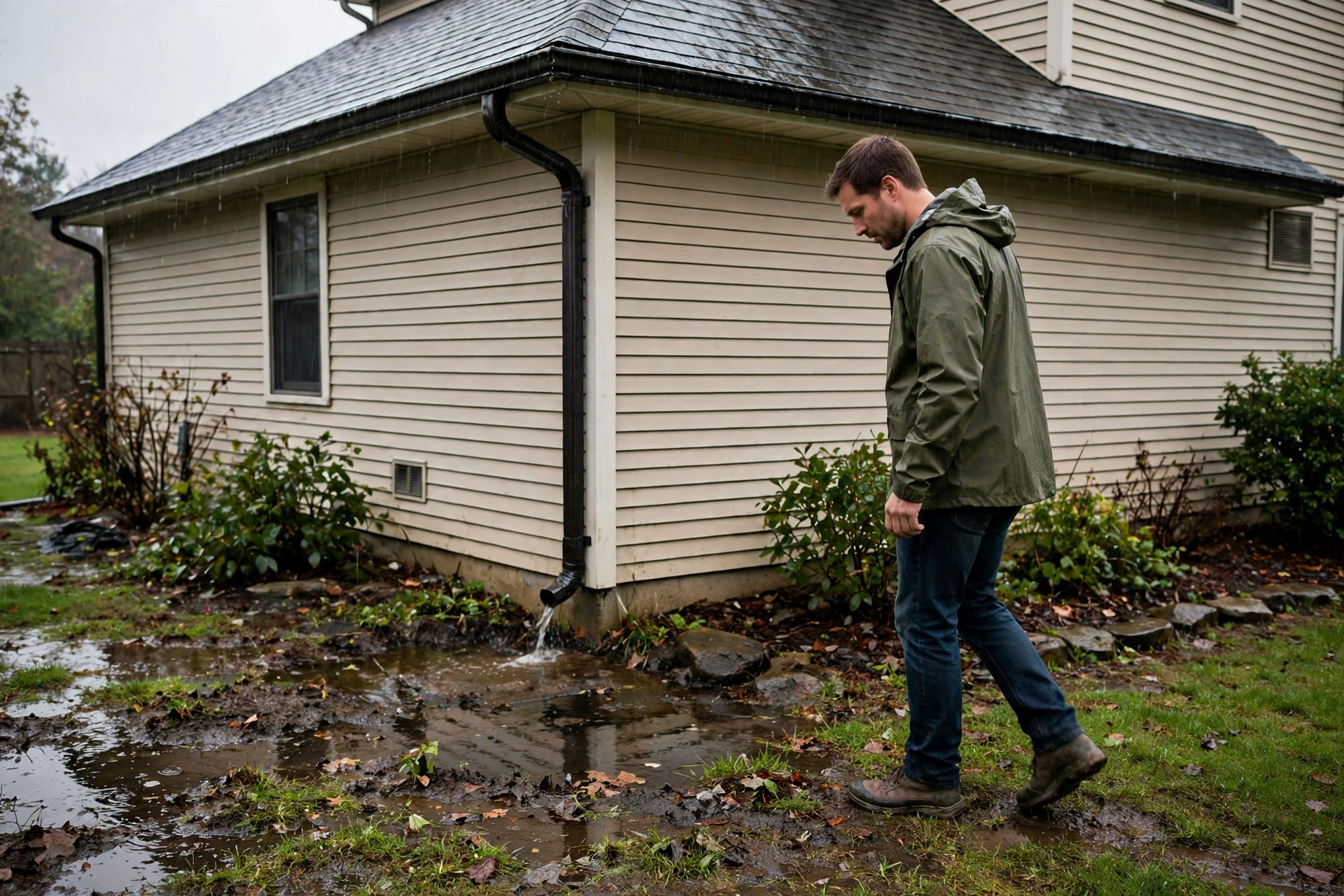
To protect home from rainwater, trace the water path. Water leaves the roof, runs through gutters, drops from downspouts, crosses soil, and meets the foundation wall. A clogged gutter spills water down siding. A short downspout floods the soil at a corner. Flat soil holds that water at the wall.
Rainwater damage has 4 entry routes: roof leaks, wall leaks through gaps, ground leaks through cracks and joints, and drain backups through blocked outlets. Each route needs a different fix. A new roof will not fix flat soil. A French drain will not fix a roof leak.
How Do You Keep Gutters and Downspouts Working?
To keep gutters and downspouts working, clean gutters twice a year, check the fall toward each downspout, keep joints sealed, and extend each downspout at least 6 feet from the house so roof water leaves the wall zone. A rain gutter is a channel at a roof edge that collects roof water and sends the water to a downspout, and the downspout carries the water to the ground outlet. Rain gutters collect water from the roof edge and direct the water away from walls and foundations.
Clean gutters in spring and autumn, and again after a storm drops heavy leaves. Scoop debris by hand, flush the run with a hose, and watch each downspout for a free flow. A slow downspout points to a block in the elbow or outlet pipe. A gutter that spills over one end points to a sag or slope fault. Fix sags with new hangers, and reset the fall toward the downspout at about one quarter inch per 10 feet of run.
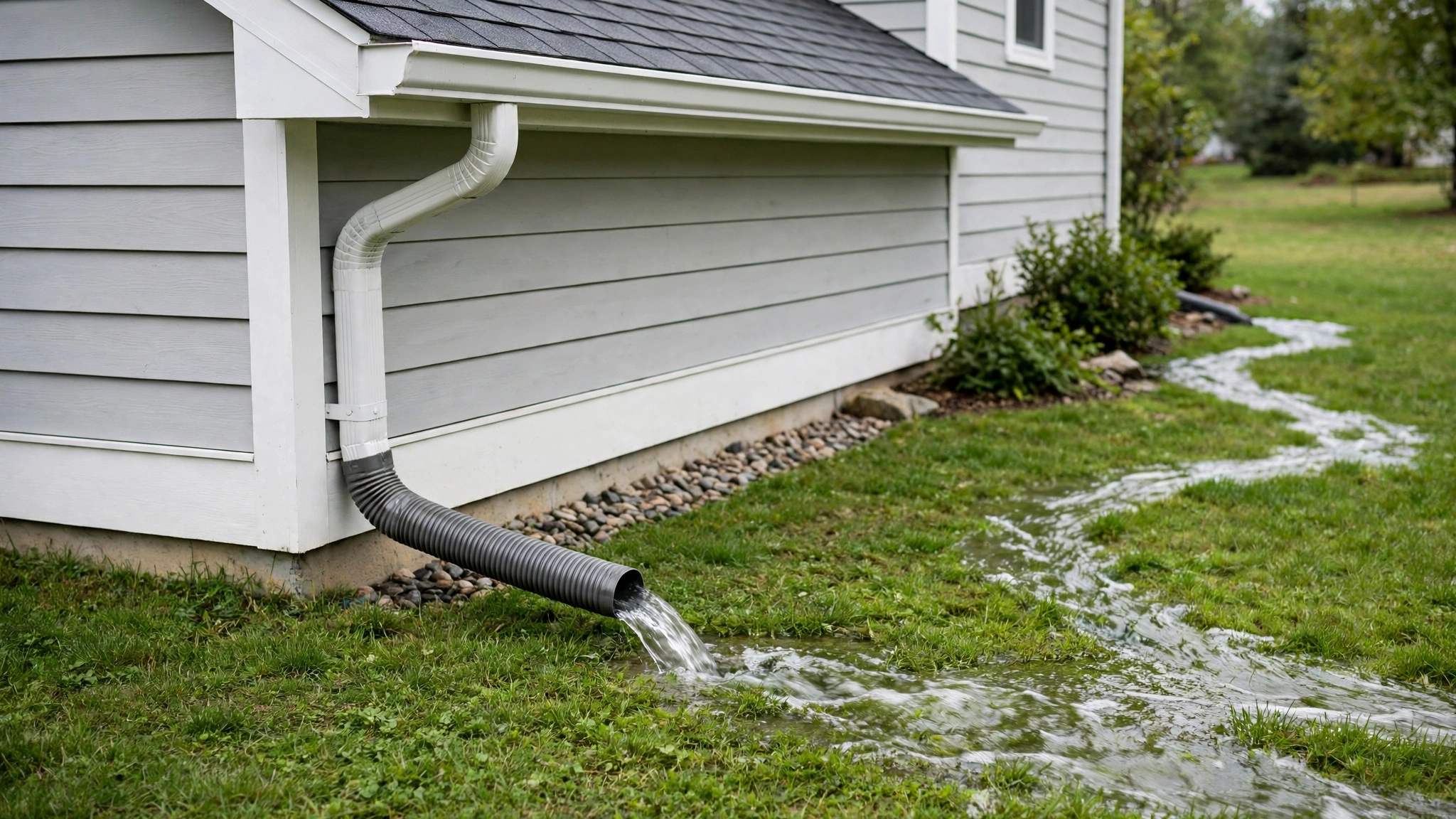
Extend every downspout past the wall zone with a rigid extension, a hinged extension, or a buried solid pipe with a clear outlet. Splash blocks help on flat ground, but a splash block alone will not move water far enough on a wet lot. Mark buried outlets so mowing and digging do not crush the pipe. Gutter guards cut leaf load, but guards still need a yearly check.
What Slope Should Soil Have Around a House?
Soil around a house should fall away from the house for at least the first 10 feet, with a fall of 6 inches over that 10 foot run near the house and a gentler fall across the open yard toward an approved outlet. Soil slope is the ground fall that moves surface water away from walls. Positive slope sends water away from a house. Negative slope sends water toward a house, and negative slope is the most common cause of wet foundation walls.
Check slope with 2 stakes, string, a line level, and a tape measure. Set one stake at the wall and one stake 10 feet out, tie the string at the same height on each stake, level the string, and measure the gap to the ground at each stake. A larger gap at the outer stake shows a fall away from the house. Repeat the check on each side, because one side can drain well while another side ponds.
Fix low ground in thin layers. Add fill in 2 to 3 inch layers, compact each layer, and recheck the fall before adding the next layer. Keep soil at least 4 inches below siding and keep several inches of foundation wall visible above finished soil. Seed bare soil at once, because bare fill washes away in the next storm. Where a lot is flat, grading alone cannot solve the problem, and a drain or pump outlet must carry the water.
How Do You Seal Windows, Doors, and Walls Against Rain?
To seal windows, doors, and walls against rain, inspect every frame and joint twice a year, replace cracked caulk and worn weatherstripping, seal small foundation cracks with masonry filler, and keep wall vents and hose bibs covered and tight. Wall seals are the caulk, weatherstripping, flashing, and filler that close gaps where water can enter a house. Wind driven rain finds gaps that still air rain misses, so a seal that looks fine in calm weather can fail in a storm.
Work through 5 seal groups: window frames, door frames, wall joints, vents, and hose bibs. At windows, cut out cracked caulk and apply exterior grade caulk in a smooth bead. At doors, replace weatherstripping that is loose, flat, or torn. At wall joints, seal gaps where siding meets trim and where pipes and cables enter the house. At vents, check covers and seals. At hose bibs, check the wall joint each spring.
For a related yard water guide, read the Yard Grading and Drainage guide for slope checks and drain choices.
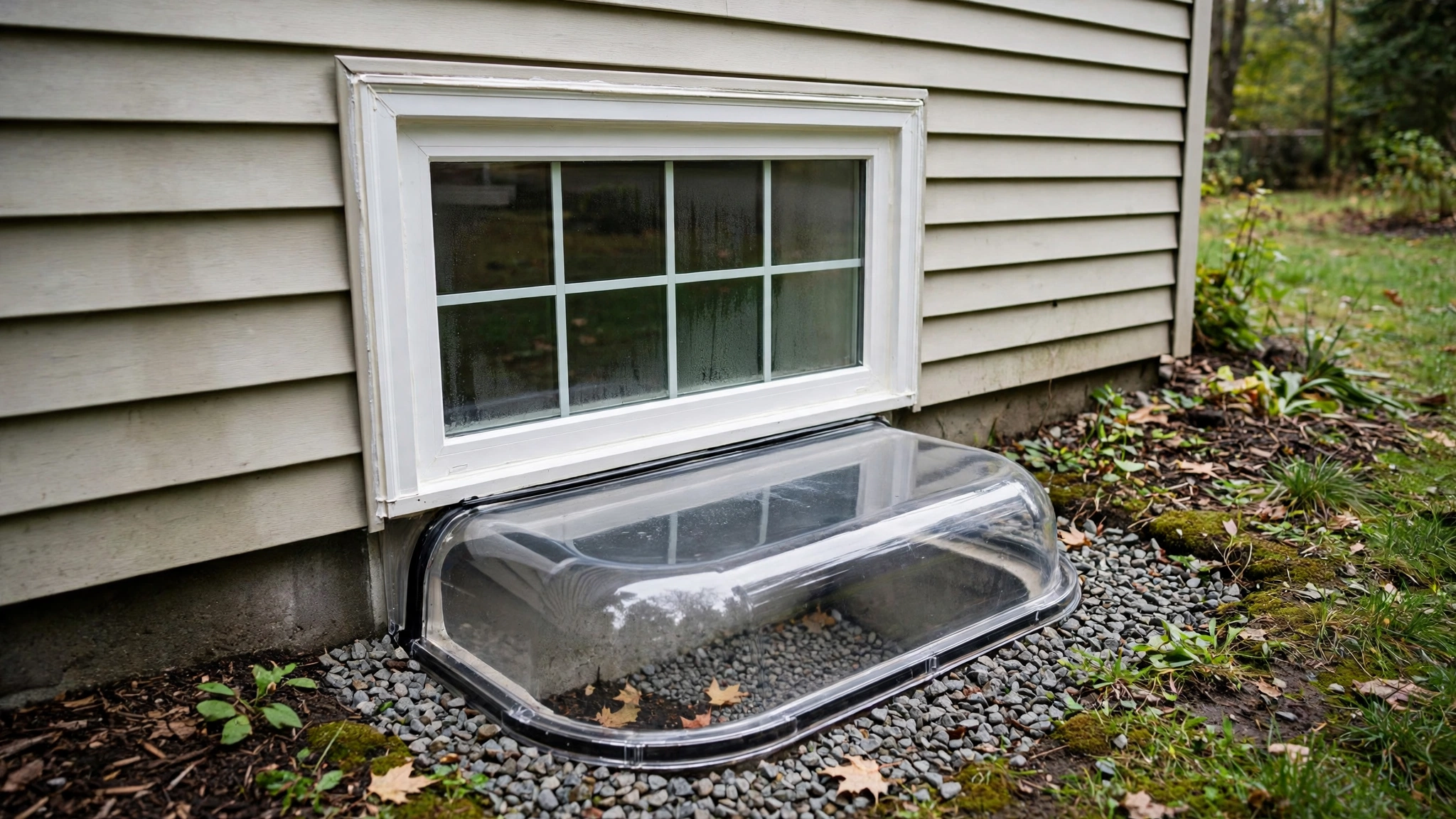
Window wells need a separate check. A window well is a walled pit outside a basement window that lets light in and gives an escape route. Wells catch leaves and rain, so a blocked well drain floods the window. Clear each well, fit a clear cover that overhangs the well edge, and check the well drain after heavy rain.
Which Drainage System Fits Your Yard?
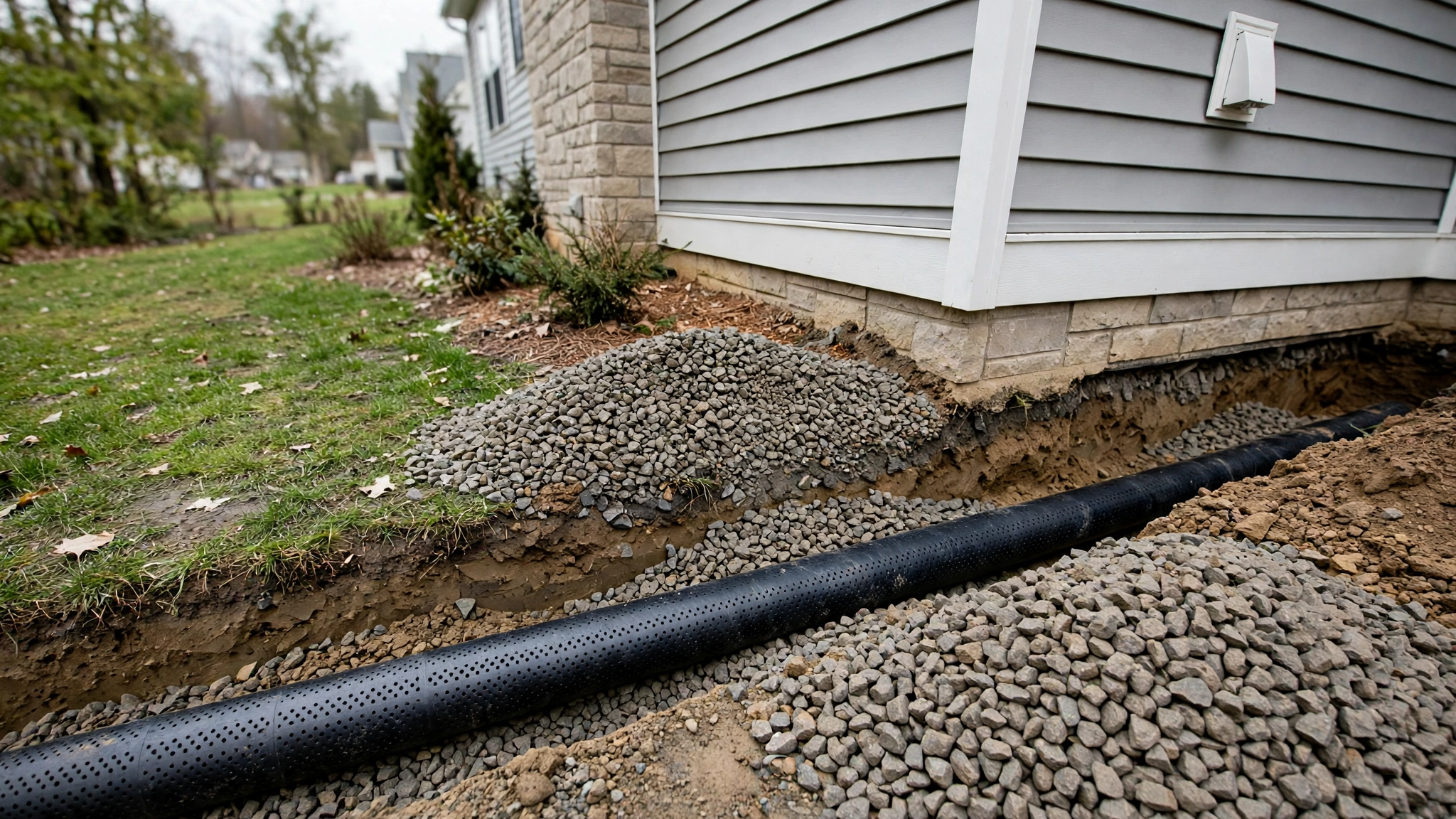
The drainage system that fits a yard depends on the water path: a swale fits surface flow, a French drain fits subsurface water, a catch basin fits a concentrated low point, a dry well fits a small roof outlet, and a sump pump fits water that cannot drain by gravity. A drainage system is a channel, pipe, or pump that collects water and carries the water to a safe outlet. A French drain is a trench filled with gravel, with or without a perforated pipe, that redirects surface water and groundwater away from an area. French drain systems use gravel and a perforated pipe to move water away from foundations and wet ground.
Use the table to match the problem to the first fix. Sheet flow across grass needs a surface fix first. Soggy soil with no surface puddle needs a subsurface fix. A flooded patio corner needs a point fix. A yard with no downhill outlet needs a pump, because gravity systems cannot lift water.
| Problem | Best first fix | Second system when needed |
|---|---|---|
| Sheet flow crosses a yard toward a house | Swale to an approved outlet | Catch basin at a patio low point |
| Soggy soil, no surface puddle | French drain with a clear outlet | Regrade a low pocket first |
| Water pools at one patio or driveway corner | Catch basin with a solid outlet pipe | Swale to move the basin discharge |
| One downspout floods a small yard | Dry well sized for roof runoff | Buried pipe to a street outlet where rules allow |
| Water enters a basement in ordinary rain | Interior drain channel to a sump pump | Exterior membrane and footing drain |
A swale needs a steady fall of at least 2 percent, grass or stone cover, and an outlet lower than the swale start. A French drain needs a steady fall, filter fabric, gravel, and an open outlet. A catch basin needs a grate that can be lifted and cleaned. A dry well needs a site away from the house and septic lines, with soil that drains. Check local rules before sending water to a street or storm drain, because many towns limit discharge points.
How Do You Protect a Basement or Crawl Space?
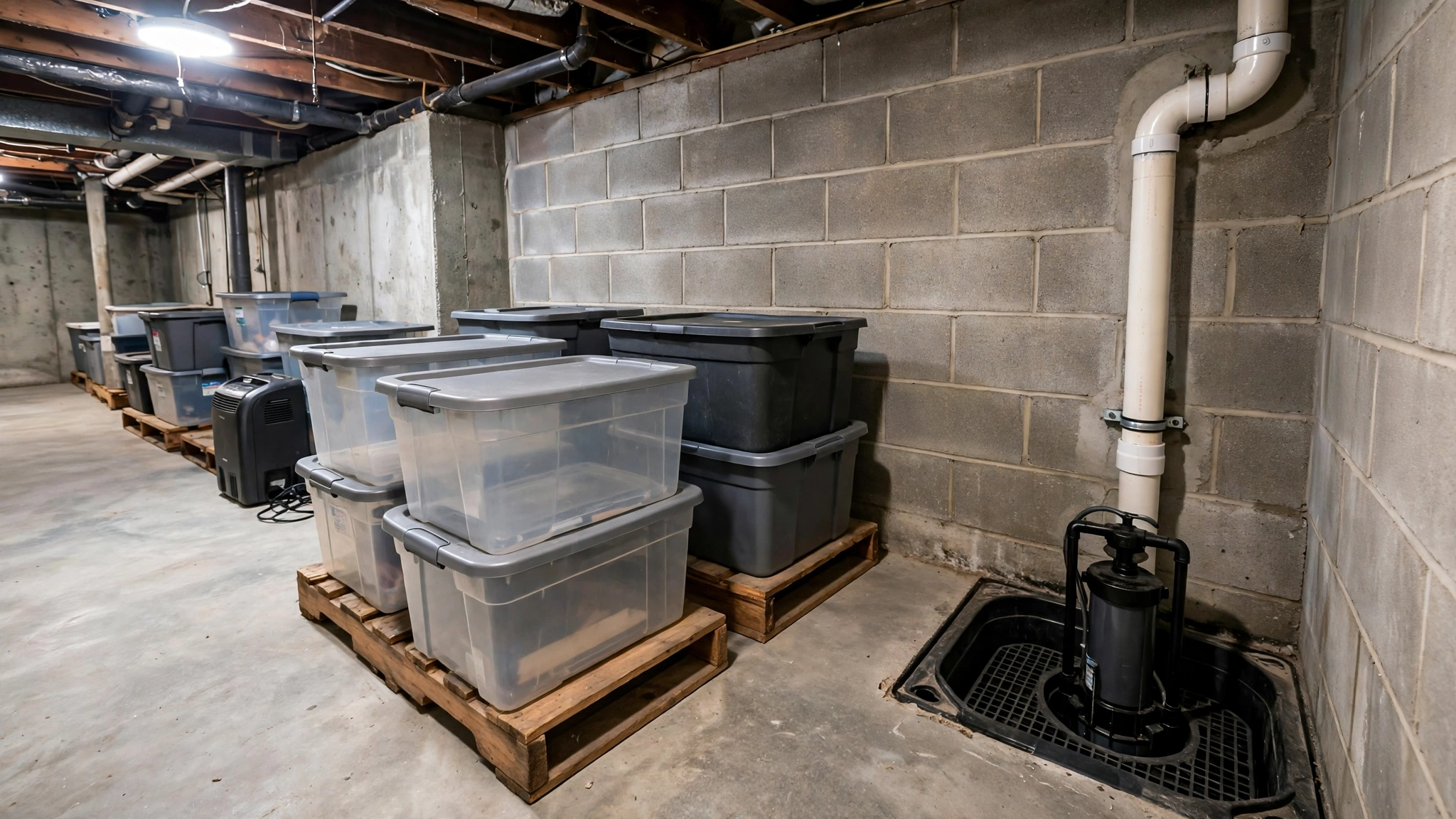
To protect a basement or crawl space, keep water out at the wall, move water that does enter to a pump, store goods off the floor, and check walls and joints after each heavy rain. A basement is a below ground room with walls and a floor slab that sit against soil. A crawl space is a low void under a house floor with soil or a vapour barrier at the base. Both spaces collect water first, because water runs downhill and soil pressure pushes water through joints and cracks.
Start outside. Fix gutters, downspouts, and soil slope before buying interior gear, because interior gear manages water that has already entered. Inside, fit an interior drain channel around the floor edge and connect the channel to a sump pump with a clear discharge pipe. Test the pump before storm season by pouring water into the pit. Fit a battery backup where storms cut power.
Seal small stable cracks with hydraulic cement or masonry filler made for wet walls. Tape across a fresh crack and check the tape monthly. A crack that grows, a wall that bows, or a floor that slopes points to soil movement and needs a structural check. Store goods on shelves or in sealed plastic bins, never in cardboard on the floor.
What Should You Check Before, During, and After Heavy Rain?
Before heavy rain, clear gutters and outlets, test the sump pump, and move goods off basement floors; during rain, watch where water pools and flows; after rain, walk the house, mark wet spots with dated photos, and fix the source before the next storm. A storm checklist is a short set of checks run at set times around a storm. The checklist works because each check catches a fault while the fault is still small.
Before rain, run 5 checks: clear gutters and outlets, clear swale channels and basin grates, test the sump pump and battery backup, close window well covers, and move items that can block drains. During rain, stay out of flooded rooms and away from downed power lines. Watch from windows for pooling at walls, spill over gutters, and water crossing paths toward the house.
After rain, walk the house in daylight and mark each wet spot with a dated photo. Check 4 zones: roof ceilings for new stains, wall bases for damp lines, basement joints for seepage, and yard low points for standing water. A puddle that lasts more than 24 hours after rain points to a grade dip or a blocked outlet. In my own yard checks, the wettest line after rain usually traced a path edge or a short downspout, and that line showed the source before digging started.
When Should You Call a Professional?
Call a professional when cracks grow, walls bow, floors slope, water enters a basement during ordinary rain, or no downhill outlet exists for graded water, because those signs point to structural movement or a drainage design problem beyond a simple soil fix. A professional check is a written assessment by a structural engineer, a drainage contractor, or a roofer, with the cause, the fix, and the cost in writing. A roofer fits roof leaks, flashing faults, and gutter replacement. A drainage contractor designs outlets, pump systems, and retaining work. A structural engineer names the cause of movement and states the repair in a written report.
Ask 3 questions before hiring: what caused the water problem, what fix matches that cause, and what happens when the fix waits 6 months. Get the answer in writing with the method, the outlet point, and the warranty terms. Get 2 quotes for drain and pump work, and compare the outlet point and the warranty, not just the price.
Call at once when water touches wiring, when a ceiling sags, when a wall bows, or when sewage backs up with rain. Those cases carry safety risks that a DIY fix cannot cover. Turn off power to a flooded room at the breaker and call a licensed tradesperson.
Conclusion
To protect home from rainwater, fix roof water first, keep gutters clear, seal gaps, slope soil away from walls, match each drain to its water path, and recheck after rain, because each part of that path must hold for the house to stay dry. Rainwater protection is a system, not a single product. Gutters move roof water. Seals close wall gaps. Soil slope moves surface water. Drains move subsurface water. Pumps lift water that gravity cannot move. When each part has a clear outlet, rain stays outside.
Start with one walk around the house. Clean the gutters, extend the downspouts, check the seals, and measure the soil slope. Fix the faults in that order, then add a drain or a pump only when the problem calls for that system. The Voice of Wave home page lists current guides across home care and other everyday topics. For more guides, visit the Voice of Wave blog hub:
Read the latest articles on the Voice of Wave blog
Frequently Asked Questions
How often should gutters be cleaned to protect a home from rainwater?
Clean gutters twice a year, in spring and autumn, plus after storms that drop heavy leaves. Clogged gutters spill roof water down walls and flood soil at the foundation. A yearly guard check also helps, because fine debris still settles in guarded runs.
What is the best slope away from a house foundation?
The best slope is a fall of 6 inches over the first 10 feet from the house. Beyond that wall zone, a gentler fall of 2 percent suits open grass and paths. A flat pocket past the wall zone still holds water, so check the full run, not just the wall edge.
Can a French drain alone fix a yard that slopes toward a house?
No, a French drain alone cannot fix a yard that slopes toward a house. Grading must first reverse the slope so surface water leaves the wall zone. A French drain then helps when soil stays soggy after grading, because the pipe collects subsurface water.
How do I know if rainwater is damaging my foundation?
Rainwater is damaging a foundation when water pools at walls, damp stains appear at floor joints, cracks grow, or doors stick after rain. Check during rain, mark wet spots with dated photos, and measure slope with stakes and string to name the cause.
Should I install a sump pump if my basement stays dry?
Yes, install a sump pump when a basement sits below grade in a wet area, even when the basement stays dry in most years. A pump with a battery backup guards against a rising water table in a severe storm, when gravity drains alone cannot cope.
What is the cheapest first step to protect a home from rainwater?
The cheapest first step is cleaning gutters and extending downspouts at least 6 feet from the house. Both steps cost little, take one afternoon, and remove the largest water load from the wall zone before spending on seals, grading, or drains.