
Introduction
Sewer repair is the work that restores a damaged sewer line so wastewater drains from a home to the public sewer main or a septic system without leaks, backups, or odors. Sewer repair covers diagnosis with a camera inspection, spot fixes for single defects, trenchless lining or bursting for longer runs, and excavation for collapsed or misgraded pipe.
Sewer repair starts with a clear diagnosis, because the same symptom can come from a clog, a crack, a root intrusion, or a collapsed section. The right option depends on pipe material, condition, defect location, and slope. This guide covers warning signs, camera inspection, repair options, trenchless comparison, cost drivers, payment responsibility, maintenance, and the point at which a professional should take over.
Key Takeaways
- Diagnose before digging: a camera inspection shows the defect type, location, and pipe condition that decide the method.
- Match the method to the defect: spot fixes suit single defects, lining suits cracked but sound pipes, bursting suits failed pipes, and excavation suits collapses and bellies.
- Several fixtures failing at once signal a main line problem: one slow fixture usually means a fixture clog.
- Check responsibility before work starts: the homeowner lateral, the property line, and the public main can fall under different owners.
- Maintain the repaired line: root control, grease control, and scheduled inspections protect a liner or a new pipe.
Table of Contents
- What Is Sewer Repair?
- What Are the Warning Signs of Sewer Damage?
- How Does a Sewer Camera Inspection Work?
- What Are the Main Sewer Repair Options?
- How Do Trenchless Methods Compare With Traditional Excavation?
- What Drives the Cost of Sewer Repair?
- Who Pays for Sewer Repair?
- How Do You Maintain a Sewer Line After Repair?
- When Should You Call a Professional for Sewer Repair?
- Conclusion
- FAQs
What Is Sewer Repair?
Sewer repair is the repair or replacement of a damaged section of a sewer line, including the private lateral that runs from a home to the public sewer main or a septic tank. Sewer repair fixes cracks, breaks, offset joints, root intrusion, corrosion, bellies, and collapsed sections, and sewer repair restores full flow and a sealed pipe.
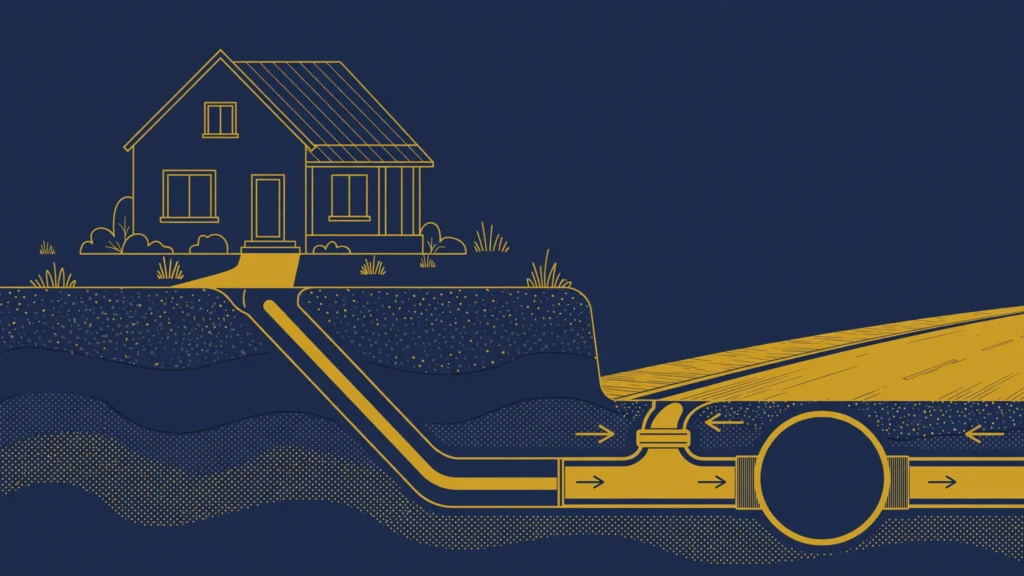
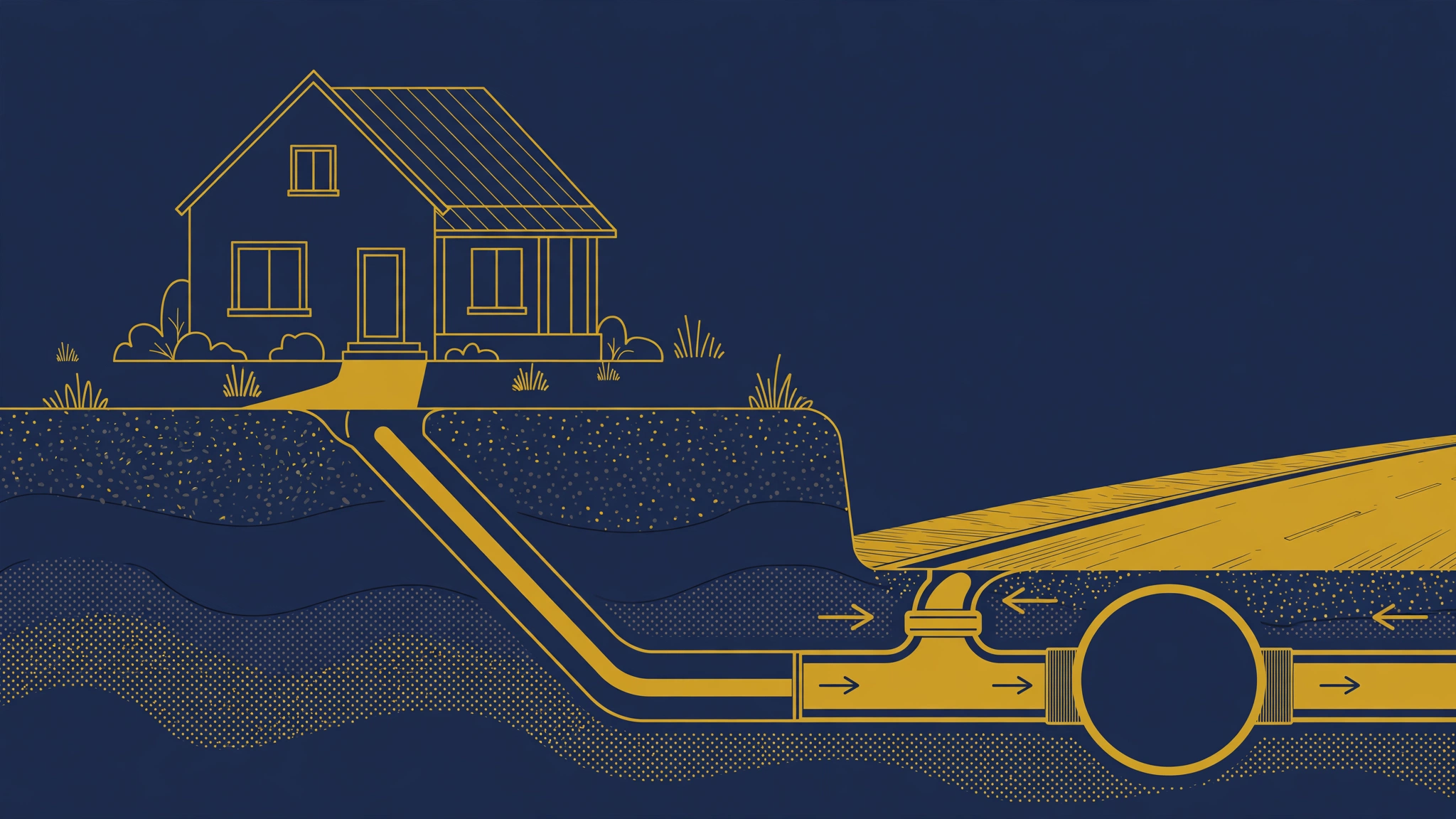
The sewer lateral carries all wastewater from a home. Fixture drains join branch lines inside the home, and branch lines join the main building drain at the foundation wall. The lateral runs underground through the yard to the public main under the street or to a septic tank, and a fault on that run can slow drains, push sewage back into low fixtures, or leak wastewater into soil. For more home maintenance guides in this area, browse the Home Improvement guides on this site.
Sewer repair differs from drain cleaning. Drain cleaning clears buildup and restores flow in a pipe that is still sound, while sewer repair changes the pipe itself through a patch, a liner, a new section, or a full replacement. A line that clogs again within weeks of cleaning often has damage, not a simple clog.
Pipe material shapes the repair choice. Clay pipes crack at joints and admit roots through joint gaps, cast iron pipes corrode and narrow as scale builds, and PVC and ABS plastic pipes resist corrosion but still fail at poorly glued joints or under shifting soil. Sewerage systems carry wastewater to treatment plants through pipes, manholes, and pumping stations, and the sewerage system design explains why a sealed, correctly sloped pipe matters for public health.
What Are the Warning Signs of Sewer Damage?
Warning signs of sewer damage are several slow drains at once, sewage backing up into low fixtures, gurgling sounds from toilets and drains, persistent sewage odors indoors or in the yard, and soggy or sunken patches in the yard. Warning signs of sewer damage point to a main line fault when several fixtures fail together.
Several slow drains at once form the strongest early signal. One slow sink points to a fixture clog, while several slow drains across bathrooms and the kitchen point to the main line. Water backing up in unexpected places gives a second signal: a toilet flush that raises water in a tub or shower means waste is pushing back through the main line.
Odors give a fourth signal. A persistent sewage smell near a floor drain, near the foundation, or in one part of the yard points to a crack, a broken joint, or a dried trap. A dried trap is fixed by running water into the drain to restore the water seal, and an odor that survives that check points to a line fault.
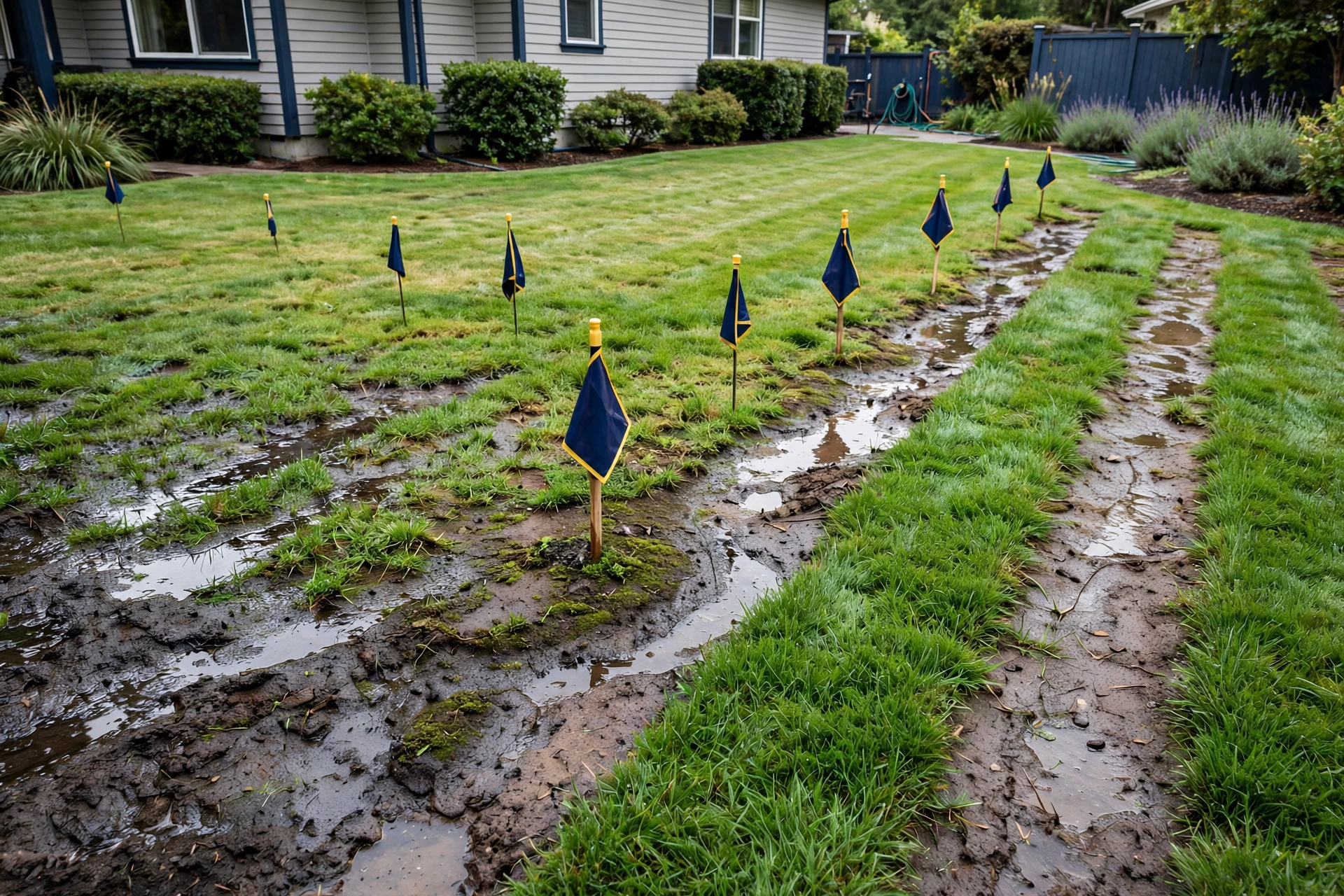
Yard signs give a fifth signal. A leaking pipe saturates the soil above the pipe and forms soggy patches even in dry weather. A sunken patch forms when soil washes into a broken pipe and the ground above settles, and a strip of grass that grows faster and greener than the rest of the yard can mark a leak.
Read the related guide on drain cleaning methods to compare a simple clog with a main line fault.
How Does a Sewer Camera Inspection Work?
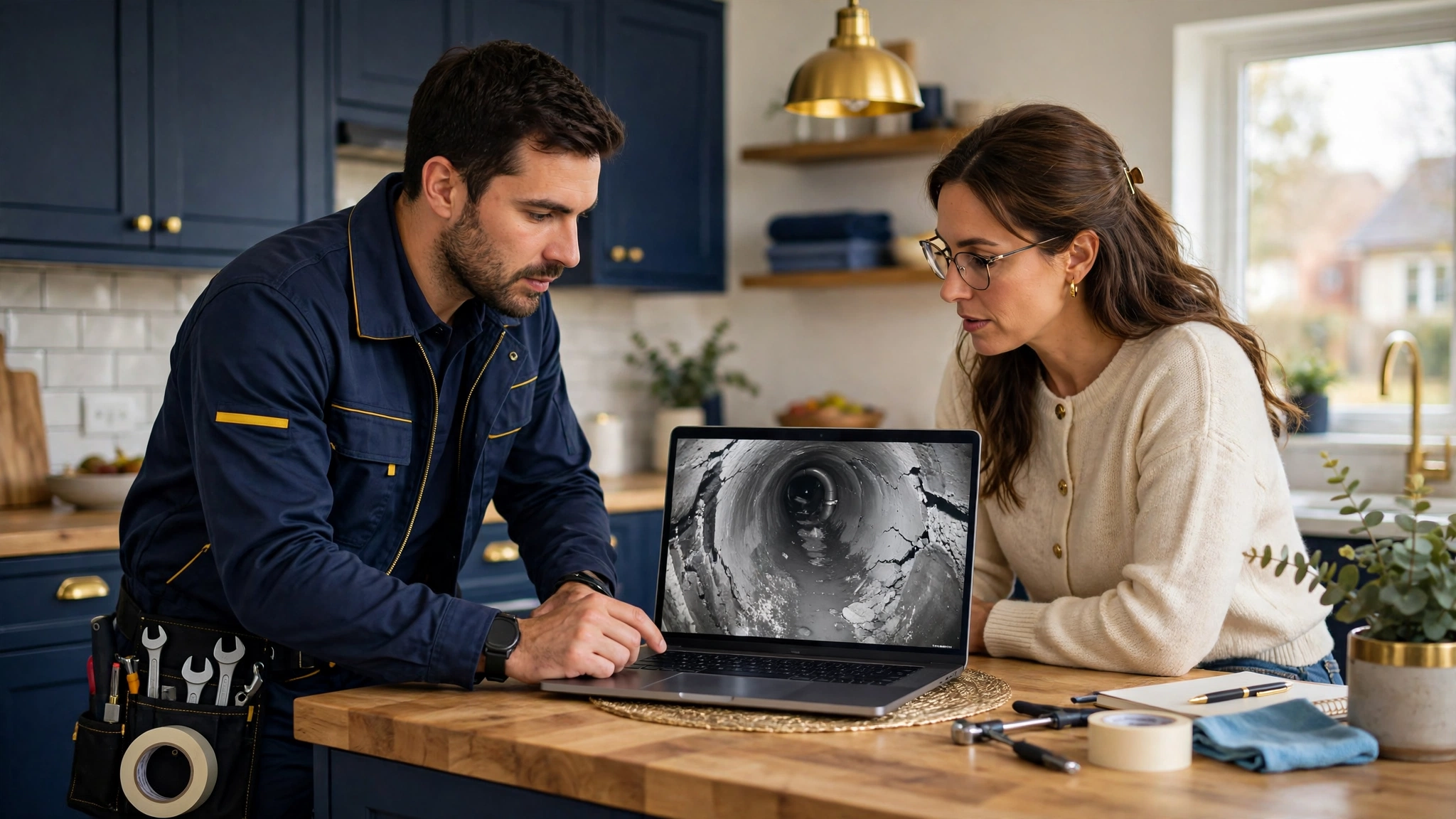
A sewer camera inspection is a video survey of the inside of a sewer line, made by feeding a waterproof camera on a flexible cable through a cleanout or an access point and recording the pipe interior in real time. A sewer camera inspection shows cracks, offsets, bellies, root intrusion, scale, and collapses.
A cleanout is a capped access pipe on the sewer line, and the cleanout gives the camera a direct entry point. The technician feeds the camera from the cleanout toward the street main or the septic tank, and the camera sends live video to a monitor above ground. A locator device tracks the camera head from the surface and marks each defect on the ground with its depth.
A camera inspection answers 4 questions before any digging starts. The inspection shows the defect type, because a crack, a root mass, a belly, and a collapse each need a different fix. The inspection shows the pipe condition along the full run and the pipe slope, because a line with the same defect at every joint needs a whole-line fix, and a belly or back-pitched section needs regrading.
What Are the Main Sewer Repair Options?
The main sewer repair options are sectional point repair for a single defect, cured-in-place pipe lining for a cracked but sound pipe, pipe bursting for a failed pipe, and traditional excavation for a collapsed pipe or a misgraded section. The main sewer repair options differ in digging, in pipe result, and in the pipe condition each method needs.
Sectional point repair fixes a short length of pipe, usually a few feet, at one defect. A short liner soaked in resin is positioned over the defect on an inflatable packer, pressed against the pipe wall, and cured in place. Point repair suits one cracked joint, one root-intruded joint, or one small break on a line that is sound elsewhere, and point repair fails as a plan when the camera shows the same defect at every joint.
Cured-in-place pipe (CIPP) lining creates a new pipe inside the old pipe. A felt or fiberglass liner soaked in resin is pulled or inverted into the existing pipe, inflated against the wall, and cured with hot water, steam, or ultraviolet light. The cured liner is jointless and blocks roots and seals leaking joints along the full lined run. CIPP lining needs a host pipe that still holds its shape and slope, and CIPP lining suits longitudinal cracks, small offsets, and leaking joints on a reasonably intact pipe.
Pipe bursting replaces the old pipe with a new pipe through two small pits. A bursting head fractures the old pipe outward while a new high-density polyethylene (HDPE) pipe is pulled in behind the head.
Traditional excavation opens a trench over the damaged section, removes the old pipe, and lays a new pipe at the correct slope. Excavation suits a fully collapsed pipe, a belly that holds standing water, a back-pitched section, and a pipe that no camera can pass, and only an open trench restores correct slope.
| Method | Best for | How it works | Limits |
|---|---|---|---|
| Sectional point repair | One defect on a sound line | Short resin liner cured over the defect | Fails when defects repeat along the line |
| CIPP lining | Cracked but sound pipe, leaking joints | Resin liner cured inside the old pipe | Needs a host pipe that holds shape and slope |
| Pipe bursting | Failed pipe, larger diameter needed | Bursting head fractures old pipe, new HDPE pipe pulled in | Needs entry and exit pits, needs a clear run |
| Traditional excavation | Collapse, belly, wrong slope | Open trench, old pipe removed, new pipe laid to grade | Heavy surface disruption and restoration |
How Do Trenchless Methods Compare With Traditional Excavation?
Trenchless methods compare with traditional excavation on digging, on time, on surface damage, and on the pipe result: trenchless methods use small access points and leave the surface between them intact, and traditional excavation opens a continuous trench and restores the surface afterward.
Trenchless work covers lining, bursting, and point repair, and trenchless work is defined by minimal digging rather than by one tool. The trenchless rehabilitation methods include CIPP lining, pipe bursting, sliplining, and mechanical spot repair, and each method works through cleanouts or small pits. Traditional excavation exposes the full damaged section through an open trench for direct replacement.
Time and disruption differ sharply. A lining or bursting job on a residential line often finishes in one to three days and leaves the lawn, driveway, and patio between access points intact. An excavation job takes longer when the trench is deep or long and adds restoration time for soil, sod, concrete, or paving, and restoration cost is often the largest difference between a trenchless quote and an excavation quote.
Limits decide the choice more than speed does. Neither lining nor bursting fixes a belly, because a liner cures to the sagged shape and a burst pipe follows the same low path, and standing water returns in both cases.
What Drives the Cost of Sewer Repair?
The cost of sewer repair is driven by the repair method, the length and depth of the damaged section, the pipe material, the surface above the pipe, the permits required, and the restoration work after the pipe work ends. The cost of sewer repair varies widely between homes.
Method sets the base. A point repair on one defect costs less than a full lining run, and a full lining run costs less than a full excavation with surface restoration in most cases. Length and depth raise the total, because deeper pipes need deeper pits or trenches, and longer runs need more liner or more new pipe.
Surface and access shape the total. A defect under open lawn is cheaper to reach than a defect under a concrete driveway, a patio, or a mature tree root zone. A defect under a sidewalk or street adds permits and traffic control and may need a right-of-way permit in addition to a plumbing permit. Rocky or waterlogged soil slows digging and raises labor time.
Published guides report widely different cost ranges for the same job, and that spread is itself a warning. A quote that names the method, the pipe length, the depth, the permit fees, and the restoration scope can be compared with another quote, while a lump sum without those items cannot.

Who Pays for Sewer Repair?
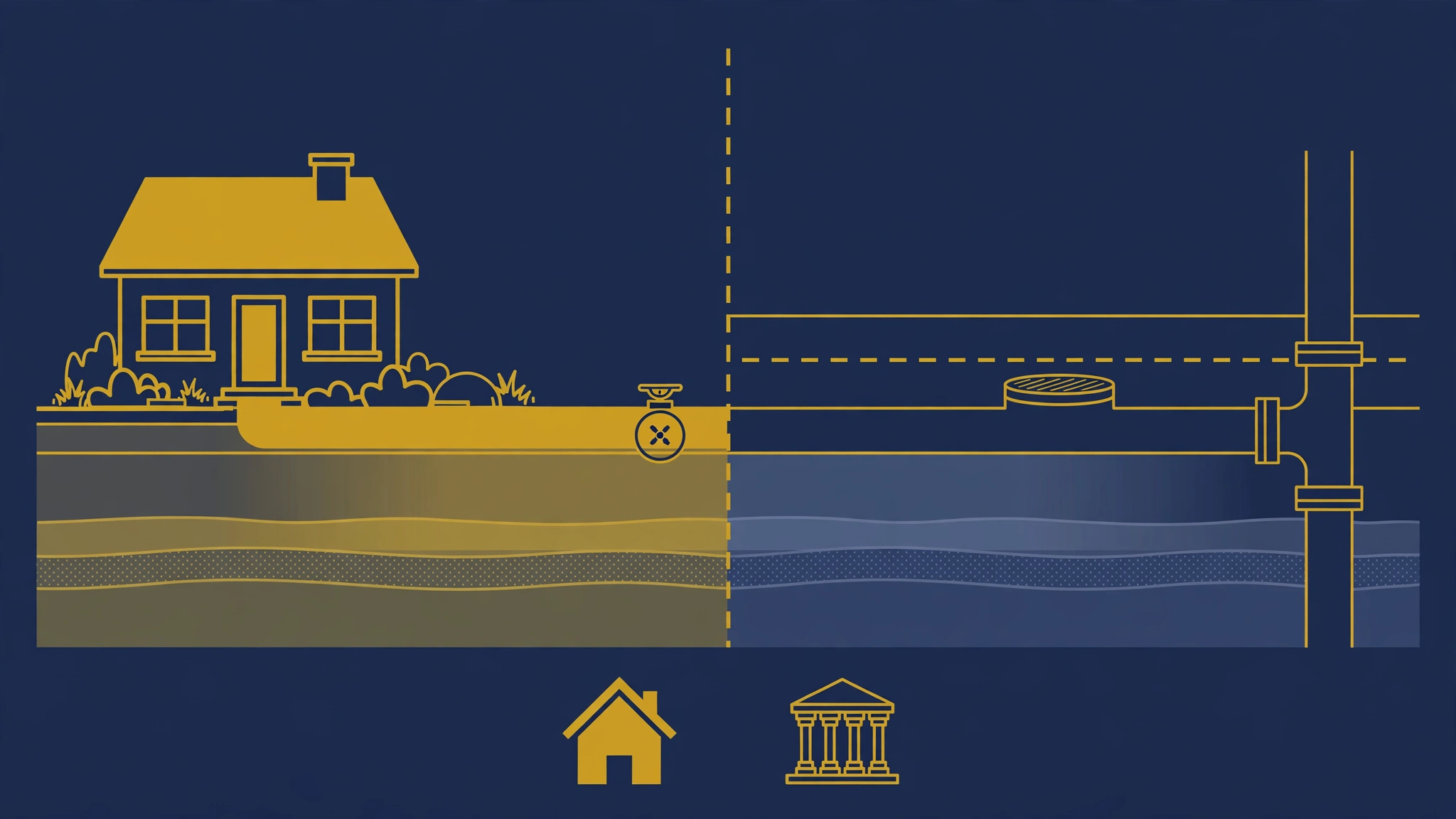
Who pays for sewer repair depends on where the fault sits: the homeowner usually pays for the private lateral from the home to the property line or to the connection point set by local rules, and the municipality or utility usually pays for the public main under the street.
The private lateral runs from the home to the public main and often crosses the yard, the sidewalk, and the planting strip before it reaches the main. Some cities place the ownership boundary at the property line, and other cities place the boundary at the connection to the public main. That difference decides who pays for a fault under the sidewalk or the planting strip.
Permits follow the same boundary. Work on the private lateral usually needs a plumbing permit, and work that enters the sidewalk, the planting strip, or the street usually needs a right-of-way permit as well. A contractor should name every permit in the quote and confirm who pulls each permit. Work that touches the public main needs utility coordination and should never start without it.
Insurance rarely covers the full job. Standard home insurance often excludes tree roots, wear, and gradual failure, and standard home insurance often covers only sudden damage such as a backup caused by a covered event. A service line rider, sold as an add-on in many areas, may cover lateral repair up to a stated limit.
How Do You Maintain a Sewer Line After Repair?
To maintain a sewer line after repair, keep grease, wipes, and foreign objects out of drains, control tree roots near the line, schedule a camera inspection every few years, and fix slow drains before they become backups. To maintain a sewer line after repair, prevention must run on a schedule.
Grease control starts in the kitchen. Hot grease flows down the drain as a liquid, cools inside the pipe, and coats the pipe wall as a solid layer that narrows the pipe and catches debris. Wipe grease from pans with a paper towel before washing, and pour cooled grease into a sealed container for the trash.
Flush only toilet paper and human waste. Wipes labeled as flushable do not break down like toilet paper and catch on joints, roots, and rough pipe walls. Cotton products, dental floss, and hygiene products cause the same snagging and belong in the trash.
Root control protects lined and new pipes. Tree roots enter through joints and small cracks and grow into a net that catches paper and waste. A liner seals joints and blocks root entry along the lined run but does not protect unlined sections or the connection points at each end. A root treatment or a scheduled cutting plan suits a line near large trees, and a camera inspection every few years shows whether roots are returning. Voice of Wave covers home maintenance topics of this kind for general readers, and the Voice of Wave home page lists the latest guides across the site categories.

When Should You Call a Professional for Sewer Repair?
Call a professional for sewer repair when several fixtures back up at once, when sewage appears in a tub or floor drain, when a clog returns within weeks of clearing, or when yard signs point to a leak. Call a professional for sewer repair when the problem sits in the main line.
Sewage in a low fixture is a same-day problem, because sewage carries bacteria and damages floors and walls on contact. A backup that follows heavy rain can also signal a municipal main problem and deserves a call to the local sewer authority as well as a plumber.
Ask the professional 3 questions before work starts: what defect did the camera show, what method fits the pipe material and condition, and what does the quote include for permits and restoration. Ask for the camera footage or a written summary after the job, because footage shows the repaired section and any remaining defects that need watching. A repair job should include a camera check after the work to confirm the fix.
Some jobs suit a homeowner and most sewer repairs do not. Clearing a single slow fixture with a plunger or a hand auger suits a homeowner and needs no permit and no digging. Any work that opens the ground, lines a pipe, bursts a pipe, or touches the public main needs a licensed professional, plus permits, utility location, and inspection. Digging without a utility locate risks gas, water, and electric lines, and that risk alone rules out do-it-yourself excavation.
Conclusion
Sewer repair works best as a matched method, not a single product: a point repair for one defect, lining for a cracked but sound pipe, bursting for a failed pipe, and excavation for a collapse or a belly. Sewer repair starts with a camera inspection, because footage shows the defect type, location, and pipe condition that decide the method. Sewer repair costs follow method, length, depth, surface, permits, and restoration. Maintenance keeps the result: grease control, root control, and scheduled inspections protect a liner or a new pipe for decades.
Read the latest home guides on the Voice of Wave blog for more maintenance topics.
FAQs
How do I know if I need sewer repair or just drain cleaning?
You need sewer repair when a camera inspection shows pipe damage such as cracks, breaks, offsets, or collapses, and you need drain cleaning when the pipe is sound but blocked by buildup. A clog that returns within weeks of cleaning, several fixtures failing at once, or sewage in a low fixture all point toward repair rather than another cleaning.
What is trenchless sewer repair?
Trenchless sewer repair is the repair or replacement of a buried sewer line through cleanouts or small access pits instead of a continuous open trench. Trenchless sewer repair covers CIPP lining, pipe bursting, and sectional point repair, and trenchless sewer repair suits pipes that still hold slope, while collapsed or bellied sections still need excavation.
How long does sewer repair take?
Sewer repair takes one to three days for most trenchless residential jobs, and sewer repair takes longer for excavation jobs that add deep trenches and surface restoration. The timeline depends on the method, the pipe length, the pipe depth, the permits required, and the weather, so a written schedule from the contractor gives the firmest estimate.
Can tree roots be removed without replacing the sewer line?
Yes, tree roots can be removed without replacing the sewer line when the pipe is still sound, because cutting and hydro jetting clear the root mass and a liner then seals the joints against regrowth. A camera inspection after root removal shows whether lining or a spot fix is still needed.
Does homeowners insurance cover sewer repair?
No, standard homeowners insurance usually does not cover sewer repair from roots, wear, or gradual failure, because those causes fall under maintenance exclusions. A separate service line rider may cover lateral repair up to a stated limit, so the policy wording and the rider limit should be checked before work starts.
How often should a sewer line be inspected?
A sewer line should be inspected with a camera every few years, and a sewer line near large trees or an older line should be inspected more often. A camera inspection is also wise before buying a home, after a major backup, and after any repair, because footage confirms the line condition at each of those points.