
Introduction
Tree safety is the inspection, pruning, placement, and storm preparation work that keeps a tree from harming people, homes, vehicles, and power lines. A tree is safe when defects are found early, weak branches are removed by the right person, and new trees are planted where mature size causes no conflict. In the United States, 34 people died in 2025 when trees or branches fell during high winds, and 101 people were injured in the same events (Source: NOAA, 2025).
Tree safety covers warning signs, ground inspection, storm preparation, pruning limits, power line rules, and arborist hiring. Tree safety also covers children and play and planting choices, because a tree planted in the right place needs less cutting later. Voice of Wave covers home topics for general readers.
Key Takeaways
- Inspect from the ground: roots, trunk, branches, and crown, with photos after each storm.
- A new lean, trunk cracks, fungal growth at the base, and dead branches over a roof need a prompt arborist check.
- Never prune near power lines, climb with a chainsaw, or use a chainsaw from a ladder.
- Children need live branches, supervision, and a height limit. Tree swings need a healthy branch at least 8 inches in diameter.
- Plant small trees 8 to 10 feet from a wall, medium trees 15 feet, and large trees 20 feet.
Table of Contents
- What Is Tree Safety?
- What Are the Warning Signs of a Hazardous Tree?
- How Do You Inspect a Tree Safely From the Ground?
- How Do You Prepare Trees for Storms?
- What Pruning Work Is Safe for Homeowners, and What Needs a Professional?
- How Close Can Trees Grow to Power Lines?
- When Should You Call a Certified Arborist?
- How Do You Keep Children Safe Around Trees?
- How Do You Choose and Place a New Tree Safely?
- Conclusion
What Is Tree Safety?
Tree safety is the set of checks and actions that lower the chance that a tree or a branch falls on a person, a home, a vehicle, or a power line. Tree safety is a routine: inspect trees, remove dead and weak branches, protect roots, prepare for storms, and call a professional when risk passes homeowner skill. Tree safety also means knowing the target under each tree. A target is any person, home, vehicle, path, or power line that a falling tree or branch could hit. A defective tree with no target carries low risk, while a defective tree over a bedroom, a driveway, or a play area carries high risk.
Tree safety rests on 3 checks: likelihood of failure, likelihood of hitting a target, and severity of harm. Likelihood of failure rises with cracks, decay, dead branches, weak unions, and root damage. Severity rises with branch size, tree height, and use of the area under the tree. Homeowners can judge targets and visible defects from the ground, and a certified arborist judges hidden decay and risk ratings. Green leaves prove that a tree is alive, and green leaves do not prove that a tree is sound.
What Are the Warning Signs of a Hazardous Tree?
The warning signs of a hazardous tree are a new or growing lean, trunk cracks and cavities, dead and hanging branches, fungal growth at the base, and root and soil movement. Each sign on its own calls for a closer look. Two or more signs on one tree call for a prompt arborist visit. A sign over a roof, path, driveway, or play area needs faster action than the same sign over open ground.
A lean needs a time check. A tree that has leaned at the same angle for years may hold stable roots, while a new or growing lean needs a prompt check. Soil cracks, heaved soil, and exposed roots point to root plate movement. For more home maintenance guides in this area, browse the Home Improvement guides on this site. Trunk signs include vertical cracks, large cavities, missing bark, and swelling. Branch signs include dead branches, hanging branches, leafless branches, and V-shaped unions. Crown signs include dieback across more than a quarter of the crown. Root signs include mushrooms at the root flare and lifted pavement. Fungal growth at the base points to active wood decay, and fungal growth is a structural warning, not a cosmetic mark.
How Do You Inspect a Tree Safely From the Ground?
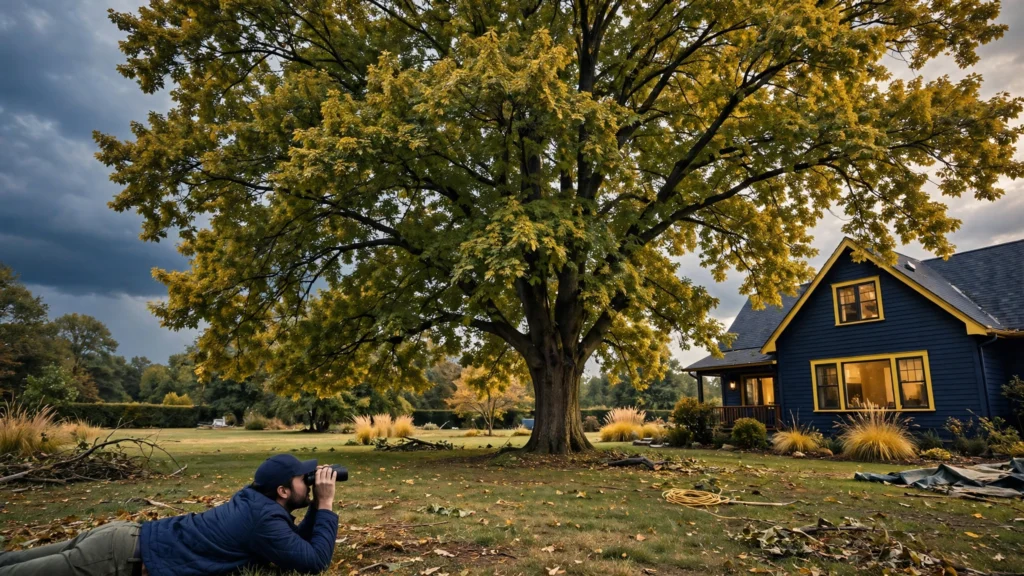
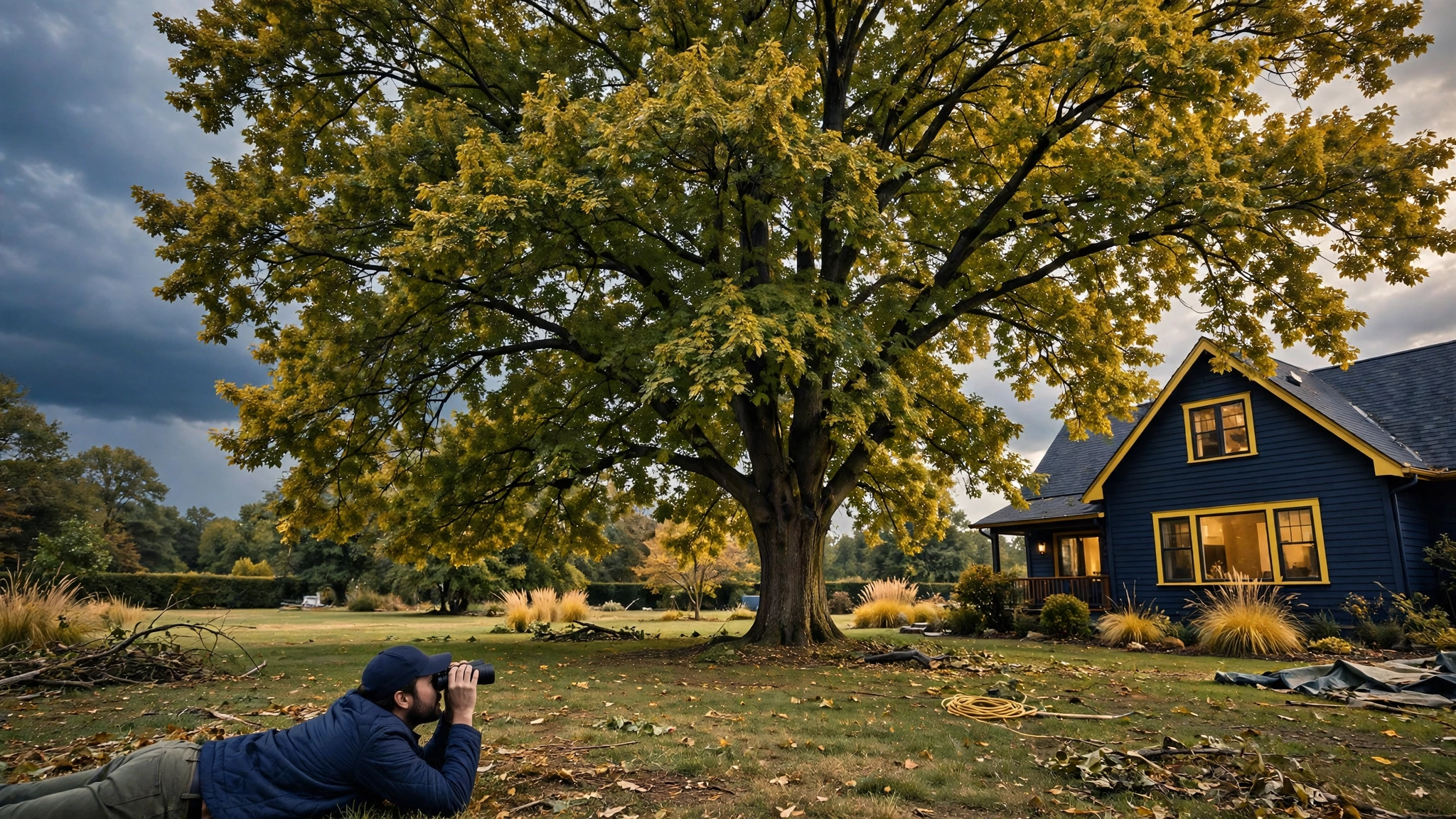
To inspect a tree safely from the ground, walk a full circle, check roots, trunk, branches, and crown in that order, and record each defect with a dated photo. Ground inspection keeps the homeowner off ladders and roofs, and out from under hanging branches. Ground inspection uses eyes, binoculars, and photos, never climbing or a chainsaw.
Run the inspection in 7 steps:
- Stand back and note the lean, the crown shape, and the targets under the tree.
- Check the base for mushrooms, cavities, exposed roots, lifted soil, and soil cracks.
- Check the trunk for cracks, seams, missing bark, swelling, and cavities.
- Check major limbs for dead wood, weak forks, hanging branches, and roof contact.
- Scan the crown with binoculars for dead branches, thinning, and sparse leaves.
- Note branches over roofs, paths, driveways, play areas, and power lines.
- Take dated photos from the same spots, and repeat the check after each storm.
In my own yard, dated photos after each storm made a slow lean easy to spot. Inspect trees 2 times each year, in spring and in fall, and again after high wind, heavy rain, ice, or snow. Construction near a tree calls for a fresh inspection, because trenching and vehicle traffic cut roots.

How Do You Prepare Trees for Storms?
To prepare trees for storms, remove dead and hanging branches before storm season, cut back branches that touch roofs and paths, protect roots, and book an arborist check for any tree with warning signs. Storm preparation works best months before storm season, because cuts need time to close and arborist bookings fill fast after a storm warning.
Start with the crown. Dead branches fall first in high wind, and dead branches over roofs, vehicles, and paths cause the most harm. Remove dead branches over 2 inches in diameter first, then hanging branches caught in the crown. Cut back branches that scrape roofs, and keep the crown balanced. In 2025, 34 people died when trees or branches fell during high winds, 19 deaths happened when trees fell on vehicles, and 101 people were injured (Source: NOAA, 2025). A study published in 2008 reported an average of 31 deaths per year from wind-related tree failures in the United States from 1995 to 2007 (Source: study cited by Weather.com, 2026). Wind speeds over 60 miles per hour can bring down trees, and weakened trees can fail at lower speeds. On a storm day, stay indoors, keep vehicles away from trees with warning signs, and keep people out from under trees until a ground check is done.
What Pruning Work Is Safe for Homeowners, and What Needs a Professional?
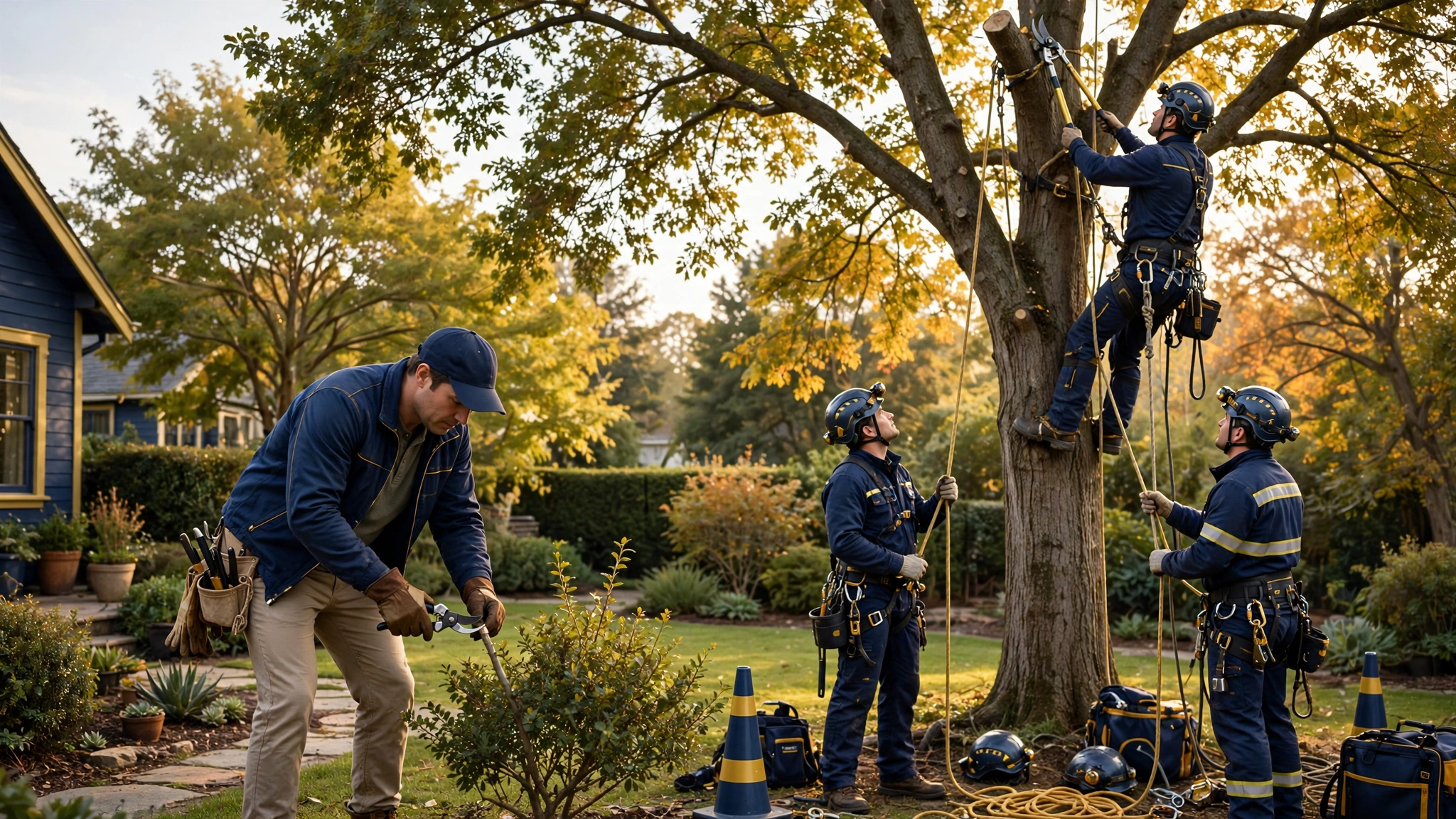
Homeowners can safely prune small, low branches from the ground with hand tools. A professional must handle pruning that needs a ladder, a chainsaw at shoulder height or higher, work near power lines, or removal of a large branch. Small branches within ground reach suit homeowner tools. Large and high branches suit trained crews with ropes and rigging gear.
Pruning methods cover deadwood removal, thinning, raising, and reduction. Deadwood removal takes out dead branches for safety. Thinning lets in light and air. Raising gives clearance under the tree. Reduction lowers height or spread. Topping cuts a tree back to stubs, leaves large wounds, forces weak regrowth, and raises long-term cost. Homeowners must not top a tree. Cut at the branch collar.
| Task | Homeowner from the ground | Professional crew |
|---|---|---|
| Small branches under 2 inches, low, clear of wires | Yes, hand pruners | Not needed |
| Work from a ladder | No | Yes, trained crew |
| Chainsaw work at shoulder height or higher | No | Yes, trained crew |
| Branches touching or near power lines | No, call the utility | Yes, line clearance crew only |
| Large branch removal, cabling, or full removal | No | Yes, rigging crew |
The United States Department of Labor reported 31 worker deaths in New England tree trimming and landscaping work since 2016, investigated by OSHA (Source: US Department of Labor, 2021). Wear eye protection, gloves, and sturdy boots, and keep children and pets clear of the drop zone.
How Close Can Trees Grow to Power Lines?
Trees must not touch power lines, and homeowners must not prune any tree near a power line. Power line work belongs to the utility company and qualified line clearance crews. A branch near a wire can carry current when wet, bent by wind, or weighted by a climber. Keep ladders and tools clear of power lines, and keep children out of any tree near a power line.
Distance rules start at planting. The Arbor Day Foundation advises small-growing trees up to 20 feet from power lines, medium-growing trees between 20 and 50 feet, and tall trees more than 50 feet from power lines (Source: Arbor Day Foundation, 2026). The Eugene Water and Electric Board advises small trees up to 25 feet high at maturity under or next to lines (Source: Eugene Water and Electric Board, 2026). Tall trees must never sit under power lines. When a tree already grows into wires, call the utility company. Do not cut, pull, or climb. Treat every downed power line as live, keep people and pets at least 30 feet away, and call the utility company at once.
When Should You Call a Certified Arborist?
Call a certified arborist when a tree shows warning signs, needs pruning beyond ground reach, stands near a power line, or needs removal, cabling, or a formal risk rating. A certified arborist holds training and continuing education in tree biology, pruning, diagnosis, soils, safety, and risk. The International Society of Arboriculture runs the Certified Arborist credential, and the Tree Risk Assessment Qualification marks added training in risk assessment. Ask for credential name, number, proof of insurance, and references before work starts.
Voice of Wave covers home care topics for general readers: check credentials, get a written scope, and compare more than price. The work of a certified arborist covers planting, pruning, structural support, diagnosis and treatment of pests and disease, lightning protection, and removal of trees judged hazardous. A certified arborist can give Level 1, 2, or 3 assessments, from a limited visual check to advanced tool testing. A written report should name defects, targets, a risk rating, and options: monitor, prune, cable, or remove. Hire with 4 checks: verify credential and insurance, get a written scope, ask how the crew protects the drop zone, and refuse door-to-door offers demanding full payment at once. A sound arborist saves trees when pruning solves the risk, and recommends removal only when risk stays high.
How Do You Keep Children Safe Around Trees?
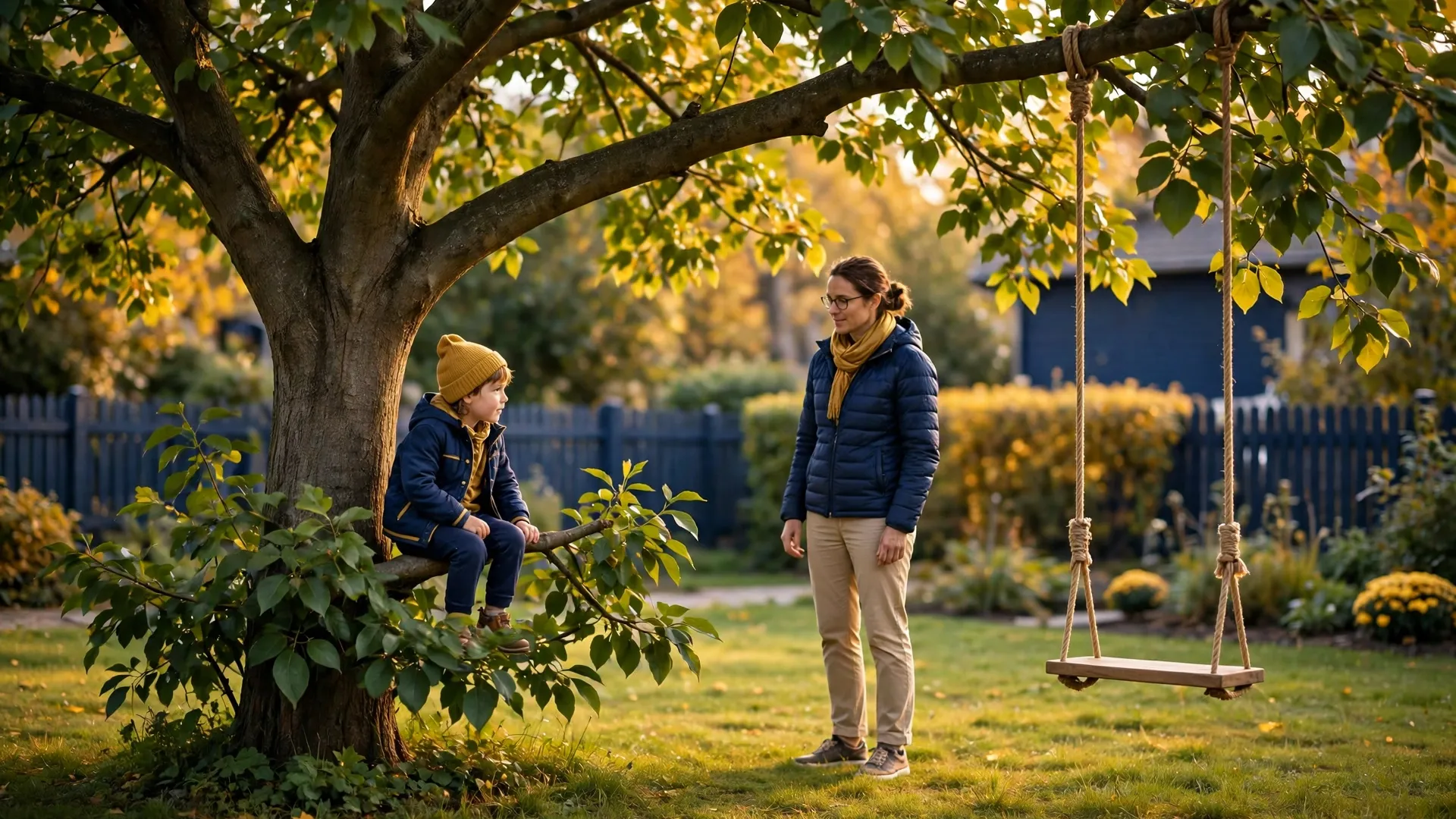
To keep children safe around trees, allow climbing only on healthy trees with live branches, set a low height limit, require supervision, and check swing branches and ropes before each use. Children must stay off dead branches, because dead branches snap with little warning. Children must climb only as high as they can climb down safely, and keep 3 points of contact: 2 hands and 2 feet, with at least 3 points on branches at all times.
Branch size sets the limit. Kidsafe NSW advises branches 15 centimetres in diameter as a guide for climbing branches (Source: Kidsafe NSW, 2021). Test a branch near the trunk first, where a branch holds the most weight. Children must keep clear of trees near power lines, and never build a tree house or fort in a tree near power lines. Children must never touch a power line, and must tell an adult at once about a fallen line. Tree swings need a stricter check: use only a healthy tree with a live, horizontal branch at least 8 inches in diameter, free of cracks and decay. Use rope rated for swing use, check knots before each use, and replace frayed rope at once. Keep one rider seated, with no jumping off at height. An arborist check before a tree house or swing gives a clear yes or no on branch strength.
How Do You Choose and Place a New Tree Safely?
To choose and place a new tree safely, match mature height and spread to the space, keep the tree clear of walls, roofs, paths, and power lines, and call 811 before digging. A new tree looks small at planting and grows to mature size over years. Planting for mature size prevents a large tree in a small space that later needs heavy cutting. Choose a species suited to local climate, soil, and sun, and use more than one species across a yard.
The Arbor Day Foundation sets minimums: small trees up to 25 feet at least 8 to 10 feet from a wall, or 6 to 8 feet from a corner; medium trees up to 40 feet at least 15 feet from walls, and 12 feet from a corner; large trees over 40 feet at least 20 feet from a wall, and 15 feet from a corner (Source: Arbor Day Foundation, 2026). Keep trees 5 feet from buried lines, and 10 feet from sewer lines. Planting steps: call 811, pick the spot with mature size and wires in view, dig no deeper than the root ball, set the tree at nursery depth, water deeply, and mulch 2 to 4 inches deep clear of the trunk. Prune lightly in the first years: keep one leader, space branches, and remove crossing branches.
For storm repair steps after a tree falls on a roof, read the Roof Storm Damage Repair Guide.
Conclusion
Tree safety is a ground routine, a set of pruning limits, a power line rule, and a prompt call to a certified arborist when warning signs appear. Tree safety starts with inspection: check roots, trunk, branches, and crown, photograph changes, and repeat the check after each storm. Tree safety continues with storm preparation and pruning limits: remove dead branches early, keep homeowner cutting low and small, and leave ladders, chainsaws, large branches, and power line work to trained crews. Tree safety protects children with live branches, supervision, and swing checks, and ends with planting for mature size. In 2025, 34 people died when trees or branches fell during high winds (Source: NOAA, 2025): inspect, record, prune within limits, and call a professional early.
Read more home guides on the Voice of Wave blog.
Frequently Asked Questions
How often should I inspect my trees for safety?
Inspect trees 2 times each year, in spring and in fall, and inspect trees again after high wind, heavy rain, ice, or snow. Each inspection runs from the ground and covers roots, trunk, branches, and crown. Dated photos from the same spots show change over time and help an arborist judge risk.
What are the signs that a tree needs to be removed?
A tree may need removal when the trunk holds large cavities or deep cracks, roots show decay or major damage, the crown shows dieback across more than a quarter of the crown, or a new lean grows after a storm. A certified arborist should confirm removal, because pruning, cabling, or monitoring may solve the risk at lower cost.
Can I prune a tree near a power line myself?
No, never prune a tree near a power line yourself. Branches near wires can carry current, and only qualified line clearance crews may work near energized lines. Call the utility company when a tree grows into wires, and keep ladders, tools, and children clear of the tree until the utility crew acts.
How far should a tree be planted from a house?
Plant small trees at least 8 to 10 feet from a wall, medium trees at least 15 feet from a wall, and large trees at least 20 feet from a wall (Source: Arbor Day Foundation, 2026). Corner distances run 6 to 8 feet for small trees, 12 feet for medium trees, and 15 feet for large trees. Mature height and spread set the distance, not the size at planting.
Is it safe for children to climb trees?
Yes, climbing is safe when children climb healthy trees with live branches, keep 3 points of contact, stay at a low height they can climb down from, and climb with adult supervision. Kidsafe NSW advises branches 15 centimetres in diameter as a guide for climbing branches (Source: Kidsafe NSW, 2021). Children must stay off dead branches and out of any tree near power lines.
When should I call an arborist instead of doing tree work myself?
Call an arborist when work needs a ladder, a chainsaw at shoulder height or higher, removal of a large branch, cabling or bracing, or any work near power lines. Call an arborist also when a tree shows warning signs such as a new lean, trunk cracks, fungal growth at the base, or dead branches over a roof or path.