
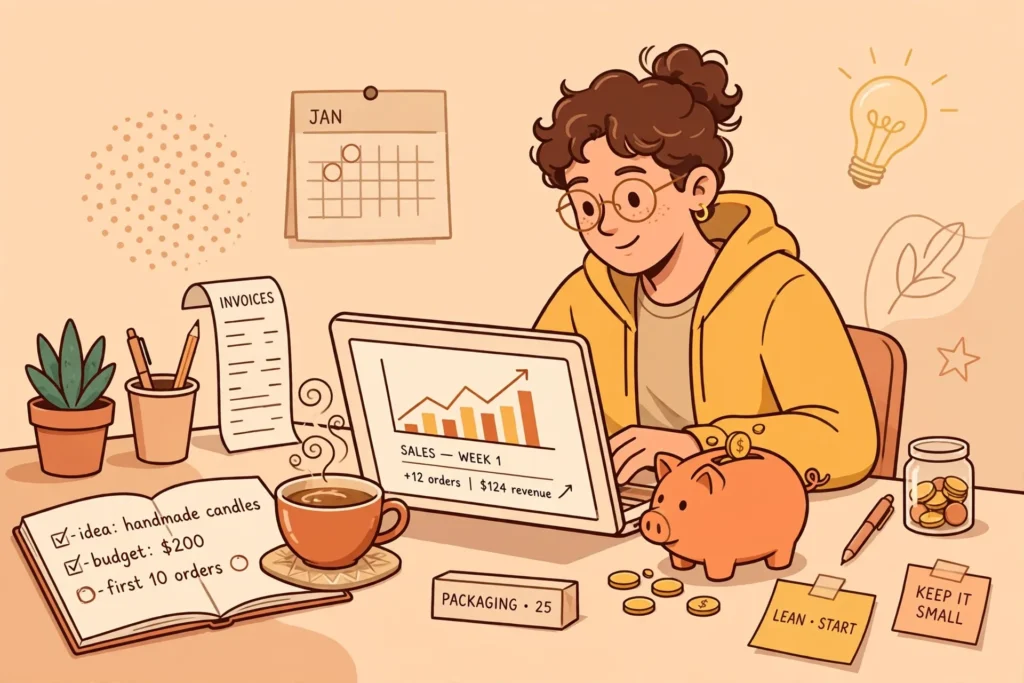
Starting a business with little money is not about finding a magic trick. It is about making a short series of smart, cheap decisions in the right order. How to start a small business on a budget comes down to three moves: pick a service-based or digital business with almost no startup costs, validate demand with pre-sales before you spend a dollar, and reinvest early revenue instead of taking on debt. Most lean businesses launch for under $500 using free tools, and service businesses can reach profitability within 60 to 90 days of consistent outreach.
That is the short answer. The longer answer is a practical playbook: how much you actually need, which business models fit a small budget, what to do in your first 30 days, and which mistakes quietly kill budget startups. Every step below is written for a beginner with more time than money.
Key Takeaways
- You can launch most service businesses for $0 to $500; product businesses usually need $500 to $5,000 for a first small run.
- Validate with paying customers before spending: pre-sales and deposits beat business plans.
- Pick asset-light models (services, digital products, freelancing) and avoid inventory until revenue proves demand.
- Free tools in 2026, including AI assistants, replace thousands of dollars in software and agency fees.
- Delay the LLC and other formal costs until you have consistent revenue, usually after $3,000 to $5,000 in sales.
Table of Contents
- What “on a budget” actually means
- How much money do you really need?
- Choose a business model built for small budgets
- Your first 30 days: a week-by-week launch plan
- Free tools that replace a startup budget in 2026
- Benefits of starting lean
- Challenges and limitations (and how to handle them)
- Real-world examples of budget startups
- Bootstrapping vs outside funding
- Frequently asked questions
- Conclusion
What “on a budget” actually means
“On a budget” does not mean zero dollars, and pretending it does sets you up for frustration. Every business has costs; the question is only what shape they take. As one 2026 playbook puts it honestly, you either pay with money or you pay with time, unpaid labor, and a slower start. A freelance writer spends almost nothing in cash but invests dozens of unpaid hours writing samples and pitching clients. A cleaner might spend $80 on supplies, then knock on forty doors.
For this guide, “on a budget” means launching with $5,000 or less, and ideally under $500. That range covers the vast majority of first-time founders, and it keeps this guide focused on how to start a small business on a budget in the real world, not in theory. It rules out restaurants, physical retail, and manufactured products with inventory, which genuinely need real capital. Everything else, from services to digital products, is on the table.
The budget mindset has one core rule: earn before you spend. Every dollar should chase a customer, not an image. A logo can wait. A fancy website can wait. Your first paying customer cannot.
How much money do you really need?
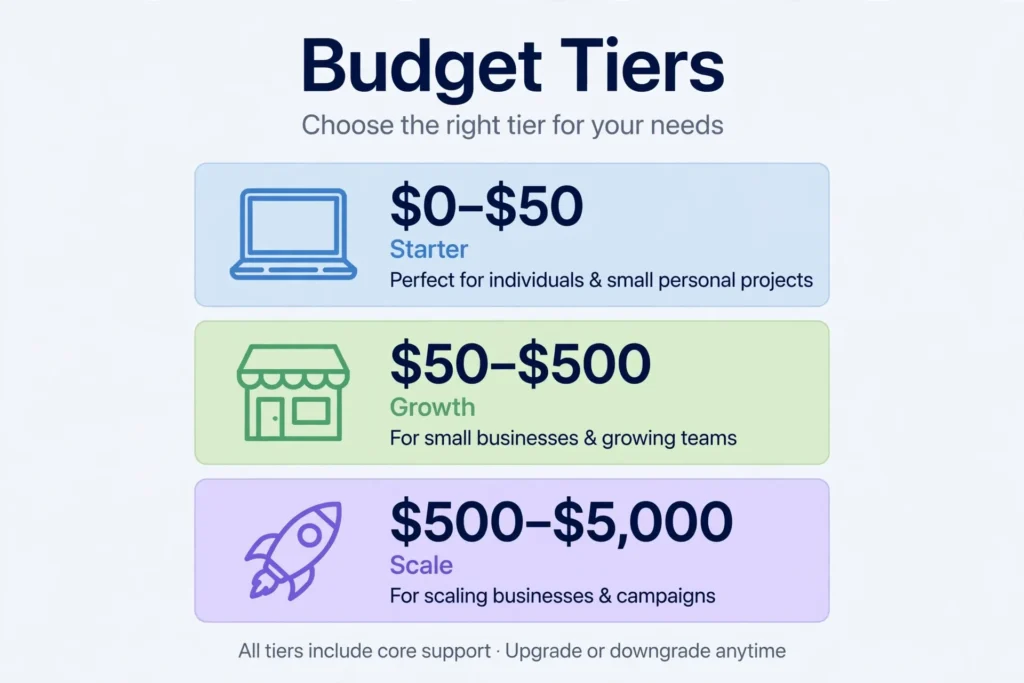
Less than you think, but probably more than zero. Here is a realistic breakdown by budget tier, based on the business models beginners actually start:
| Budget tier | What it covers | Best for |
|---|---|---|
| $0 to $50 | Phone + internet you already have, free tools, social profiles | Freelance writing, virtual assistance, tutoring, consulting |
| $50 to $500 | Basic website or portfolio, domain, simple supplies, local ads | Cleaning, pet care, lawn care, coaching, handmade goods |
| $500 to $5,000 | Small inventory run, better equipment, LLC filing, modest ad test | Print on demand, reselling, small e-commerce, food from home |
Notice what is missing from every tier: office rent, employees, and expensive branding. Those are growth expenses, not launch expenses. When people ask how to start a small business on a budget, this table is the most honest answer: match your model to your cash, then let revenue upgrade the model.
The most useful exercise is to write your own line-item budget before spending anything. List every cost, then cross out everything that does not directly lead to a customer in the first 30 days. Most beginners cut their list in half. That is the entire secret: spend only on what earns.
Choose a business model built for small budgets
Not every business can start cheap. The models below are ranked by how little cash they demand.
Service-based businesses
Services are the cheapest businesses to start because you sell skill and time, not stuff. If you want to know how to start a small business on a budget with the least risk, start here. Freelance writing, graphic design, virtual assistance, tutoring, social media management, cleaning, pet sitting, and lawn care can all launch for under $200. Your “inventory” is your ability, and your storefront is a free profile on a marketplace or social platform. Service businesses also reach profitability fastest, often within 60 to 90 days, because each new client is immediate revenue.
Digital products
Instead of shipping boxes, you ship files. E-books, planners, templates, and short courses cost almost nothing to create and sell repeatedly. Platforms like Gumroad and Etsy handle payments and delivery. Your main investment is the time to make something genuinely useful.
Reselling and flipping
Buy undervalued items at thrift stores or clearance racks, then resell them online for under $100 in startup costs. This model teaches pricing and customer service fast and generates cash quickly. The trade-off: it scales with your hours, so treat it as a cash engine unless you systematize it.
What to avoid at first
Skip inventory, commercial rent, or staff until revenue justifies it. A product brand, cafe, or boutique makes a wonderful second business, but a terrible first one on a budget. For more on picking the right idea, see the business guides on the Voice of Wave homepage.
Your first 30 days: a week-by-week launch plan

Week 1: Validate before you spend
Do not build first. Talk first. This is the step most guides skip, yet it is the heart of how to start a small business on a budget without wasting money. Describe your offer in one paragraph and share it with 20 people who might buy: friends, local groups, online communities. Better yet, build a free one-page site with a “Book Now” or “Pre-Order” button and see if anyone clicks. Your goal is three people saying “I would pay for that” before you spend a dollar. If nobody bites, adjust the offer, not the budget.
Week 2: Set up the minimum viable business
Register only what is legally required where you live (often just a DBA or local permit, usually under $100). Keep business money separate from personal money from day one. Set up free essentials: a Google Business profile, one social account, and a simple way to take payment. Skip the LLC until $3,000 to $5,000 in sales, unless liability risk demands it sooner.
Week 3: Get your first three customers
Forget “marketing strategy.” Do direct outreach: message 10 prospects a day, knock on doors, post in local groups, ask every happy contact for a referral. Offer an founding-customer discount in exchange for a testimonial. Your only metric this week is conversations started. Most budget businesses die from silence, not from competition.
Week 4: Deliver, collect proof, reinvest
Over-deliver for your first customers, then ask for reviews and referrals while the experience is fresh. Put the first revenue straight back into the business: better tools, a small ad test, or materials for the next job. This is the bootstrapping loop, and repeating it is how small budgets become real businesses.
Free tools that replace a startup budget in 2026
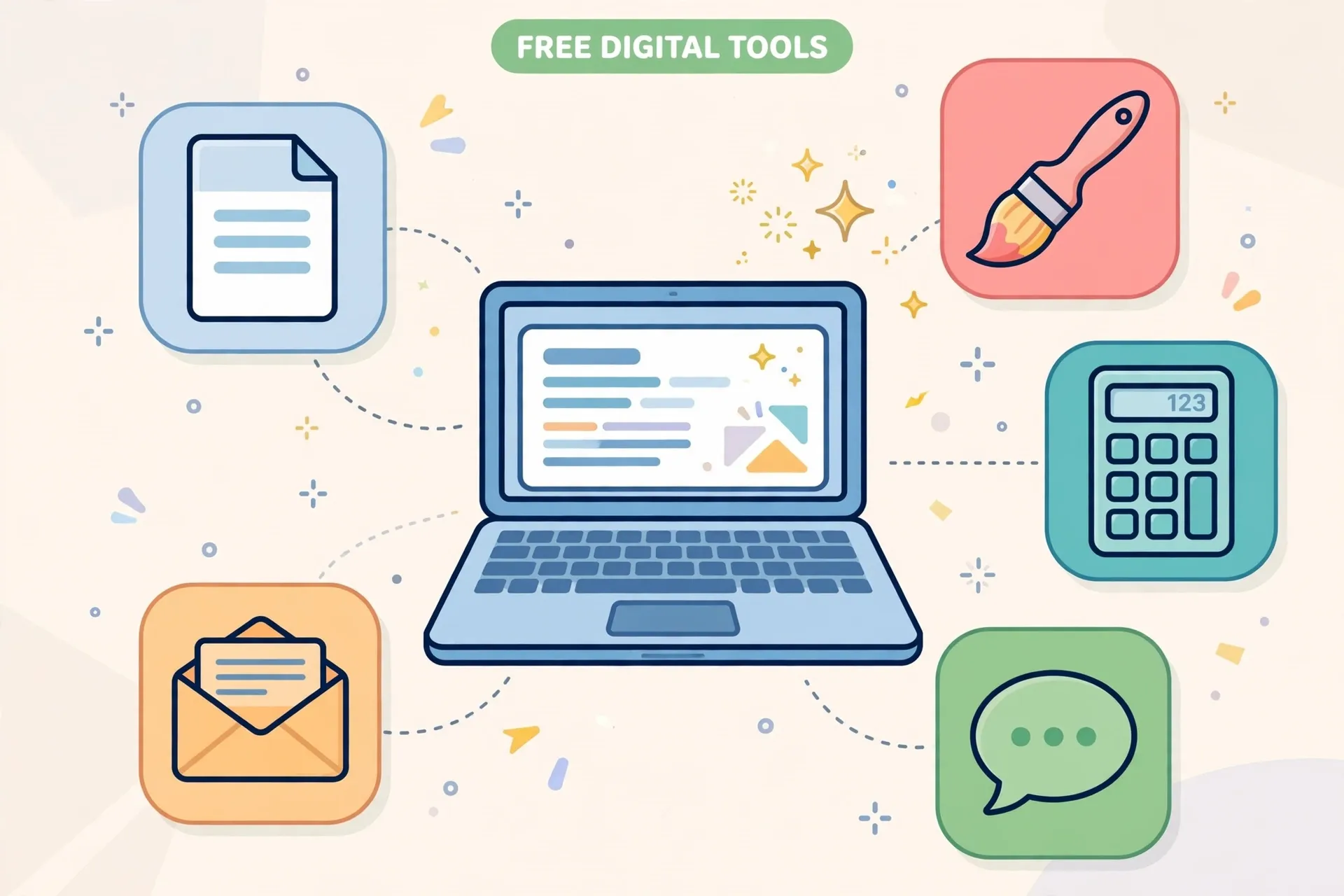
This is the content gap competitors miss. In 2026, free AI and no-cost software replace thousands of dollars in agency and software fees:
- Writing and planning: free AI assistants draft your website copy, emails, and social posts; you edit for accuracy and voice.
- Design: Canva’s free tier covers logos, social graphics, and flyers that once cost hundreds from a designer.
- Bookkeeping: free tiers of accounting apps track income and expenses until you outgrow them.
- Communication: WhatsApp Business, free video-call tools, and free email marketing tiers handle customer contact at zero cost.
- Learning: libraries, free courses, and business podcasts teach marketing, pricing, and operations without tuition.
The rule: use free until a paid tool pays for itself. When a $15-per-month tool saves you five hours a month, buy it. Until then, free wins. Mastering this habit is a quiet superpower for anyone learning how to start a small business on a budget, because every dollar you do not spend on software is a dollar that can chase a customer.
Benefits of starting lean
Starting with little money is not just a constraint; it is an advantage. A small budget forces you to talk to customers instead of hiding behind a fancy launch. Anyone studying how to start a small business on a budget should see the constraint as a teacher: it keeps your financial risk tiny. Lean founders learn pricing, selling, and operations personally, which sharpens every later decision. And with no investor watching, you keep full control and can pivot in a day. Many founders say the lean years taught them more than any funding round could.
Challenges and limitations (and how to handle them)
Honesty matters here. A small budget brings real constraints:
Time becomes your currency. With no money for ads or staff, you trade hours for growth. Protect your energy: work in focused blocks and automate repetitive tasks early, even with free tools.
Some doors stay closed. You cannot open a restaurant or stock a retail shelf on $500. Accept the constraint and pick a model that fits, rather than resenting it.
Credibility takes longer. Big clients may hesitate with a one-person operation. Counter it with proof: testimonials, a clean portfolio, and fast communication beat a fancy office every time.
Cash flow is fragile. One slow month hurts when reserves are thin, which is why how to start a small business on a budget always includes a cash-flow warning. Keep personal expenses low, maintain a small emergency buffer, and never commit to fixed costs (leases, subscriptions, salaries) until revenue is steady.
Burnout risk is real. Doing everything yourself is exhausting. The fix is not hiring; it is ruthless prioritization. Each week, identify the single task that most directly leads to revenue and do that first.
Real-world examples of budget startups
Consider the freelance writer who figured out how to start a small business on a budget with nothing but a laptop: she pitched 50 blogs, landed three retainer clients in two months, and now earns more than her old salary. Or the cleaner who spent $90 on supplies and filled a weekly route in six weeks purely on referrals. None raised money. All followed the same loop: validate, launch lean, deliver well, reinvest.
Bootstrapping vs outside funding
Bootstrapping means funding the business yourself, through savings and early revenue: total control, no debt, forced discipline, but slower growth. Outside funding (loans, investors, grants) buys speed but costs control, interest, or equity, and is rarely available to unproven beginners anyway. For a first business on a budget, bootstrapping wins by default. It teaches the exact skills (selling, budgeting, prioritizing) that make a founder dangerous later.
Frequently asked questions
What is the cheapest business to start?
Service businesses are cheapest because they need almost no equipment. Freelance writing, virtual assistance, tutoring, cleaning, pet care, and social media management typically launch for $0 to $200. You sell skill and time, so the main investment is outreach effort, not cash. Pick the service closest to skills you already have to start earning fastest.
Can I really start a business with no money?
Mostly yes, with a caveat. Pure-service businesses can start at true zero using free tools and sweat equity, but expect to trade significant time for traction. Small unavoidable costs (a domain, supplies, transport) usually appear, so plan for $50 to $100 even in the leanest case. Anyone promising literal zero forever is selling something.
How long until a budget business becomes profitable?
Service businesses with consistent outreach often profit within 60 to 90 days. Digital products and content-based models take longer, typically 6 to 18 months, because they need audience building first. Speed depends less on budget and more on how quickly you start real sales conversations. Daily outreach compresses every timeline.
Do I need a business plan to start on a budget?
Not a 40-page document. A one-page plan answering four questions is enough: what are you selling, who is buying, how does money come in, and what are your 90-day goals. This prevents the most common early mistakes without wasting weeks on paperwork. Formal plans matter later, when seeking loans or partners.
Should I form an LLC right away?
Usually not. In most US states, you can operate as a sole proprietor under your own name or a low-cost DBA registration (often under $100). Form the LLC after $3,000 to $5,000 in consistent sales, when liability protection and tax options justify the state fees. Check your local rules, since requirements vary by place.
What is the biggest mistake budget founders make?
Spending on image before income: logos, premium websites, business cards, and office decor before the first customer. Every dollar spent pre-revenue should be traceable to a customer conversation. The second biggest mistake is waiting to feel ready. Launching small and adjusting beats planning forever.
Conclusion
Learning how to start a small business on a budget is really learning how to start smart. Pick an asset-light model, validate with paying customers before you spend, use the remarkable free tools available in 2026, and reinvest every early dollar into growth. The founders who win on small budgets are not the ones with the best ideas; they are the ones who start conversations fastest and waste the least. Your budget is smaller than you want, but it is bigger than you need. Start this week, with what you have, where you are, and let your first customers fund the rest of the journey.