

A gutter system moves rainwater from the roof to the ground and away from the foundation. Gutter cleaning tips work when they follow a clear order: clear dry debris by hand, flush the trough with a hose, test each downspout, and fix slope or sagging before the next rain. A clogged gutter sends water over the edge, down the walls, and into soil next to the foundation. That overflow can stain siding, rot fascia boards, and soak the ground where a basement or crawl space sits. Clean gutters protect the roof edge, the walls, and the foundation with one routine job done twice a year. The job needs a ladder, gloves, a scoop, a bucket, and a hose. It also needs a plan for safety, for downspouts, and for the seasons. This guide gives that plan in plain steps, with costs, tools, and a calendar you can follow.
Key Takeaways
- Clean gutters at least twice a year, in late spring and in late fall, and add a check after each major storm.
- Scoop dry debris first, then flush with a hose toward the downspout, and watch the downspout exit to prove the pipe is clear.
- Set the ladder at a 4-to-1 angle, keep three points of contact, and never lean the ladder on the gutter.
- Gutters need a slope of 1/4 inch per 10 feet toward the downspout, and downspouts need to send water at least 5 feet from the foundation.
- Gutter guards cut cleaning frequency but do not end cleaning, and a pro visit costs $119 to $234 in the United States, based on Angi cost data updated August 5, 2026.
- Standing water after a flush means a slope or sagging problem, not a debris problem.
Table of Contents
- Why Do Clogged Gutters Damage a Home?
- How Often Should You Clean Your Gutters?
- What Tools Do You Need to Clean Gutters?
- How to Clean Gutters Safely, Step by Step
- How Do You Unclog a Downspout?
- Gutter Guards vs Regular Cleaning: Which Wins?
- DIY vs Professional Gutter Cleaning: Which Fits Your Home?
- What Is the Best Seasonal Gutter Cleaning Calendar?
- 7 Signs Your Gutters Need Cleaning Now
- Conclusion
- FAQs

Why Do Clogged Gutters Damage a Home?
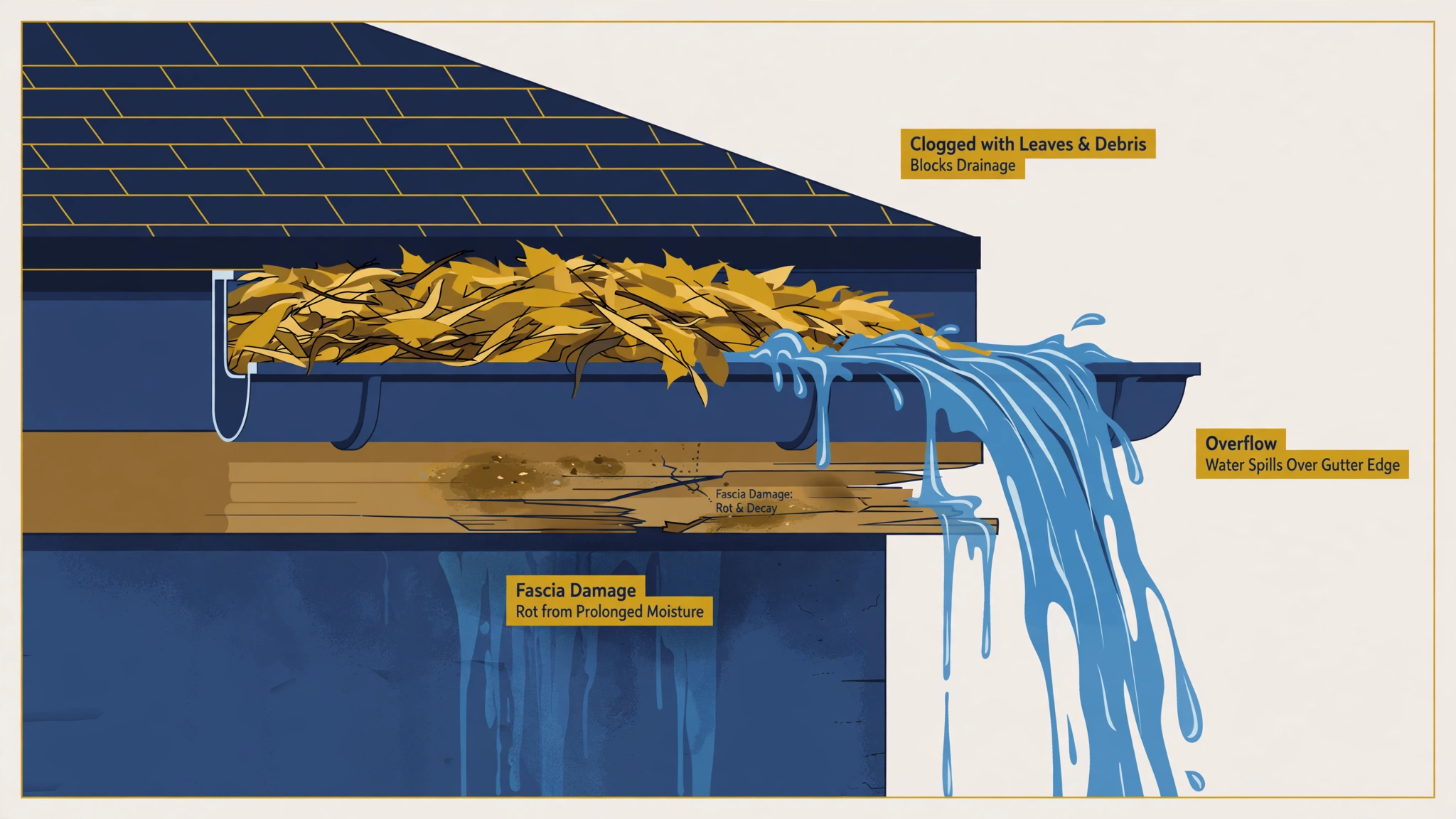
Clogged gutters damage a home because trapped water overflows the trough, soaks the fascia boards, runs down the walls, and pools in the soil next to the foundation. A gutter holds only a small volume of water. Leaves, twigs, pine needles, seed pods, and shingle grit fill that volume fast. Rain then has no path to the downspout. Water spills over the front edge and the back edge at the same time. The back spill soaks the fascia board and the roof edge. The front spill erodes soil, splashes siding, and wets walkways.
A 2025 This Old House survey of 1,000 homeowners found the most common debris in gutters was leaves, reported by nearly 85% of respondents, followed by dirt or dust at about 44%, insect debris at roughly 41%, pine needles at about 31%, and pine cones at nearly 25%. Source: This Old House (2025). Wet leaves pack into a mat that holds water and adds weight. A full trough can pull hangers loose and bend the gutter out of shape. Sagging then creates a low spot where water pools, and the pool grows the next clog.
Stagnant water brings more problems. Mosquitoes breed in still water, and damp debris feeds mold growth on nearby wood. In cold weather, trapped water freezes into ice. Ice adds weight and can lift shingles at the roof edge. A clean gutter avoids each of these chains. Water enters the trough, runs to the downspout, and leaves the house. For more home care ideas in this category, browse the Home Improvement section.
How Often Should You Clean Your Gutters?
Clean your gutters at least twice a year, once in late spring and once in late fall, and add a third or fourth cleaning if tall trees hang over the roof. Late spring cleaning clears seeds, blossoms, pollen, and shingle grit left by winter. Late fall cleaning clears fallen leaves before the first hard freeze. Homes with few trees or no trees near the house can hold to the twice a year plan. Homes under maple, oak, or pine trees need more checks. Pine needles fall all year, and maple seeds drop in spring in large numbers.
Use this table to set your own frequency. Tree cover and storms decide the number, not the calendar alone.
| Your situation | Recommended cleaning frequency |
|---|---|
| Few or no trees near the house, simple roofline | Twice a year, spring and late fall |
| One or two large trees over the roof | 3 times a year, spring, mid summer, late fall |
| Heavy tree cover, pine trees, or large oaks | 4 times a year, once per season |
| Frequent severe storms or high winds | Twice a year minimum, plus an inspection after each major storm |
| Gutter guards installed | Once a year, plus a check after leaf fall |
A storm check takes 10 minutes from the ground. Look for overflow stains on the siding, water spilling over the edge during rain, and plants growing from the trough. Each sign means debris has built up since the last cleaning. Do not wait for the next scheduled date when you see these signs.
What Tools Do You Need to Clean Gutters?
You need a sturdy ladder, work gloves, safety glasses, a bucket, a gutter scoop or garden trowel, and a garden hose with an adjustable nozzle. That set covers a standard single story cleaning from a ladder. Add a ladder stabilizer, also called a standoff, to keep the ladder off the gutter and to widen the base of support. Add a tarp to catch debris and to protect the lawn below the work area. Add a plumber’s snake for downspout clogs that a hose cannot move.
Ground level tools suit homes where ladder work feels unsafe. A telescopic gutter cleaning wand attaches to a garden hose and reaches the trough from the ground. A wet/dry vacuum with a curved gutter attachment pulls dry leaves out without a ladder. A leaf blower with a gutter nozzle blows dry debris out of the trough. Each ground tool works best on dry, loose debris. Wet, packed debris still needs hand scooping. A plastic scoop beats a metal trowel for this job, because metal can gouge the gutter coating and invite rust.
How to Clean Gutters Safely, Step by Step
To clean gutters safely, set the ladder at a 4-to-1 angle, scoop debris by hand into a bucket, flush the trough with a hose toward the downspout, and test each downspout until water runs free. Safety comes first, because the ladder is the riskiest part of the job. The CDC National Institute for Occupational Safety and Health (NIOSH) reports that a ladder sliding out at the base, because it was set at the wrong angle, is the cause in about 40% of ladder injury cases. Source: CDC NIOSH, cited in 2026 gutter safety guides. The 4-to-1 rule fixes the angle: for every 4 feet of ladder height, the base sits 1 foot out from the wall. OSHA ladder standard 29 CFR 1926.1053 sets the same angle for non self supporting ladders. Source: OSHA (29 CFR 1926.1053).
Follow these 7 steps in order.
- Pick a dry, calm day and tell someone your plan, then set the ladder on firm, level ground.
- Extend the ladder rails at least 3 feet above the gutter line so you have a handhold at the top.
- Wear gloves and safety glasses, hook the bucket to the ladder, and spread a tarp below.
- Scoop debris by hand or with a plastic scoop, starting near the downspout and working away from it.
- Remove the downspout strainer or basket, clean it, and set it aside for the flush test.
- Flush the trough with a hose, starting at the end farthest from the downspout and working toward it.
- Watch the downspout exit, check the slope, and note any leaks, sagging, or loose hangers.
Keep three points of contact on the ladder at all times, with both feet and one hand, or both hands and one foot, on the rails. Keep your belt buckle between the rails and never lean out sideways to reach farther. Climb down and move the ladder instead. Never rest the ladder on the gutter, because the gutter is not structural and the weight can dent the trough or pull it from the fascia. Use a stabilizer that spans the gutter and rests on the wall or roof edge. Never work in wind, on wet rungs, or from the roof itself unless you have the training and gear for roof work. For two story homes where you cannot set a ladder safely, hire a pro.
A rain gutter is a channel that carries roof water to a downspout and away from the walls and foundation, and its design decides how much rain it can move at once. Read the rain gutter page on Wikipedia for the parts, materials, and profiles used in home gutter systems.

How Do You Unclog a Downspout?
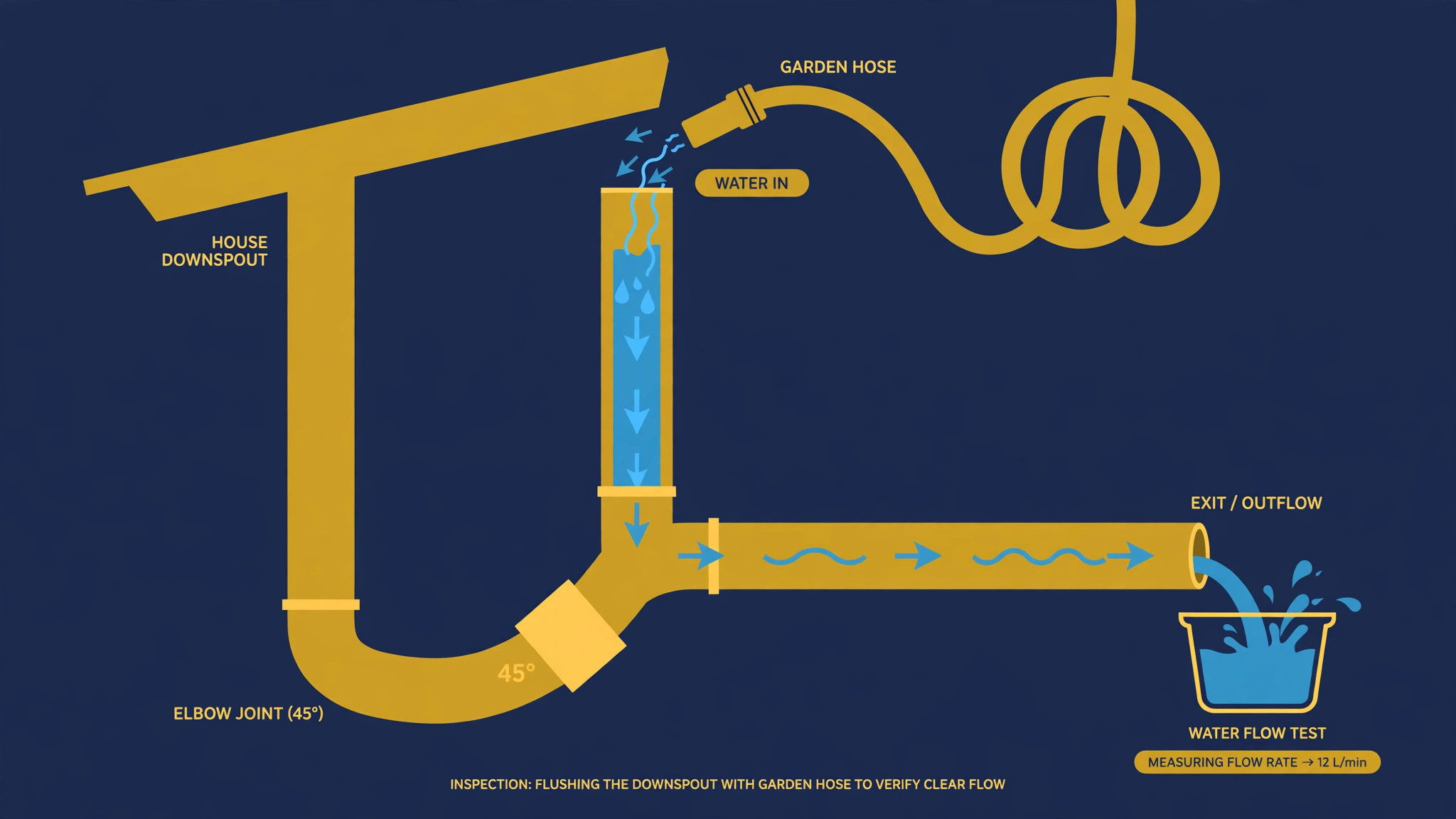
You unclog a downspout by flushing it with a hose at full pressure, then feeding a plumber’s snake through the clog, and then removing the elbow if the clog still holds. Start with the flush test. Run the hose into the top of the downspout. A clear downspout gushes from the bottom like a faucet. A trickle or a backup means a clog sits in the pipe, most often in an elbow bend. Elbows trap twigs, leaves, pine needles, and roof grit in tight bends, and you cannot see inside them from the ground.
Use this diagnostic table to read what the water tells you.
| What you see during the flush test | What it means | What to do |
|---|---|---|
| Water gushes freely from the bottom | Downspout is clear | Move to the next downspout |
| Water trickles or backs up into the trough | Clog in the downspout or elbow | Flush at full pressure, then use a plumber’s snake |
| Water pools in the trough after flushing | Slope or sagging problem | Check slope at 1/4 inch per 10 feet and check hangers |
| Water leaks at a seam or joint | Failed seal or loose joint | Dry the joint, reseal with gutter sealant, or replace the section |
| Water spills over the front edge in rain | Trough still holds debris or the run is too long for one downspout | Re-scoop the trough, then check downspout count and size |
Feed the snake from the top or from the bottom, and work it with short, gentle turns. Do not force a pressure nozzle into a clogged pipe, because a split seam costs more to fix than a clog. If the snake does not free the clog, remove the elbow screws and clear the bend by hand. Rinse the elbow parts before you refit them. Check the bottom outlet too. A splash block or extension that sits in soil or mulch can block the exit and send water back up the pipe. The University of Nebraska Extension recommends extending downspouts at least 5 feet from building foundations to help avoid water seepage into basements. Source: University of Nebraska Extension, cited in 2026 gutter guides.
A downspout is a pipe that carries rainwater from a rain gutter to the ground, and its bottom bend decides where that water lands. Read the downspout page on Wikipedia for the parts and discharge options used at the base of a home.
Gutter Guards vs Regular Cleaning: Which Wins?
Gutter guards win on cleaning frequency, and regular cleaning wins on cost, so the right choice depends on tree cover, budget, and how often you want to climb a ladder. A gutter guard is a screen, mesh, foam insert, brush, or solid cover that sits on or in the trough. Guards let water in and keep most debris out. Micro mesh guards block the smallest debris, including pine needles and shingle grit. Screen guards block leaves and twigs. Foam and brush guards are cheap and easy to fit, but foam pores clog and brush guards still trap fine debris. Reverse curve guards use surface tension to guide water in while leaves fall off the edge.
Guards do not end cleaning. Fine grit, seeds, and pollen still pass through or sit on top of the guard. A guard system still needs an annual inspection and a light cleaning. Compare the two paths in this table before you buy.
| Factor | Regular cleaning only | Gutter guards plus annual check |
|---|---|---|
| Cleaning frequency | 2 to 4 times a year | Once a year, plus a check after leaf fall |
| Upfront cost | $35 to $65 for basic DIY supplies | $250 to $900 for DIY micro mesh on a standard home |
| Professional cost | $119 to $234 per visit, Angi data updated August 5, 2026 | $1,200 to $1,600 for a pro install on a 200 foot home, Angi data |
| Time per year | 4 to 16 hours of DIY work | 1 to 2 hours of inspection and light cleaning |
| Best for | Homes with few trees, tight budgets, hands on owners | Homes under heavy trees, busy owners, two story homes |
| Weak point | Missed cleanings cause clogs fast | Upfront cost takes years to pay back from cleaning savings alone |
Angi reports that guards can reduce cleaning costs, sometimes by up to 50%, and that many homeowners go from several cleanings a year to once a year or less. Source: Angi (2026). At the Angi national average of $168 per pro visit, a home that drops from two cleanings a year to one saves about $168 a year. A $1,200 to $1,600 pro guard install then takes about 7 to 9.5 years to pay back from cleaning savings alone. DIY guards pay back faster, often in 1 to 2 seasons, because the material cost is lower.
Read the roof care guide on roof repair signs to spot roof damage early while you inspect your gutters.
DIY vs Professional Gutter Cleaning: Which Fits Your Home?
DIY gutter cleaning fits a single story home with safe ladder access, and professional cleaning fits a two story home, a steep roof, or any home where ladder work feels unsafe. DIY costs little when you already own a ladder. A basic DIY kit runs $50 to $120 upfront, including gloves, a scoop, and a hose attachment, based on 2026 cost guides. If you already own a ladder, DIY supplies cost under $50. A pro visit costs $119 to $234 in the United States, with a national average of $168, based on Angi cost data updated August 5, 2026. Source: Angi (2026). Two cleanings a year at that range cost $238 to $468 a year.
Time and risk decide the rest. DIY cleaning takes 2 to 4 hours for a typical single story home, and 4 to 6 hours for a two story home. A pro crew takes 45 minutes to 3 hours on site, and your time is zero. A pro also spots roof damage, loose hangers, and failed seals while cleaning, and carries insurance for the work.
| Factor | DIY cleaning | Professional cleaning |
|---|---|---|
| Cost per cleaning | $0 to $15 in supplies after the first kit | $119 to $234 per visit, $168 national average |
| Time per cleaning | 2 to 4 hours, single story | 45 minutes to 3 hours on site, zero owner time |
| Safety risk | Ladder fall risk, borne by the owner | No ladder risk to the owner |
| Inspection value | Depends on owner skill | Pro spots roof, hanger, and seal faults |
| Best for | Single story, safe ladder access, hands on owners | Two story, steep roof, heavy tree cover, limited mobility |
Hire a pro when the roof is steep, the home is two stories or taller, the gutters show sagging or detachment, or you feel unsure on a ladder. A pro visit is a small cost next to a fascia repair or a foundation leak. Voice of Wave covers home care topics like this one, with plain guides for everyday maintenance tasks.

What Is the Best Seasonal Gutter Cleaning Calendar?
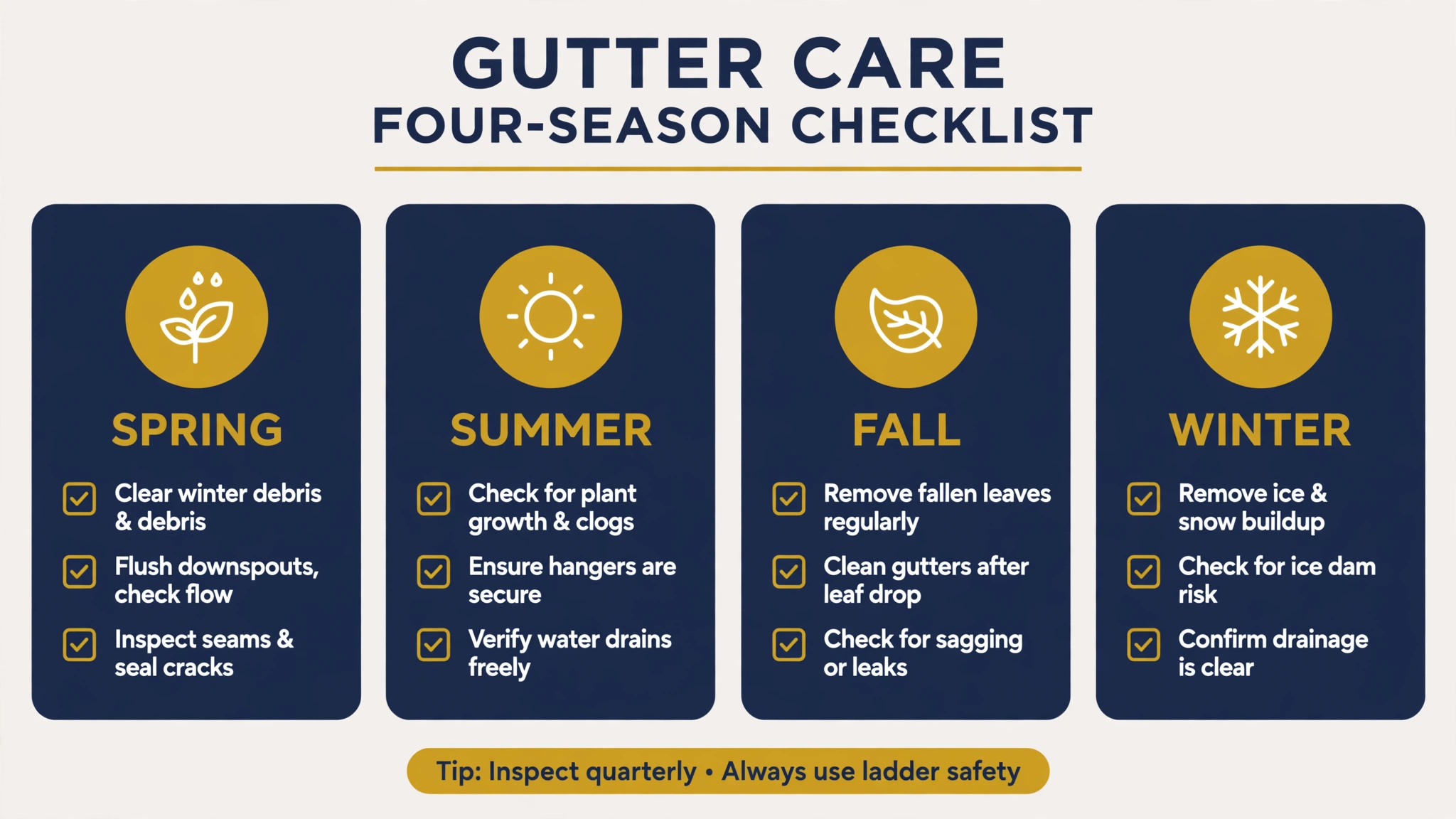
The best seasonal gutter cleaning calendar pairs a full cleaning in late spring and late fall with a light check in summer and a freeze check in winter. Each season brings a different type of debris. Spring brings seeds and blossoms. Summer brings nests and plant growth. Fall brings leaves in bulk. Winter brings ice and snow load. A calendar that matches the season stops each type before it becomes a clog.
| Season | Main task | Time needed |
|---|---|---|
| Spring, late spring | Full cleaning, clear seeds, pollen, and shingle grit, check slope and hangers | 2 to 4 hours |
| Summer | Ground check for nests, plant growth, and overflow stains, trim overhanging branches | 30 minutes |
| Fall, late fall | Full cleaning after most leaves drop, flush and test every downspout | 2 to 4 hours |
| Winter | Ground check for ice buildup, icicles at the edge, and sagging under snow load | 15 minutes |
| After each major storm | Ground inspection for overflow, detached sections, and blocked downspout exits | 10 minutes |
Trim trees that overhang the roof as part of the summer check. A branch that hangs over the trough drops leaves straight into it and rubs the roof in wind. Cut the branch back to the trunk or to a side branch, and keep the cut clear of power lines. If a branch touches a power line, call the utility or a tree service.
Winter needs care with ice. Never chip ice out of a gutter with a metal tool, because the tool can crack the trough or lift the seal at a joint. Let the ice melt, then clear the debris that the melt reveals.
7 Signs Your Gutters Need Cleaning Now
Your gutters need cleaning now when water spills over the edge in rain, plants grow in the trough, or pests gather near the roofline. Do not wait for the next scheduled date when you see any of these 7 signs.
- Water spills over the front edge during rain, even in light rain.
- Water stains or streaks run down the siding below the gutter line.
- Plants, grass, or small weeds grow from debris in the trough.
- Birds, wasps, or mosquitoes gather near the gutters or roofline.
- The gutter sags, pulls away from the fascia, or shows a visible dip in the middle.
- Water pools near the foundation after rain, or the basement smells damp after storms.
- Peeling paint, rust spots, or soft wood appear on the fascia boards or soffits.
Each sign points to a different fault. Overflow points to a clog. Sagging points to weight or loose hangers. Peeling paint points to water soaking the wood. A damp basement smell after rain points to downspouts that end too close to the house. Fix the cause, not just the sign. Scoop the trough, test the downspout, check the slope, and extend the downspout exit to at least 5 feet from the foundation.
A first hand note from the field: the worst clogs I have seen sat at the downspout elbow, not in the open trough. The trough looked clear from the ground, but the elbow held a packed plug of wet leaves and grit. The flush test found it in seconds, because water backed up into the trough at once. Check the elbow first when water backs up, and you will save an hour of re-scooping a clean trough.
Conclusion
Gutter cleaning tips work as a system: clean twice a year, scoop before you flush, test each downspout, fix slope and sagging, and check the gutters after each storm. A clog-free gutter system needs no fancy gear. It needs a ladder set at the right angle, a scoop, a bucket, a hose, and a routine you keep. Spring and fall cleanings clear the bulk of the debris. Gutter guards help homes under heavy trees, and a pro helps homes where ladder work is unsafe. The cost of a pro visit, $119 to $234 based on Angi data updated August 5, 2026, is small next to a fascia repair or a foundation leak.
Explore the latest home and living guides on the Voice of Wave blog and find your next maintenance project.
FAQs
How often should I clean my gutters?
Clean your gutters at least twice a year, once in late spring and once in late fall. Homes under tall trees need 3 to 4 cleanings a year. Add a ground inspection after each major storm. A storm check takes 10 minutes and catches clogs before the next rain.
Can I clean my gutters without a ladder?
Yes, you can clean gutters from the ground with a telescopic hose wand, a wet/dry vacuum with a curved attachment, or a leaf blower with a gutter nozzle. Ground tools work best on dry, loose debris. Wet, packed debris still needs hand scooping from a ladder or a pro visit.
How do I know if my downspout is clogged?
Run a hose into the top of the downspout and watch the bottom exit. A clear downspout gushes like a faucet. A trickle or a backup means a clog, most often in an elbow bend. Flush at full pressure, feed a plumber’s snake through the clog, or remove the elbow and clear it by hand.
Do gutter guards mean I never need to clean my gutters?
No, gutter guards do not end cleaning. Guards block most leaves but fine grit, seeds, and pollen still pass through or sit on the guard. A guard system still needs an annual inspection and a light cleaning. Angi reports guards can cut cleaning costs by up to 50% in 2026.
How much does professional gutter cleaning cost?
Professional gutter cleaning costs $119 to $234 per visit in the United States, with a national average of $168, based on Angi cost data updated August 5, 2026. Two cleanings a year cost $238 to $468. Price varies with home height, gutter length, and debris level.
What is the correct slope for gutters?
Gutters need a slope of 1/4 inch per 10 feet toward the downspout. Standing water after a flush means the slope is wrong or the gutter sags. Check the hangers, tighten loose screws, and refit the run to restore the slope. Severe sagging may need a section replaced.