

Urgent dental care is the fast treatment of a tooth or mouth problem that cannot wait for a routine visit, and it covers severe pain, a knocked-out tooth, a broken tooth, uncontrolled bleeding, and swelling that threatens breathing. The right first step is to call a dentist at once, control bleeding and pain with the steps in this guide, and reach care within 30 minutes for a knocked-out permanent tooth. This guide explains what counts as an emergency, what to do first, how to save a knocked-out tooth, how to handle toothache and swelling, what to do for a broken tooth or lost crown, where to go, what a visit costs, and how to prevent the next emergency. It also gives a first-aid kit list and a cost comparison so you can act fast instead of searching while in pain.
Key Takeaways
- Urgent dental care covers same-day problems: severe pain, a knocked-out tooth, heavy bleeding, and swelling that affects breathing or swallowing.
- A knocked-out permanent tooth survives best when it returns to its socket within 15 to 30 minutes.
- Call a dentist first for tooth problems; use the emergency room only for breathing trouble, heavy bleeding, or a facial fracture.
- Never put aspirin on a gum, never drain an abscess yourself, and never replant a knocked-out baby tooth.
- Keep a dental first-aid kit at home: gauze, saline, a lidded container, a cold pack, and your dentist’s number.
Table of Contents
- What Is Urgent Dental Care?
- What Counts as a Dental Emergency?
- What Should You Do First in a Dental Emergency?
- How Do You Save a Knocked-Out Tooth?
- What Should You Do for Severe Toothache and Swelling?
- What Should You Do for a Broken Tooth, a Lost Filling, or a Lost Crown?
- Urgent Dental Care vs Emergency Room: Where Should You Go?
- What Happens at an Urgent Dental Visit?
- How Much Does Urgent Dental Care Cost?
- How Can You Prevent the Next Dental Emergency?
- Conclusion

What Is Urgent Dental Care?
Urgent dental care is same-day dental treatment for a tooth or mouth problem that needs fast action to stop pain, stop bleeding, save a tooth, or stop an infection from spreading. Urgent dental care sits between a routine checkup and a hospital emergency, and it handles problems that cannot wait days for the next open appointment. A dental emergency is an issue involving the teeth and supporting tissues that needs treatment by a dental professional, and pain is the most common signal that something needs to be looked at.
Urgent dental care has 4 parts. Triage sorts the problem into go now, same day, or routine. Pain control uses cold compresses, rinses, and pain relievers taken as directed. Stabilization covers a temporary filling, a splint, a drained abscess, or a replanted tooth. A follow-up plan sets the permanent fix, such as a crown, a root canal, or an extraction.
Urgent dental care differs from routine dentistry in speed, goal, and scope: same-day slots and after-hours phone lines, relief and protection first with the permanent fix later, and one problem treated per visit. Browse the Health category on Voice of Wave for more guides on everyday health topics.
What Counts as a Dental Emergency?
A dental emergency is a tooth or mouth problem that needs same-day care because it threatens a tooth, causes severe pain, bleeds without stopping, or risks spreading infection. Not every tooth problem is an emergency, and sorting the problem correctly saves time, money, and teeth. Use the table below to sort your symptoms before you call.
| Situation | Urgency | Where to go |
|---|---|---|
| Swelling that affects breathing or swallowing | Go now | Emergency room |
| Bleeding that will not stop after 15 to 20 minutes of pressure | Go now | Emergency room or dentist |
| Broken jaw or facial bones | Go now | Emergency room |
| Knocked-out permanent tooth | Same day, within 30 minutes | Dentist |
| Severe toothache not eased by pain relievers | Same day | Dentist |
| Abscess with fever, pus, or spreading swelling | Same day | Dentist |
| Broken tooth with a sharp edge or exposed nerve | Same day | Dentist |
| Lost filling or lost crown without pain | Within 2 to 3 days | Dentist |
| Small chip with no pain | Routine visit | Dentist |
| Mild sensitivity to hot or cold | Routine visit | Dentist |
Severe toothache counts as an emergency when pain keeps you awake, stops you eating, or does not ease with a pain reliever taken as directed. Swelling counts as an emergency when it spreads toward the eye, down the neck, or under the tongue. An abscess will not heal on its own. Call 911 or go to the emergency room when breathing or swallowing is affected, since that is a medical emergency, not only a dental one.

What Should You Do First in a Dental Emergency?
The first step in a dental emergency is to stay calm, call your dentist, and start first aid while you wait for care. Most dentists keep emergency slots each day, and many list an after-hours number on their voicemail. Follow these 7 steps in order:
- Call your dentist and describe the problem in plain words.
- Rinse your mouth gently with warm salt water.
- Apply clean gauze with firm pressure to bleeding for 15 to 20 minutes.
- Hold a cold compress on the outside of your cheek for 15 to 20 minutes.
- Take a pain reliever as directed on the label, if it is safe for you.
- Save any tooth pieces, a lost crown, or a knocked-out tooth.
- Avoid chewing on the hurt side and skip very hot, cold, hard, or sticky food.
Do not put aspirin or any painkiller directly on the gum or tooth, because it burns the gum tissue. Do not use heat on a swollen face, because heat can worsen swelling. Do not try to pull a loose tooth or drain a swelling yourself. If you have no dentist, call an urgent dental clinic or your local urgent care center, and ask for the nearest dentist who takes emergency cases.
How Do You Save a Knocked-Out Tooth?
A knocked-out permanent tooth can be saved when it goes back in its socket fast, and replantation within 15 minutes gives the best chance of success. More than 5 million teeth are knocked out each year in the United States (Source: Wikipedia, Dental avulsion, 2026). A knocked-out tooth is called a dental avulsion, and dental avulsion is the complete displacement of a tooth from its socket after trauma such as a fall, a sports injury, or a road accident.
Follow these steps the moment a permanent tooth comes out:
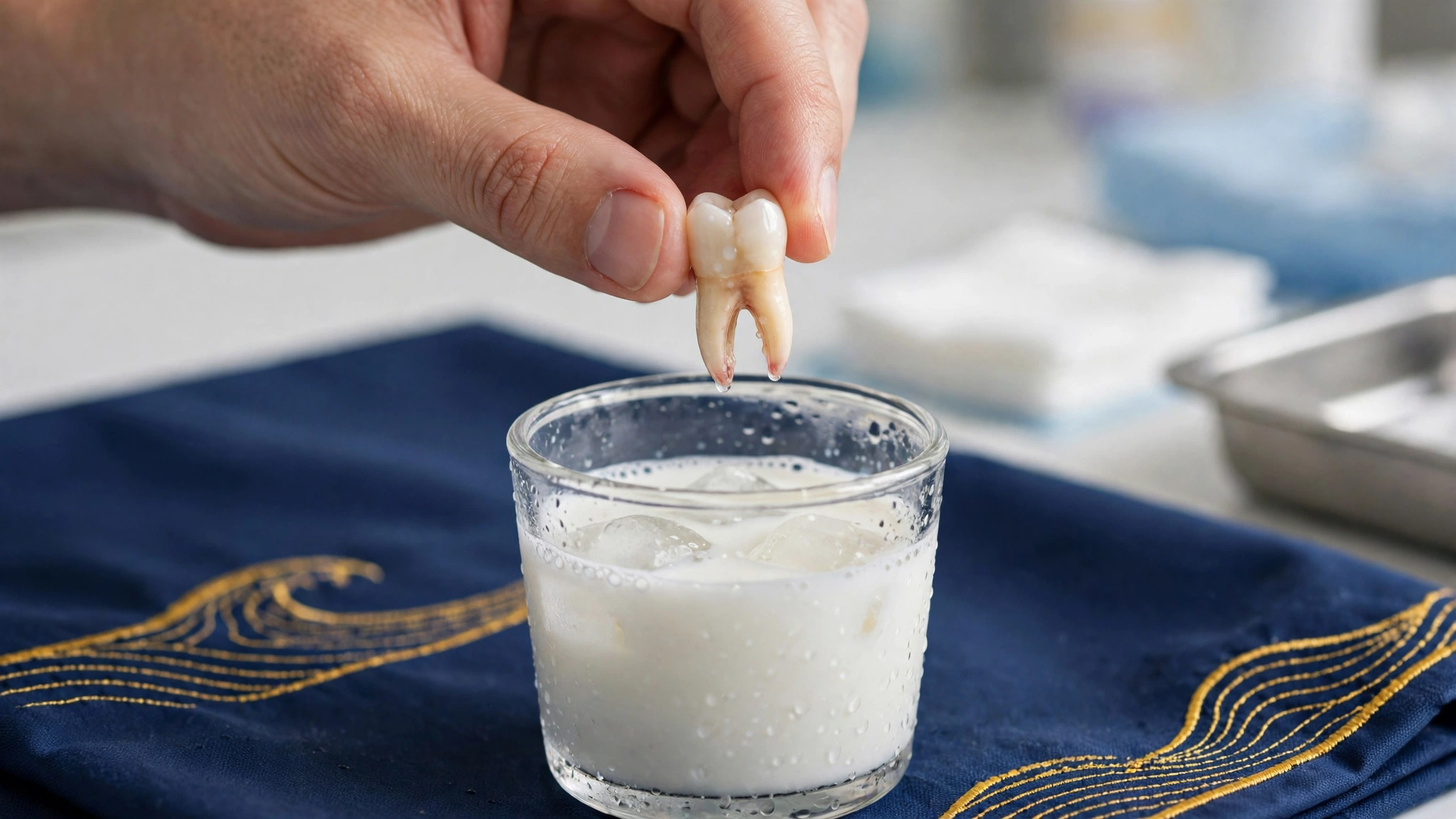
- Find the tooth and pick it up by the crown, the white chewing part, never by the root.
- Rinse it briefly with milk or clean water if it is dirty, and do not scrub it.
- Push it gently back into the socket and hold it with clean gauze.
- If it will not go back in, store it in cold milk, in saliva inside the cheek, or in a tooth preservation kit.
- See a dentist within 30 minutes if possible, and do not let the tooth dry out.
The clock matters. Replantation within 15 minutes is linked to the best prognosis, because the periodontal ligament cells on the root are still alive. Total extra-oral dry time of more than 60 minutes, no matter the storage medium, has a poor prognosis (Source: Wikipedia, Dental avulsion, 2026). Use the timeline below to judge your window.
| Time since the tooth came out | What to do | Chance of saving the tooth |
|---|---|---|
| 0 to 15 minutes | Replant at once or store in milk | Best |
| 15 to 30 minutes | Replant or store in milk, reach a dentist | Good |
| 30 to 60 minutes | Store in milk, reach a dentist at once | Falling |
| After 60 minutes dry | Still see a dentist, but the outlook is poor | Poor |
Baby teeth follow the opposite rule: never put a knocked-out baby tooth back in, because it can damage the permanent tooth growing below it. Take the child to a dentist as soon as you can, and bring the tooth with you. The International Association of Dental Traumatology (IADT) 2020 guidelines state that immediate replantation at the place of the accident is the best treatment for an avulsed permanent tooth (Source: IADT, 2020). I keep a small dental first-aid kit in my bathroom cabinet with gauze, a lidded container, and my dentist’s number on a card, because the first minutes after a fall leave no time to search for supplies.
What Should You Do for Severe Toothache and Swelling?
Severe toothache and swelling need a same-day dentist visit, and first aid at home only buys time until that visit. Toothache has 4 common causes: deep decay, a cracked tooth, gum infection, and a dental abscess. An abscess is a pocket of infection at the tooth root or in the gum, and it causes throbbing pain, swelling, fever, and sometimes a bad taste in the mouth.
Follow these steps while you wait for your visit:
- Rinse gently with warm salt water to keep the area clean.
- Use dental floss to remove any food stuck near the aching tooth.
- Hold a cold compress on the outside of your cheek for 15 to 20 minutes at a time.
- Take ibuprofen or acetaminophen as directed on the label, if it is safe for you.
- Sleep with your head raised to ease throbbing.
Never place aspirin on the aching tooth or gum, because it burns the tissue. Never place heat on a swollen face, and never try to drain an abscess or poke the swelling with a sharp object. See a dentist within 24 hours when pain comes with swelling, fever, or pus, even when the pain eases, because the infection can still progress (Source: American Dental Association, 2023, cited in iliveactive.com, 2026). Go to the emergency room at once when swelling spreads to the eye or neck, or when swallowing or breathing gets hard.
After the pain settles, learn how to protect the tooth long term in our guide to Aesthetic Dentistry: Complete Guide.

What Should You Do for a Broken Tooth, a Lost Filling, or a Lost Crown?
A broken tooth, a lost filling, or a lost crown needs a dentist within 2 to 3 days, and sooner when pain, bleeding, or a sharp edge is present. These 3 problems look small, but each one leaves the tooth open to decay, infection, and further breakage. Save every piece you can find, and bring the pieces to your visit.
For a broken tooth, follow these steps:
- Rinse your mouth with warm water to clean the area.
- Apply gauze with firm pressure to any bleeding for about 10 minutes.
- Hold a cold compress on the outside of your cheek to limit swelling.
- Cover a sharp edge with dental wax or sugar-free gum so it does not cut your tongue.
- Save the broken piece in milk or saliva and bring it to the dentist.
For a lost filling, rinse with warm salt water, avoid chewing on that side, and cover the hole with temporary filling material from a pharmacy if the tooth is sensitive. For a lost crown, keep the crown, rinse it gently, and try temporary dental cement from a pharmacy to hold it in place for a short time. Do not force a crown back on when it hurts, and do not use household glue on a tooth or a crown. A small chip with no pain can wait for a routine visit, but a broken tooth that exposes the nerve, bleeds, or hurts when you bite needs same-day care.
Urgent Dental Care vs Emergency Room: Where Should You Go?
Go to a dentist first for tooth problems, and go to the emergency room only when breathing, heavy bleeding, or a facial fracture is involved. The two places treat different problems, and picking the wrong one wastes hours. Emergency room staff can give pain relief and antibiotics, but they do not perform fillings, crowns, or root canals. Guides from Voice of Wave cover everyday health topics in plain language, and the same plain approach applies here: match the problem to the place that can fix it.
| Place | Treats well | Cannot do | Best for |
|---|---|---|---|
| Your dentist | Knocked-out tooth, broken tooth, abscess, lost crown, severe toothache | Life-threatening bleeding, broken jaw | Most dental emergencies |
| Urgent dental clinic | Same-day tooth problems, after-hours pain, broken teeth | Facial fractures, breathing trouble | Nights, weekends, no regular dentist |
| Urgent care center | Pain relief, antibiotics, referral to a dentist | Fillings, crowns, extractions | When no dentist is open |
| Hospital emergency room | Heavy bleeding, breathing trouble, facial fractures, spreading infection | Fillings, crowns, root canals | Life-threatening signs only |
When no dentist is open, call the after-hours number on your dentist’s voicemail first. When you have no dentist, search for an urgent dental clinic and call before you travel, because hours and walk-in rules vary. When you are traveling, the American Dental Association advises using its Find-a-Dentist tool to locate a member dentist near you (Source: American Dental Association, 2014, updated 2021). When cost is the barrier, ask for a written estimate and payment plans before treatment starts.

What Happens at an Urgent Dental Visit?
An urgent dental visit has 2 goals: get you out of pain, then set the long-term fix. The visit runs in 5 steps, and most urgent visits take 30 to 60 minutes.
- The dentist examines the tooth and asks how the problem started.
- The dentist takes X-rays to see what is happening below the gum line.
- The dentist relieves the pain by draining an infection, smoothing a sharp edge, placing a temporary filling, or starting medication.
- The dentist stabilizes the tooth with a splint, a temporary crown, or a replanted tooth held in place.
- The dentist gives a written plan with the permanent fix, the cost, and the next appointment.
A root canal, a crown, or an extraction rarely happens at the first urgent visit, because the first visit focuses on stabilization. The dentist may prescribe antibiotics when infection is present, and you must finish the full course even when the pain fades. Bring a list of medicines you take, note any allergies, and tell the dentist about heart conditions or blood thinners before treatment starts.
How Much Does Urgent Dental Care Cost?
Urgent dental care costs vary by clinic, city, and insurance, so ask for a written estimate before treatment starts. No single price fits every case, because an exam costs far less than a root canal or an extraction. The table below shows what drives the bill.
| Cost driver | What it covers | Price note |
|---|---|---|
| Emergency exam and X-rays | Diagnosis of the problem | Lowest cost item, often a flat fee |
| Temporary filling or recemented crown | Short-term protection of the tooth | Low cost, buys time for the permanent fix |
| Tooth extraction | Removal of a tooth that cannot be saved | Mid-range, varies by tooth and difficulty |
| Root canal treatment | Removal of infected pulp and sealing of the tooth | Higher cost, often needs a crown after |
| Dental crown | Cap that covers and protects a weak tooth | Higher cost, priced per tooth |
| After-hours or weekend fee | Care outside normal clinic hours | Added fee at some clinics, ask first |
In England, an NHS urgent dental appointment costs 27.90 pounds, and it covers an emergency exam, X-rays, pain relief, and temporary treatment (Source: OpenWide, 2026). In the United States, dental insurance often pays part of an emergency exam, an X-ray, and an extraction, but it rarely pays for purely cosmetic work. Many clinics accept Health Savings Account funds, credit cards, and payment plans through lenders such as CareCredit. Ask these 3 questions before treatment: what is the total cost, what does my insurance cover, and what payment plans exist.

How Can You Prevent the Next Dental Emergency?
The next dental emergency is prevented by daily care, regular checkups, a mouthguard for sport, and a ready first-aid kit. Daily care means brushing twice a day with fluoride toothpaste and cleaning between teeth each day. Regular checkups mean a dentist visit every 6 months, so small decay is fixed before it becomes an abscess. Regular use of a protective mouthguard during sports is the most effective prevention of dental injuries (Source: Wikipedia, Dental emergency, 2026). Keep the supplies below in one place before you need them.
Build this dental first-aid kit and keep it with your home first-aid supplies:
| Item | Use |
|---|---|
| Clean gauze pads | Pressure on bleeding |
| Small lidded container | Storage for a knocked-out tooth or crown |
| Saline solution or small milk carton | Rinse and storage for a knocked-out tooth |
| Cold pack | Swelling control on the cheek |
| Pain relievers | Pain control as directed on the label |
| Dental wax and temporary filling material | Cover for a sharp edge or lost filling |
| Dentist phone number on a card | Fast call when minutes count |
| Tooth preservation kit | Storage fluid for a knocked-out tooth |
Fix small problems early. A small cavity costs less and hurts less than an abscess, and a loose crown fixed this week avoids a lost crown on a weekend. Wear a mouthguard for rugby, hockey, boxing, basketball, and any sport with contact or falls. Do not use teeth to open bottles or packaging, and do not chew ice or hard sweets, because both crack teeth.
Conclusion
Urgent dental care is the fast, same-day answer to a tooth problem that cannot wait, and it covers severe pain, a knocked-out tooth, a broken tooth, heavy bleeding, and swelling that threatens breathing. The first step is always the same: call a dentist, start first aid, and reach care within 30 minutes for a knocked-out permanent tooth. Urgent dental care saves teeth when minutes count, and a small kit, a saved dentist number, and the steps in this guide turn panic into a clear plan. Keep the kit ready, fix small problems early, and wear a mouthguard for sport, so the next dental emergency meets a prepared reader instead of a surprised one.
Read more health guides: Explore the latest articles on everyday health, home care, and wellbeing on the Voice of Wave blog.
—
Frequently Asked Questions
Is a toothache a dental emergency?
No, a mild toothache is not a dental emergency, but a severe toothache is. A toothache becomes an emergency when pain keeps you awake, stops you eating, does not ease with a pain reliever taken as directed, or comes with swelling, fever, or pus. See a dentist the same day in those cases.
How long do I have to save a knocked-out tooth?
You have 30 minutes for the best chance, and replantation within 15 minutes gives the best prognosis. Pick the tooth up by the crown, rinse it briefly, push it back into the socket or store it in milk, and reach a dentist fast. After 60 minutes dry outside the mouth, the outlook is poor.
Can I go to the emergency room for a toothache?
Yes, you can go, but the emergency room is the wrong first choice for most toothaches. Emergency room staff can give pain relief and antibiotics, but they do not perform fillings, crowns, or root canals. Go to the emergency room only for breathing trouble, heavy bleeding, or a facial fracture.
What should I do if my tooth is knocked out at night?
Call your dentist’s after-hours number first, then protect the tooth while you travel. Rinse the tooth briefly, push it back into the socket or store it in cold milk, and go to an urgent dental clinic or the emergency room for help. Do not wait until morning, because the tooth dries out.
Should I put a knocked-out baby tooth back in?
No, never put a knocked-out baby tooth back in its socket. Replanting a baby tooth can damage the permanent tooth growing below it. Take the child to a dentist as soon as you can, and bring the tooth with you for the dentist to check.
How much does urgent dental care cost without insurance?
The cost varies by clinic, city, and treatment, so ask for a written estimate first. An emergency exam is the cheapest item, while a root canal or crown costs far more. In England, an NHS urgent dental appointment costs 27.90 pounds (Source: OpenWide, 2026). Many clinics offer payment plans.
—