

The best morning routine ideas are small, repeatable habits done in the same order each day: drink water, get daylight, move for 5 to 10 minutes, write down one priority, and start that task before checking email. A routine of 15 to 30 minutes beats a long routine you quit, because it removes decisions from the first hour.
Morning routine ideas are the small habits that fill the first hour after waking. This guide covers what a morning routine is, why mornings shape focus, the best routine for a productive day, 15 ideas to try, sample plans for 15, 30, and 60 minutes, and the mistakes that break routines. Browse the Lifestyle guides for more everyday living topics in the same series.
Key Takeaways
- A 15 to 30 minute routine done daily beats a 90 minute routine done weekly.
- Adults need at least 7 hours of sleep a night for a productive morning (Source: Centers for Disease Control and Prevention).
- About 43 percent of daily behaviors run on habit, so a fixed morning order saves willpower (Source: Wood, Quinn and Kashy, 2002).
- A new habit takes 66 days on average to feel automatic, with a range of 18 to 254 days (Source: Lally et al., 2010).
- Pick one priority before email, and start it in the first work block.
Table of Contents
- What Is a Morning Routine?
- Why Does a Morning Routine Make You More Productive?
- What Is the Best Morning Routine for a Productive Day?
- How Do You Build a Morning Routine That Sticks?
- 15 Morning Routine Ideas to Try
- Morning Routine Ideas by Goal
- Sample Morning Routines: 15, 30, and 60 Minutes
- Morning Routine vs Night Routine: Which Matters More?
- What Mistakes Ruin a Morning Routine?
- Conclusion
- FAQs

What Is a Morning Routine?
A morning routine is a fixed set of small actions done in the same order after waking, before the workday starts. The routine has 3 parts: wake the body, clear the mind, and set one priority for the day ahead. Each part takes minutes.
A morning routine is not a strict schedule with clock times for every minute: a schedule lists appointments, and a routine lists habits in order. The routine starts when you wake and ends when you start your first real task. A good routine has 3 to 6 actions, and more than 6 turns it into a chore that gets skipped on busy days.
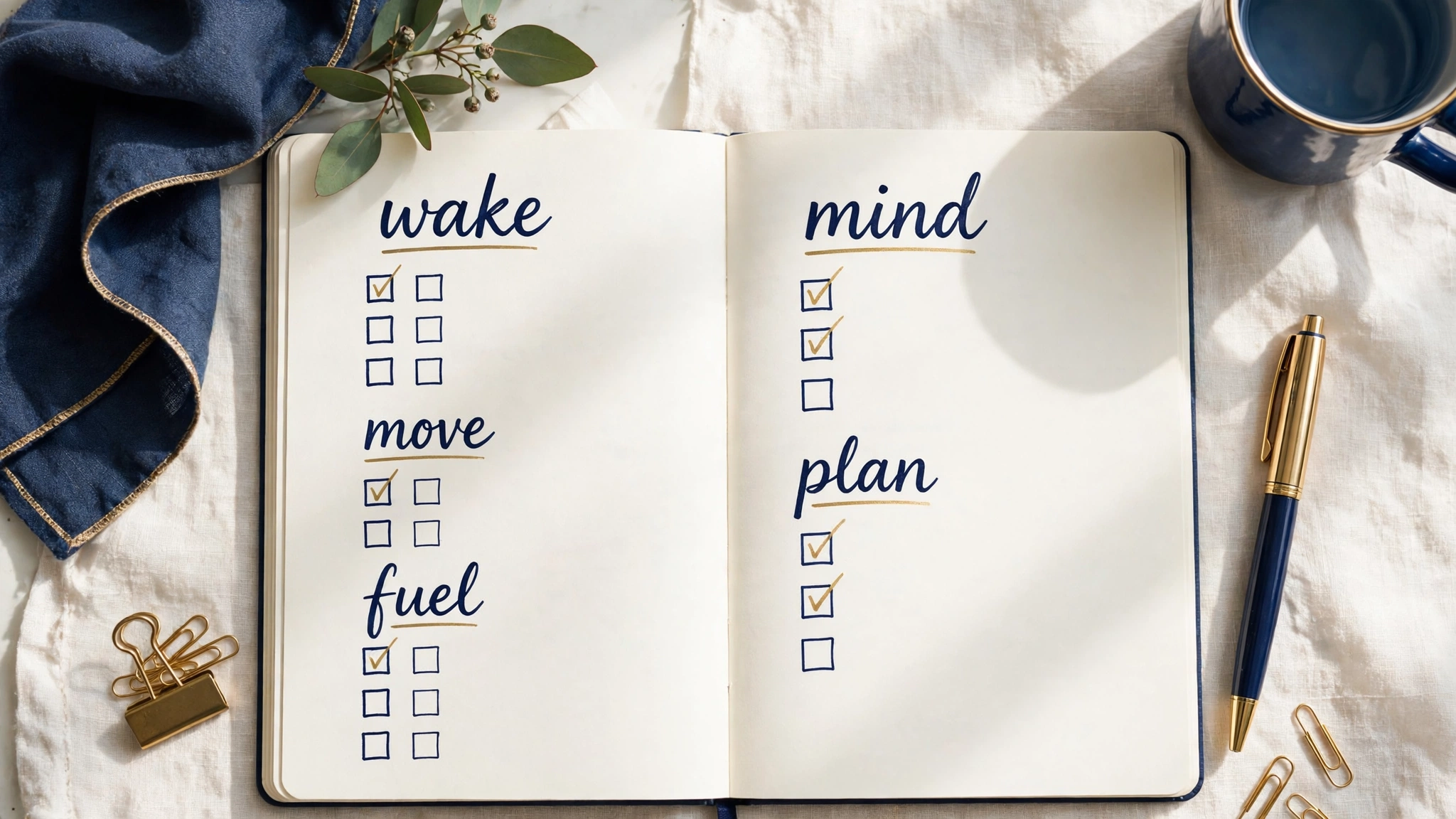
Morning routine ideas fall into 5 groups: wake up well, move the body, fuel the body, clear the mind, and plan the day. A full routine takes one idea from each group, and a short routine takes one idea from 3 groups. The first action, such as drinking water, is the start cue, and the first work action, such as opening your task list, is the end cue.
Why Does a Morning Routine Make You More Productive?
A morning routine makes you more productive because it turns the first hour into habit, and habit needs no willpower. About 43 percent of daily behaviors run on habit (Source: Wood, Quinn and Kashy, 2002), so a fixed morning order frees your mind for the first real task.
The body runs on a 24 hour clock called a circadian rhythm. A circadian rhythm is a natural cycle that repeats about every 24 hours, and light is the main cue that sets it. Morning daylight tells the body clock the day has started.
Sleep sets the ceiling for the whole routine: adults need at least 7 hours of sleep a night (Source: Centers for Disease Control and Prevention). No routine fixes a 5 hour night, so fix sleep first.
A routine also protects attention: email, news, and feeds pull attention in 10 directions at once. A phone free first 30 minutes keeps the morning under your control, and one written priority gives the day a direction before other people set it for you.

What Is the Best Morning Routine for a Productive Day?
The best morning routine for a productive day has 5 steps in 30 minutes each morning: drink water, get daylight, move for 10 minutes, eat a simple breakfast, and write down one priority, then start that priority first, before email. Each step has one job, and no step needs special gear.
Follow these 5 steps each morning:
- Drink a glass of water and open the curtains for daylight.
- Move for 10 minutes: stretch, walk, or do bodyweight moves.
- Shower, dress, and make the bed.
- Eat a simple breakfast with protein, such as eggs, yogurt, or peanut butter on toast.
- Write down one priority and two smaller tasks, then start the priority.
Water comes first because the body loses water overnight. Daylight comes next because light sets the body clock, and 5 to 10 minutes by a window or outside beats a dark room with a lamp. Movement comes third because it raises alertness without coffee. A 10 minute walk or a short stretch is enough.
Breakfast keeps energy steady through the first work block. Protein slows the energy drop that cereal and fruit juice cause on their own. Eggs, Greek yogurt, or peanut butter on toast take 5 minutes to make, and a prepped breakfast takes zero minutes.
The priority step is the heart of the routine. Write one task that would make the day feel worthwhile if it were the only thing you finished, add two smaller tasks under it, then start the priority in a 25 minute block before you open email. Starting the priority early is what makes the day productive.
How Do You Build a Morning Routine That Sticks?
You build a morning routine that sticks by starting with 2 or 3 habits, linking each new habit to a habit you already have, and repeating the same order until it feels automatic. A small routine that survives a bad week beats a perfect routine that lasts 9 days.
Habit stacking is the main build method. A habit is a routine of behavior that is repeated regularly and tends to occur without conscious thought. Habit stacking links a new habit to a habit that already runs on its own: after I drink my coffee, I open my notebook. The old habit is the cue, so you never need to remember a list.
Start with 2 or 3 habits only: water, daylight, and one written priority. Do those 3 for 2 weeks, and add one more habit only when the first 3 feel easy. A new habit takes 66 days on average to reach automaticity, with a range of 18 to 254 days depending on the person and the habit (Source: Lally et al., 2010).
Track the routine with a check mark on a paper calendar. Miss one day and restart the next morning. Miss two days in a row and shrink the routine back to 3 habits.
In my own mornings, a glass of water on the nightstand changed more than any alarm app did. The water was there before the phone, so the first action of the day was a habit, not a scroll.
15 Morning Routine Ideas to Try
These 15 morning routine ideas cover 5 groups: wake up well, move the body, fuel the body, clear the mind, and plan the day. Pick 2 or 3 to start, add one more each week, and stop at 6 habits total.
Wake Up Well
- Wake at the same time every day, within 30 minutes on weekends too.
- Skip the snooze button: place the alarm across the room.
- Open the curtains or step outside for 5 to 10 minutes of daylight.
Move the Body
- Drink a glass of water before coffee, then enjoy coffee as a second drink, not a rescue.
- Stretch arms, legs, neck, and back for 5 minutes.
- Take a 10 minute walk outside without your phone.
Fuel the Body
- Eat a protein breakfast: eggs, Greek yogurt, or peanut butter on toast.
- Prep breakfast the night before: overnight oats or a packed lunch box remove one morning decision.
Clear the Mind
- Write 3 lines in a journal: one feeling, one thing you are grateful for, and one thing you want from the day.
- Breathe slowly for 2 minutes before any screen: in for 4 counts, out for 6 counts.
- Make the bed: a made bed closes the sleep stage and gives the morning its first finished task.
Plan the Day
- Pick your one thing: ask what single task would make today a success, and write it where you can see it.
- Write a top 3 list: one priority and two smaller tasks, then cross off the priority first.
- Set up your workspace: clear the desk and open only the first task.
- Delay your phone for 30 minutes: charge it outside the bedroom, and check messages only after the routine ends.
Morning Routine Ideas by Goal
Morning routine ideas work best when they match your goal right now. Pick the goal that matters most, add its 2 ideas to your basic routine, and skip the rest. Energy, focus, calm, fitness, and sleep each need different morning ideas.
| Goal | Add these 2 ideas | Skip this |
|---|---|---|
| More energy | 10 minute walk outside, protein breakfast | A long workout before breakfast |
| More focus | Phone free first 30 minutes, one written priority | News and feeds before work |
| Less stress | 2 minutes of slow breathing, 3 journal lines | A 12 step routine with strict times |
| Better fitness | 10 minute bodyweight set, prepped breakfast | Skipping breakfast to save time |
| Better sleep | Fixed wake time, daylight in the first hour | Late caffeine and late screens |
Energy comes from light, movement, and food. Focus comes from protecting attention. Calm comes from slow actions. Fitness comes from a short daily set. Sleep comes from a fixed wake time.
Sample Morning Routines: 15, 30, and 60 Minutes
The 15 minute routine fits busy days, the 30 minute routine fits most people, and the 60 minute routine fits slow mornings. Copy the plan that matches your day, and shrink to the 15 minute version when the day gets busy.
The 15 minute routine
- Drink a glass of water and open the curtains (2 minutes).
- Stretch for 5 minutes.
- Make the bed and get dressed (5 minutes).
- Write one priority while coffee brews (2 minutes).
- Eat a prepped breakfast (1 minute).
The 30 minute routine
- Drink water and get daylight (5 minutes).
- Walk for 10 minutes outside (10 minutes).
- Shower and dress (8 minutes).
- Eat a protein breakfast without your phone (5 minutes).
- Write one priority and two smaller tasks (2 minutes).
The 60 minute routine
- Drink water, get daylight, and make the bed (10 minutes).
- Move for 20 minutes: a walk, a run, or a workout (20 minutes).
- Shower, dress, and eat a protein breakfast (15 minutes).
- Journal 3 lines and breathe for 2 minutes (5 minutes).
- Write the top 3 list and start the priority (10 minutes).
Use the 15 minute routine on hard days and the 30 minute routine on normal days. A routine that shrinks on busy days survives.
Morning Routine vs Night Routine: Which Matters More?
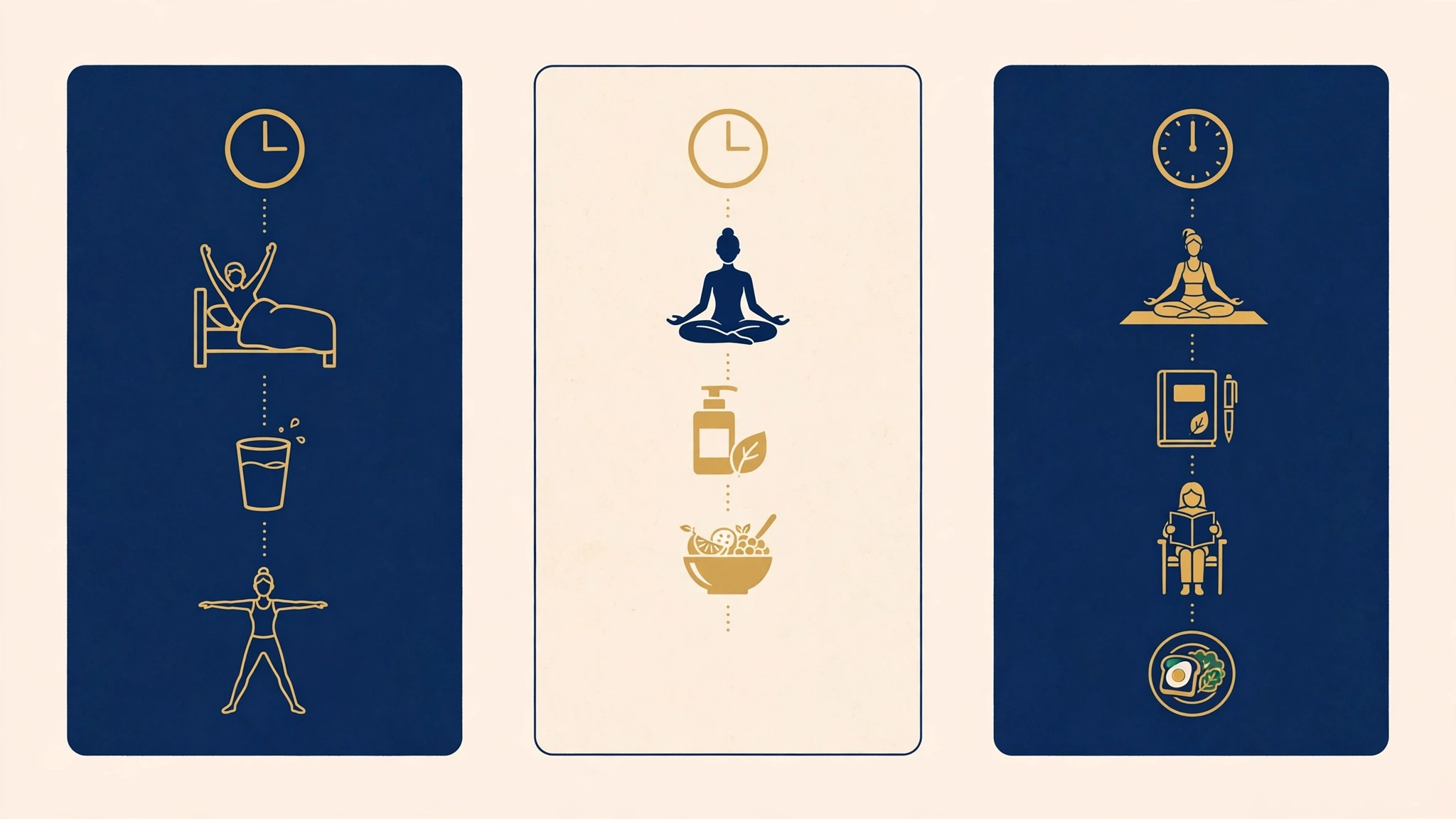
The night routine matters more, because the morning routine runs on what the night routine prepared the night before. A good night routine sets the wake time, the clothes, the breakfast, and the priority, so the morning has no decisions left.
| Feature | Morning routine | Night routine |
|---|---|---|
| Main job | Start the day with energy and focus | Prepare the next day and protect sleep |
| Key actions | Water, daylight, movement, priority | Clothes out, breakfast prepped, phone charging outside the bedroom |
| Time needed | 15 to 30 minutes | 10 to 15 minutes |
| Main risk | Too many steps, skipped on busy days | Late screens and late caffeine |
| Best for | Focus and first work block | Sleep quality and calm mornings |
The night routine takes 10 to 15 minutes: lay out clothes, prep breakfast, write tomorrow’s one priority, and charge the phone outside the bedroom.
Fix the night routine first if mornings feel rushed.

What Mistakes Ruin a Morning Routine?
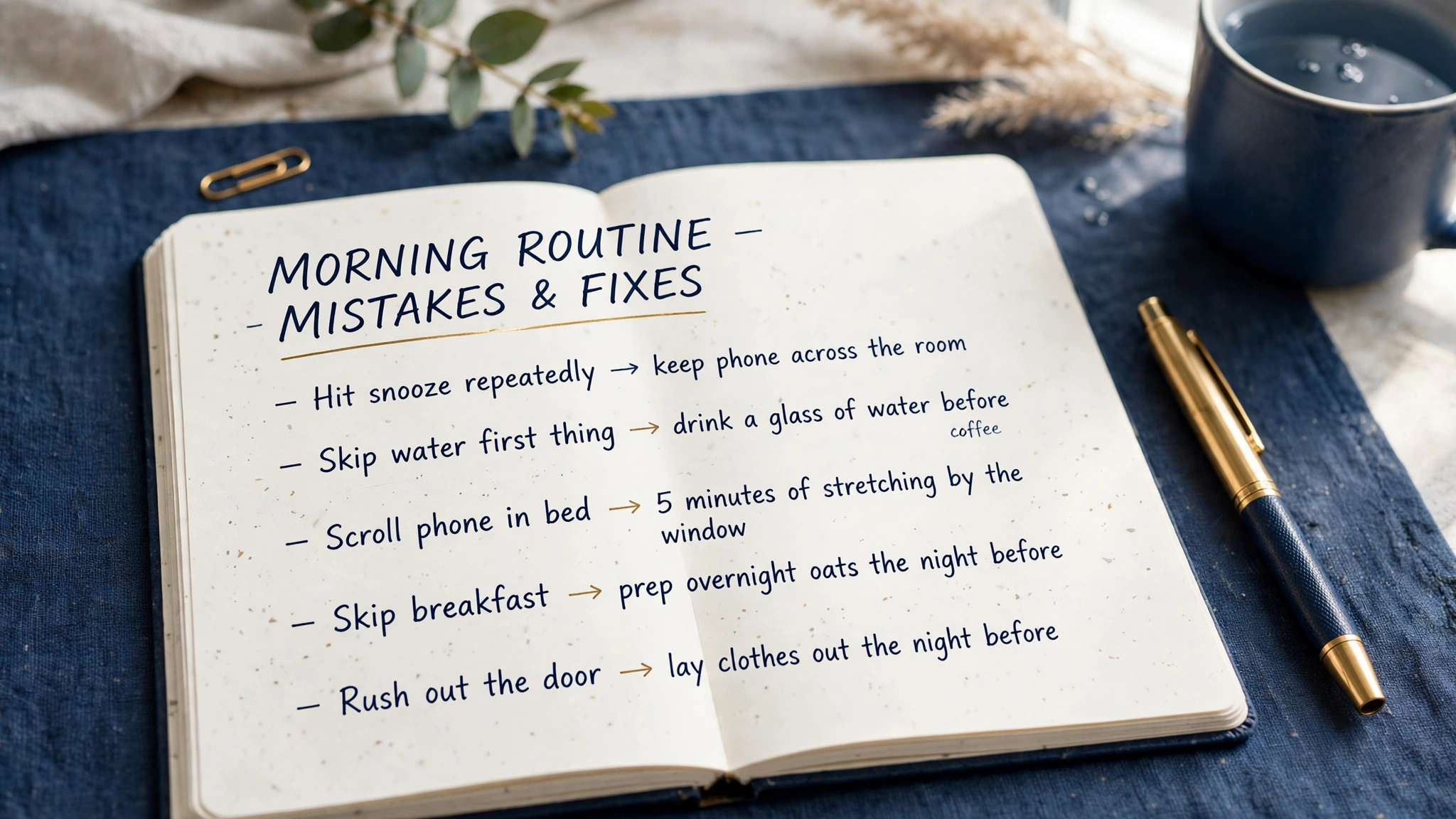
The mistakes that ruin a morning routine are starting with 12 habits at once, waking at 5 a.m. on too little sleep, checking the phone first in the morning, skipping breakfast, and quitting after one missed day for good. Each mistake has one small fix.
The 12 habit start is the most common mistake: 12 steps take 90 minutes, and 90 minutes does not survive a busy week. The fix is 3 habits: water, daylight, and one priority.
The 5 a.m. alarm on 6 hours of sleep is the second mistake: early waking only helps when sleep is long enough. Adults need at least 7 hours a night (Source: Centers for Disease Control and Prevention), so pick a wake time that leaves 7 to 9 hours of sleep.
The phone first mistake hands the morning to other people, because feeds and messages set the agenda before you do. The fix is a phone free first 30 minutes, with the phone charging outside the bedroom.
Skipping breakfast is the fourth mistake: it leaves energy low in the first work block, and coffee alone does not fix it. The fix is a 5 minute protein breakfast, or a prepped breakfast.
Quitting after one missed day is the fifth mistake: one missed day feels like failure, and the routine gets dropped. The fix is a rule: never miss twice.
Pair a calmer morning with a calmer home. Read Minimalist Living: Less Stuff, More Life for simple living ideas that cut morning clutter.
Conclusion
Morning routine ideas work when they stay small, fixed, and daily: water, daylight, 10 minutes of movement, a simple breakfast, and one priority started before email. The 15 minute routine fits busy days and the 30 minute routine fits most days. Start tonight: lay out clothes, prep breakfast, write tomorrow’s priority, and charge the phone outside the bedroom. Voice of Wave covers everyday living guides in this plain style.
Read more lifestyle guides on the Voice of Wave blog.
FAQs
What is the best morning routine for a productive day?
The best morning routine for a productive day has 5 steps in 30 minutes: drink water, get daylight, move for 10 minutes, eat a simple breakfast, and write down one priority, then start that priority before email. Each step has one job, and no step needs special gear.
How long should a morning routine be?
A morning routine should be 15 to 30 minutes for most people. A 15 minute routine fits busy days, and a 30 minute routine fits normal days. A routine longer than 60 minutes is hard to keep, and a short routine you do daily beats a long one you quit in a week.
What time should I wake up for a productive morning?
You should wake up at a time that leaves 7 to 9 hours of sleep, not at a fixed hour like 5 a.m. Adults need at least 7 hours of sleep a night (Source: Centers for Disease Control and Prevention). Pick a wake time, keep it within 30 minutes each day, and build the routine around it.
How do I start a morning routine as a night owl?
Start a morning routine as a night owl by keeping your natural wake time and shrinking the routine to 15 minutes: water, daylight, a 5 minute stretch, and one written priority. Do not force a 5 a.m. alarm, because short sleep breaks the routine. Shift the wake time 15 minutes earlier each week if you want an earlier start.
Should I check my phone in the morning?
No, you should not check your phone in the first 30 minutes of the morning. Email, news, and feeds pull attention in many directions before you set your own priority. Charge the phone outside the bedroom, finish the routine first, and check messages only after you start your first task.
How long does it take for a morning routine to become a habit?
It takes 66 days on average for a new habit to feel automatic, with a range of 18 to 254 days depending on the person and the habit (Source: Lally et al., 2010). Start with 2 or 3 habits, link each one to a habit you already have, and track the routine with a daily check mark.