
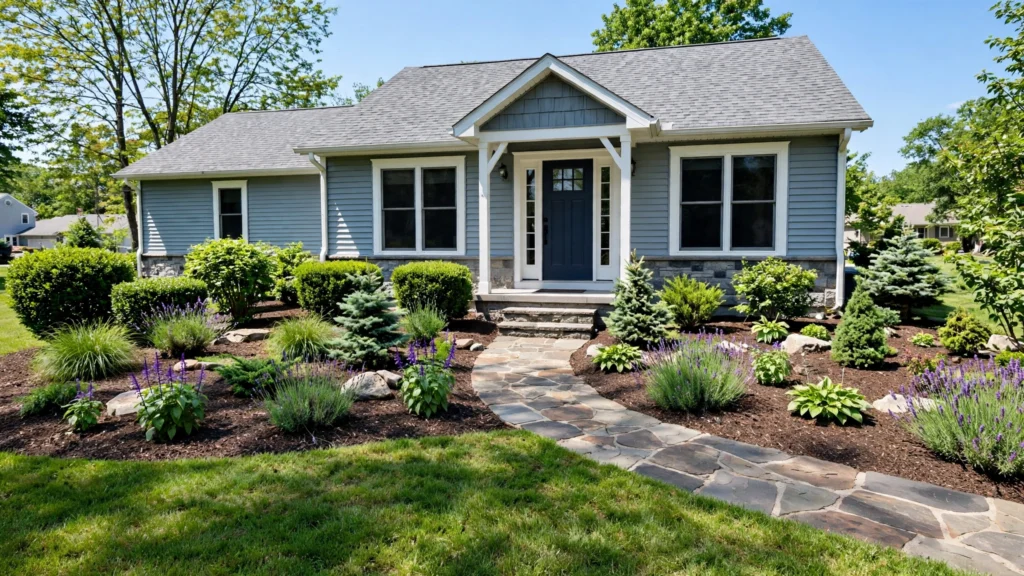
Low maintenance landscaping is a yard design that cuts mowing, watering, weeding, and pruning to a few short tasks each month, and it does this with a smaller lawn, tough plants matched to sun and soil, deep mulch, and hard surfaces where grass adds little value. A yard built this way still looks full and cared for, because structure comes from shrubs, grasses, stone, and clear bed edges, not from weekly cutting and feeding. This guide covers what low maintenance landscaping means, how much time it saves, how to shrink the lawn, which plants to pick, how mulch and drip irrigation cut work, what xeriscaping suits, how to plan in 5 steps, what it costs, and how to keep it looking good through the year.
Key Takeaways
- Cut the lawn first: keep grass only where people walk, play, or sit.
- Match plants to the site: native and drought tolerant plants need less water, feed, and pruning.
- Mulch 2 to 4 inches deep: mulch holds soil moisture, blocks weeds, and cuts watering and weeding.
- Water at the roots: drip irrigation and deep, spaced watering beat daily sprinkler runs.
- Plan in phases: start with the lawn edge and one bed, then add paths, shrubs, and irrigation later.
- Expect some work: a finished yard still needs 2 to 4 hours a month for edging, light pruning, and a yearly mulch top-up.
Table of Contents
- What Is Low Maintenance Landscaping?
- How Much Time Does Low Maintenance Landscaping Save?
- How Do You Shrink the Lawn Without Losing a Usable Yard?
- Which Plants Need the Least Water and Care?
- How Does Mulch Cut Weeding and Watering?
- What Is Xeriscaping and When Does It Work Best?
- How Do You Water Less With Drip Irrigation and Smart Timing?
- Low Maintenance Landscaping vs a High Maintenance Yard
- How Do You Plan a Low Maintenance Yard in 5 Steps?
- What Mistakes Make a Yard Harder to Keep?
- How Much Does Low Maintenance Landscaping Cost?
- How Do You Keep a Low Maintenance Yard Looking Good Through the Seasons?
- Frequently Asked Questions
- Conclusion
What Is Low Maintenance Landscaping?
Low maintenance landscaping is a yard design that lowers repeat work by matching each part of the yard to its real use, with a smaller lawn, plants suited to local sun, soil, and rain, mulch on bare soil, drip or timed watering, and hard surfaces.
Readers can find more house and yard guides in the Home Improvement guides. Test any new idea this way: if the idea adds a weekly task, it fails the low maintenance test. In my own yard work, beds with one evergreen shrub, one grass, and 2 repeated perennials stayed tidy.
How Much Time Does Low Maintenance Landscaping Save?
Low maintenance landscaping saves time by cutting the 3 largest yard tasks, and a finished yard needs about 2 to 4 hours of care per month after year 2, against 8 to 16 hours for a typical lawn and bed yard.
Outdoor use is about 30 percent of household water use on average, with more than half of that going to lawns and gardens (Source: US EPA WaterSense, 2026). Xeriscaped yards in EPA-reviewed comparisons reported an average cut of 26.4 labor hours and 206 dollars in yearly maintenance costs (Source: US EPA, 2026).
How Do You Shrink the Lawn Without Losing a Usable Yard?
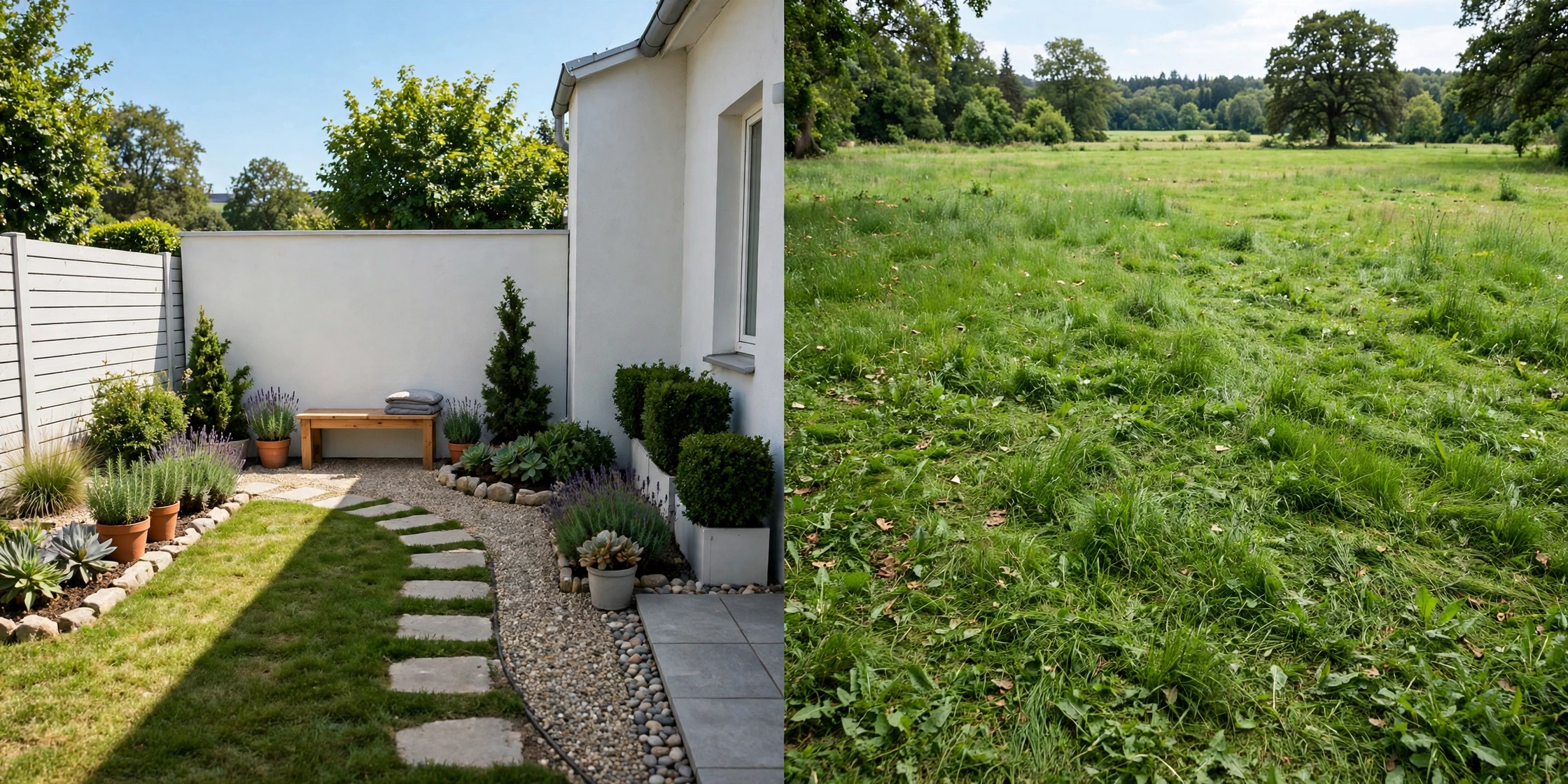
To shrink the lawn without losing a usable yard, keep grass only where people walk, play, or sit, and replace the rest with beds, groundcover, gravel, or a patio, because grass that no one uses still needs mowing, watering, and feeding.
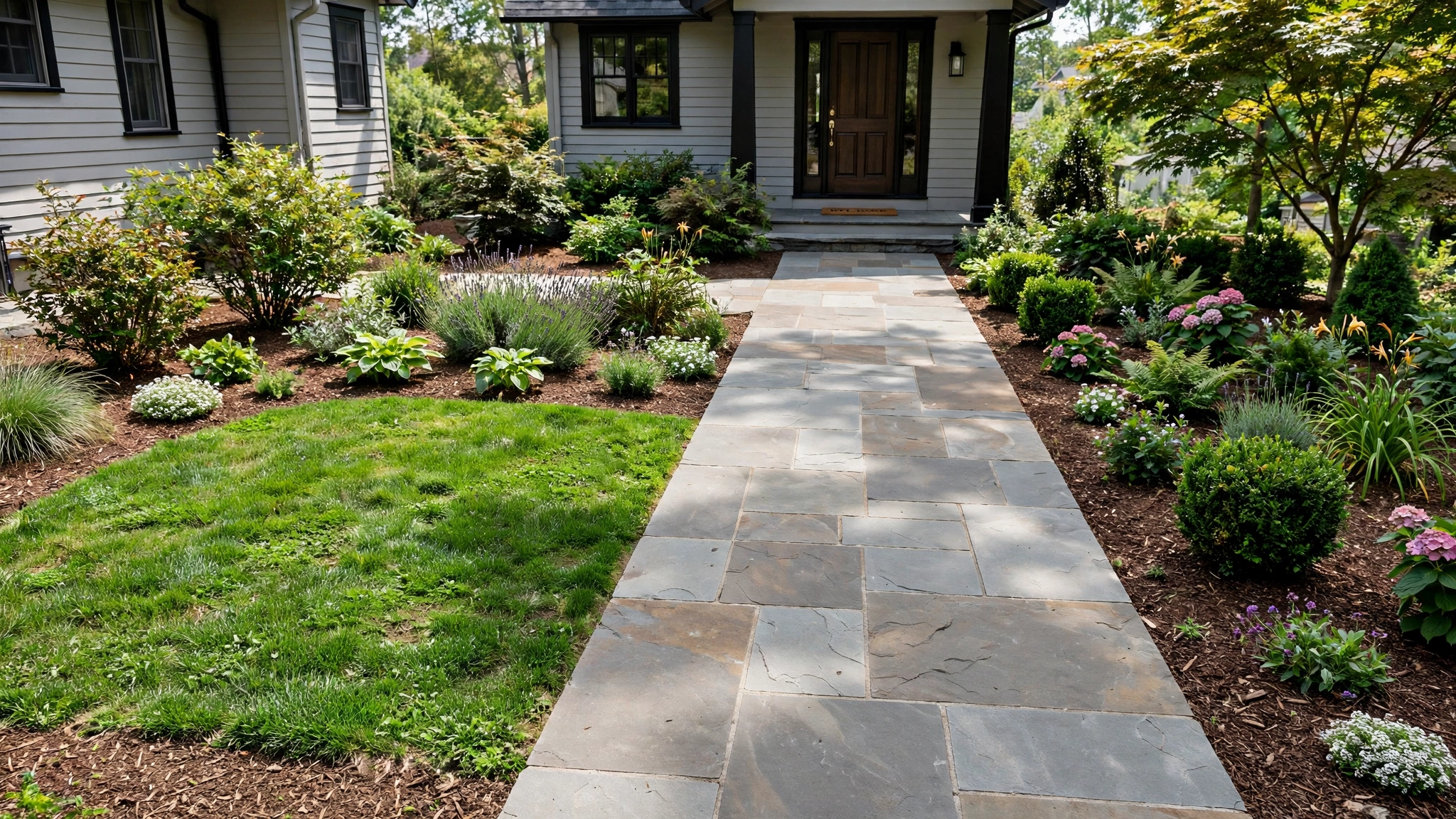
Start with a sketch of the lot and mark the front path, back door, sitting area, and play area. Grass belongs in the play area and one open sitting area. Replace the rest with groundcover plants such as creeping thyme, white clover, and sedum, no-mow fescue, gravel, or a patio of pavers. Edge new beds with steel, brick, or stone, and make beds 4 to 6 feet deep.
Which Plants Need the Least Water and Care?
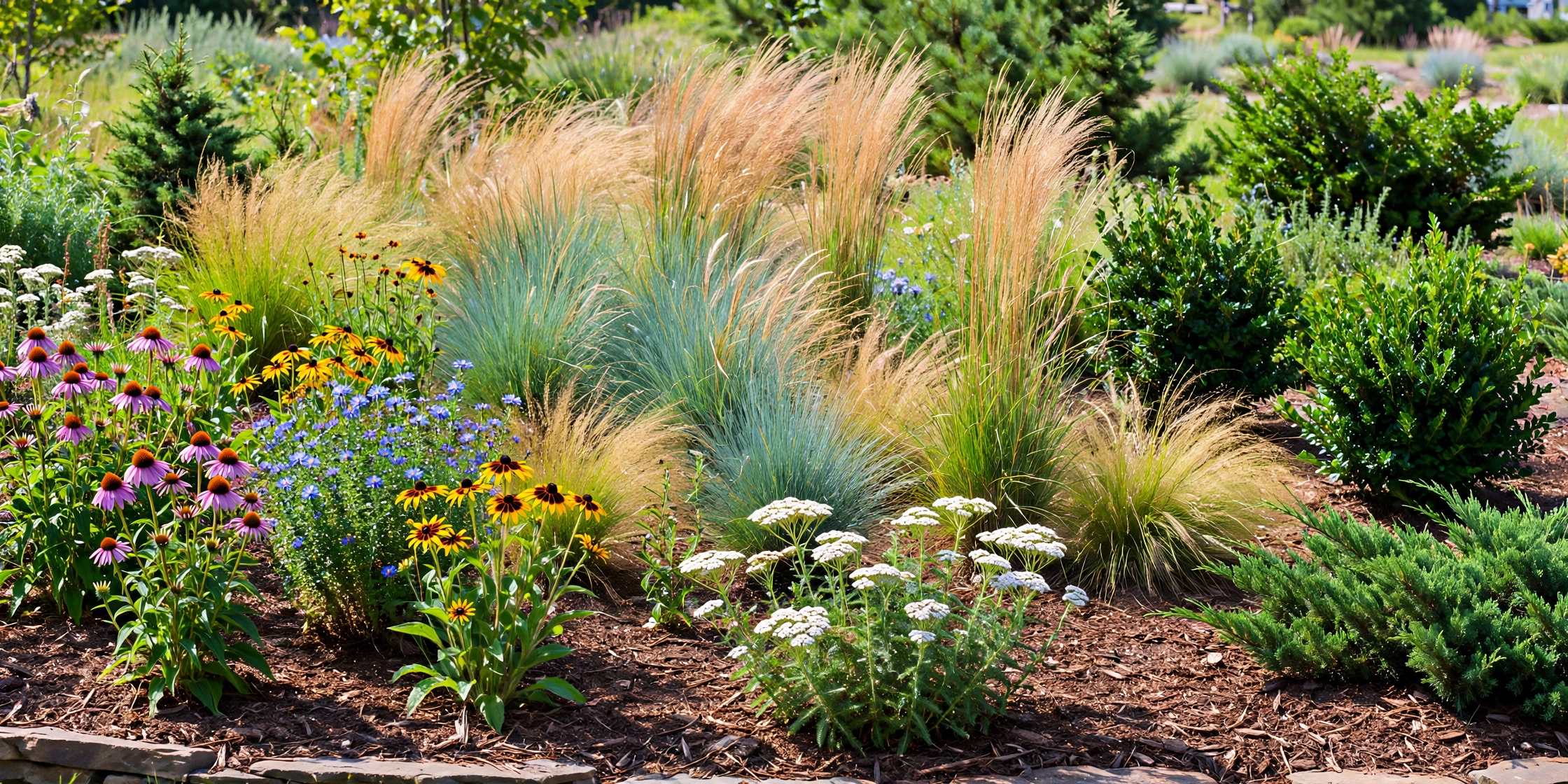
The plants that need the least water and care are native perennials, drought tolerant shrubs, ornamental grasses, and evergreen shrubs matched to the local hardiness zone, sun hours, and soil type, because plants that fit the site need little extra water, feed, or pruning after year 1.
Pick plants by site, not by photo. Full sun beds suit black-eyed Susans, lavender, Russian sage, coneflower, yarrow, and sedum. Shade beds suit hostas, ferns, and pachysandra. Dry spots suit yucca, agave in warm zones, and blue fescue. Check the USDA hardiness zone and sun hours.
| Plant group | Best site | Care after year 1 | Examples |
|---|---|---|---|
| Native perennials | Sun or part shade | Cut back yearly, water in drought | Coneflower, black-eyed Susan, yarrow |
| Drought tolerant shrubs | Full sun, well drained soil | Prune once a season | Lavender, rosemary, Texas sage |
| Ornamental grasses | Sun, open beds | Cut back in late winter | Blue fescue, fountain grass |
| Evergreen shrubs | Sun or shade, by type | Little or no pruning | Boxwood, juniper |
How Does Mulch Cut Weeding and Watering?
Mulch cuts weeding and watering by covering bare soil with a 2 to 4 inch layer that blocks light from weed seeds, holds soil moisture, and steadies soil temperature, and mulch works best on weed-free, damp soil with a gap around plant stems.
A mulch is a layer of material spread on soil to conserve soil moisture, improve soil health, and reduce weed growth. The layer must be deep enough to block light, and keep it off stems, because mulch piled against a stem invites rot.
Use organic mulch in planting beds and stone mulch in dry or hot spots. Shredded bark suits shrubs and trees and feeds the soil as it breaks down. Apply mulch in 5 steps: pull weeds, water the soil, spread mulch 2 to 4 inches deep, keep it 2 to 3 inches from stems, and top up each spring.
What Is Xeriscaping and When Does It Work Best?
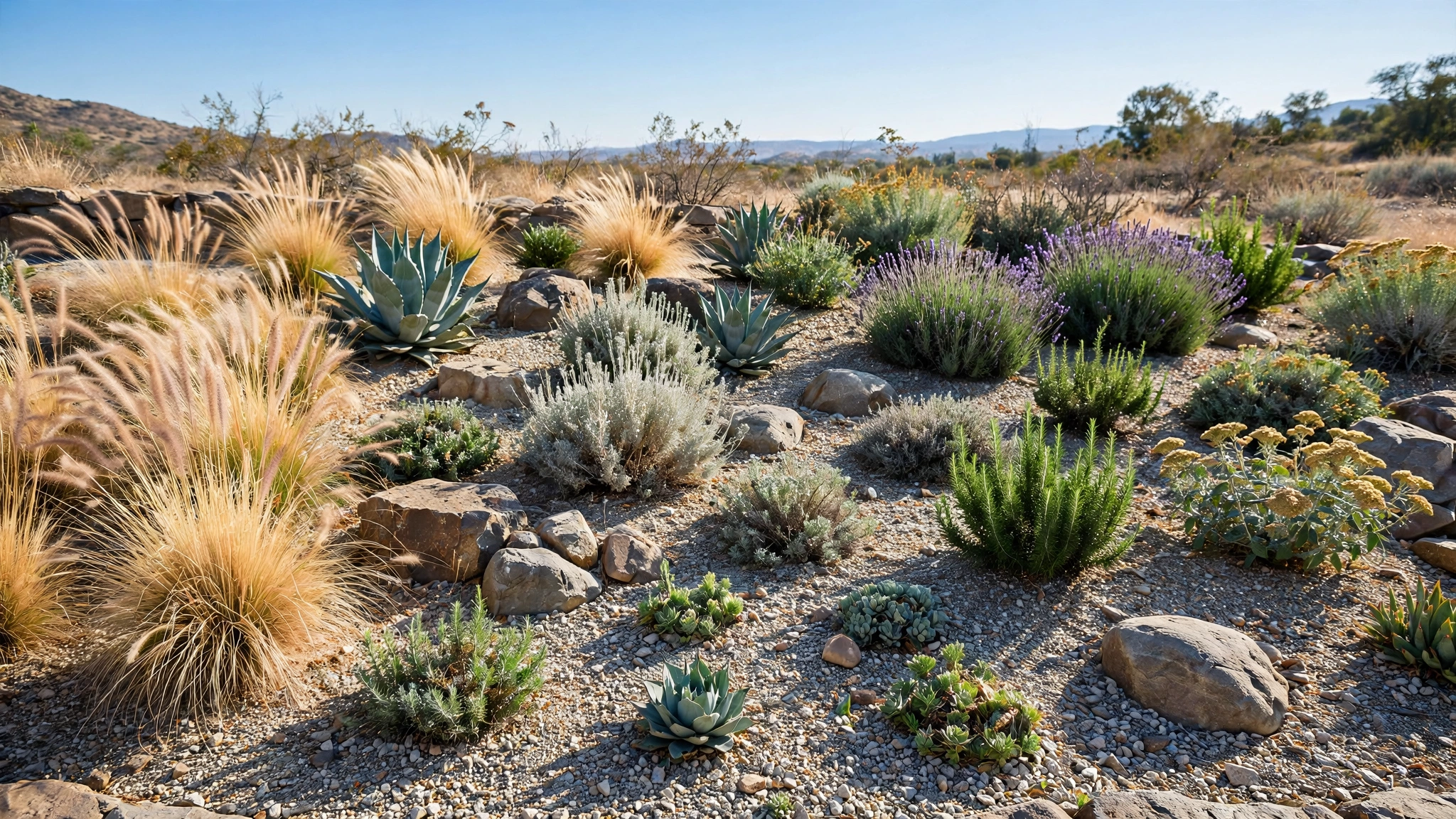
Xeriscaping is a form of landscaping that reduces or removes the need for irrigation by using plants suited to local rainfall and mulch, and xeriscaping works best in dry and sunny regions, and in yards where water limits make a full lawn hard to keep.
Xeriscaping reduces or eliminates the need for irrigation. A good xeriscape has layers: drought tolerant shrubs, ornamental grasses, succulents, groundcovers, and a small lawn only where people use it.
Xeriscapes can reduce water consumption by 60 percent or more compared with regular lawns (Source: Wikipedia, Xeriscaping, 2026). In arid states such as Arizona and Nevada, about 75 percent of household potable water went to residential and urban lawns (Source: Wikipedia, Xeriscaping, 2026).
For a smaller lawn that still looks full, read Healthy Lawn With Fresh Sod: Laying and Care Guide.
How Do You Water Less With Drip Irrigation and Smart Timing?
To water less with drip irrigation, deliver water slowly at the roots through drip lines or soaker hoses on a timer, water deeply and less often, because drip lines cut evaporation and runoff and deep watering pulls roots down where soil stays moist longer.
Microirrigation uses 20 to 50 percent less water than conventional sprinkler systems, and switching can save a typical home more than 25,000 gallons a year (Source: US EPA, 2026).
Set up drip irrigation in 4 parts: a main line to each bed, drip tubing along the plant row, emitters giving 0.5 to 1 gallon per hour per plant, and a timer, filter, and pressure regulator to control flow and stop clogs. Water deeply to 4 to 6 inches, then wait until the top inch of soil dries, and water in the morning, so leaves dry before dark.
Low Maintenance Landscaping vs a High Maintenance Yard
Low maintenance landscaping differs from a high maintenance yard in 4 ways: lawn size, plant type, soil cover, and watering method.
| Factor | High maintenance yard | Low maintenance yard |
|---|---|---|
| Lawn | Full lot, mowed weekly | Small use area only |
| Plants | Annuals, thirsty exotics | Native perennials, tough shrubs |
| Soil cover | Bare soil, thin mulch | Mulch 2 to 4 inches deep |
| Watering | Sprinklers, daily in summer | Drip lines, deep and spaced |
| Pruning | Monthly shearing | Once a season, light shaping |
| Monthly work | 8 to 16 hours | 2 to 4 hours after year 2 |
How Do You Plan a Low Maintenance Yard in 5 Steps?
To plan a low maintenance yard in 5 steps, map use zones, test sun and soil, shrink the lawn, pick a short plant list, and add mulch and drip lines, because each step removes a guess that adds weekly work later.
- Map the lot: mark doors, paths, play areas, bins, slopes, wet spots, and shade.
- Test sun and soil: note sun hours, test pH, and check drainage after rain.
- Shrink the lawn: cut grass to use zones, add edging, and mark new beds and paths.
- Pick 5 plant types: one evergreen anchor, one shrub, one grass, and 2 repeated perennials.
- Cover and water: spread mulch 2 to 4 inches deep, lay drip lines under mulch, and set a timer.
What Mistakes Make a Yard Harder to Keep?
The mistakes that make a yard harder to keep are keeping a full lawn, planting thirsty plants in dry beds, using thin mulch, picking shrubs that outgrow their spot, and watering daily by sprinkler.
A thirsty plant in a dry bed forces watering for the whole bed. Thin mulch lets weeds through. A shrub that grows 6 feet tall in a 3 foot spot needs yearly shearing.
How Much Does Low Maintenance Landscaping Cost?
Low maintenance landscaping costs less over time than a lawn-led yard, because upfront spending on mulch, drip lines, and hard surfaces replaces yearly spending on mowing, water, feed, and replanting.
Lawn mowing costs 30 to 85 dollars per visit for an eighth to quarter acre yard, or 900 to 2,000 dollars a year for a 25 to 35 visit season (Source: HomeGuide, 2026). Full service lawn care costs 200 to 400 dollars a month for a quarter acre (Source: HomeGuide, 2026).
| Item | Typical cost range | Notes |
|---|---|---|
| Bark mulch, per cubic yard | 30 to 70 dollars | Covers 100 square feet at 3 inches |
| Drip irrigation kit, per bed | 50 to 150 dollars | Timer and filter add 40 to 80 dollars |
| Pea gravel, per square foot installed | 0.85 to 2.80 dollars | A 200 square foot path costs 115 to 380 dollars (Source: HomeGuide, 2026) |
Voice of Wave covers home care, yard care, and everyday guides for general readers, with new practical guides each week.
How Do You Keep a Low Maintenance Yard Looking Good Through the Seasons?
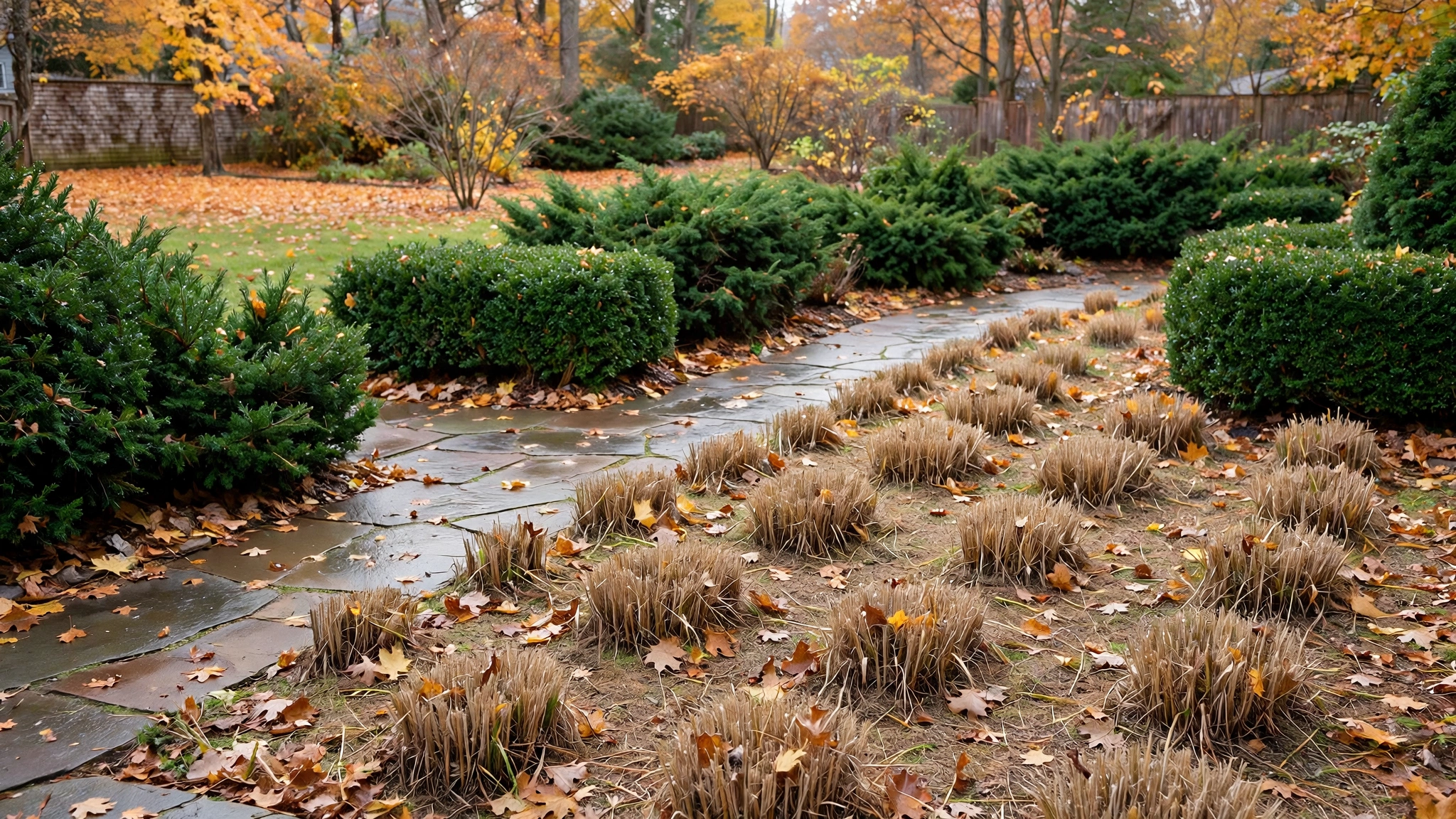
To keep a low maintenance yard looking good through the seasons, mulch and prune in spring, check drip lines and weed monthly in summer, cut back grasses and clear leaves in autumn, and leave structure plants alone in winter.
Spring is the main visit: top up mulch, prune shrubs once, check the timer, and replace plants that failed over winter. Summer is a check visit: look for clogged emitters, pull weeds once a month, and water only in dry spells. Autumn is a tidy visit: cut back ornamental grasses and clear leaves from paths and drains. Winter is a rest visit: leave evergreen shrubs and grasses for shape.
Conclusion
Low maintenance landscaping works when the lawn shrinks to used areas, plants fit sun and soil, soil stays covered with mulch, and water goes to roots on a timer, and that combination cuts monthly yard work to 2 to 4 hours after year 2.
Start with the lawn edge and one bed, pick 5 plant types, mulch 2 to 4 inches deep, and add drip lines under the mulch. Phase the rest over 2 seasons, and check HOA rules and drainage first.
Browse more practical home guides on the Voice of Wave blog.
Frequently Asked Questions
What is the easiest low maintenance landscaping idea?
The easiest low maintenance landscaping idea is to shrink the lawn and mulch the beds, because those 2 steps cut mowing and weeding at once with no new plants to learn. Cut grass to used areas only, edge the new beds, pull weeds, and spread mulch 2 to 4 inches deep.
How much does low maintenance landscaping cost?
Low maintenance landscaping costs 500 to 3,000 dollars in phase 1, because mulch, a drip kit, and a short plant list cost far less than paths and patios. Mulch and drip lines come first, shrubs come next, and paths and patios come last. Most yards recover the upfront cost in 2 to 3 seasons.
What plants are best for a low maintenance yard?
The best plants for a low maintenance yard are native perennials, drought tolerant shrubs, ornamental grasses, and evergreen shrubs matched to the local zone, sun, and soil, because those plants need little water, feed, or pruning after year 1. Check the tag for zone and sun first.
Does low maintenance landscaping mean no maintenance?
No, low maintenance landscaping does not mean no maintenance, because even tough plants need a seasonal pass for mulch, pruning, and timer checks. A finished yard needs about 2 to 4 hours a month after year 2, mostly edging, light pruning, and a yearly mulch top-up.
How do I make a small front yard low maintenance?
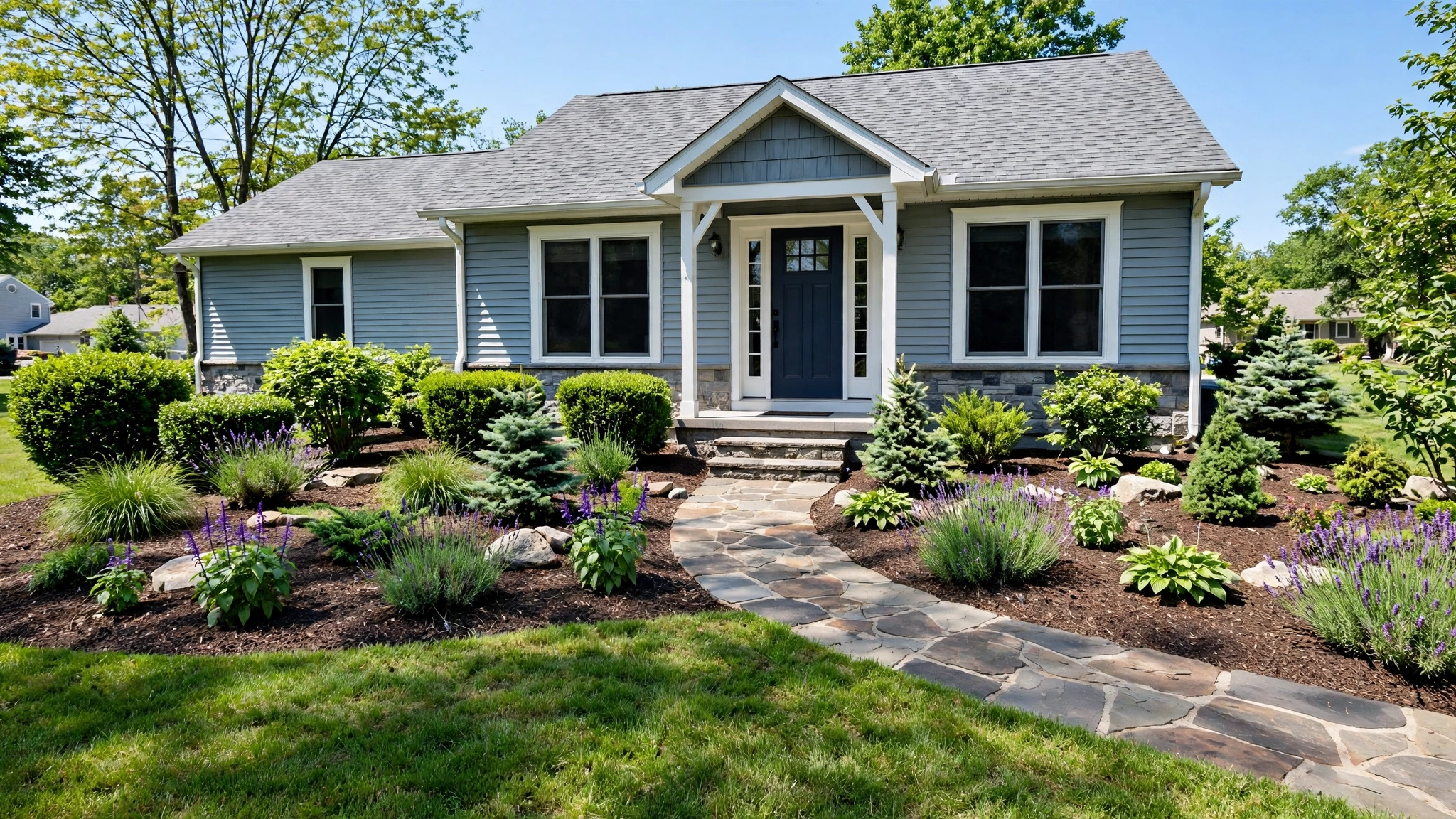
To make a front yard low maintenance, keep a small lawn or none, add a wide path to the door, plant 2 repeated shrubs and one grass, and mulch the beds, because a small yard needs structure more than plant count. Use stone where grass would be hard to mow.
Is xeriscaping the same as low maintenance landscaping?
No, xeriscaping is not the same as low maintenance landscaping, because xeriscaping is one water-saving method inside low maintenance design, which also covers lawn size, mulch, pruning, and hard surfaces. A xeriscape uses drought tolerant plants and little irrigation, while a low maintenance yard in a wet region uses plants suited to rain.