

Moving day has a reputation for chaos, but the stressful moves are never the big ones, they are the unplanned ones. At Voice of Wave, we treat a calm move as a learnable skill, and this relocation guide breaks it into weekly steps anyone can follow.
To plan a stress-free move, start eight weeks early with a timeline, declutter before packing, and pack in stages rather than all at once. Book movers, label every box by destination room, handle address changes four weeks out, and keep a first-night essentials box separate. Confirm mover details a week before, then do a final walkthrough on moving day.
That is the whole method in one paragraph. Below: a moving timeline, a moving house checklist, packing tips, mover vetting, a realistic budget, and plans for kids, pets, and first-time movers.
Key Takeaways
- Start planning eight weeks before moving day and begin packing non-essentials at six weeks; most moving stress comes from compressing this schedule.
- Declutter before moving: every item you donate, sell, or discard is one you never pack, carry, or unpack.
- Label boxes by destination room, not origin room, and keep a first-night essentials box with you at all times.
- Get at least three written mover quotes, verify licensing and insurance, and never pay a large deposit upfront.
- Budget beyond the mover’s quote: deposits, overlapping rent, cleaning, supplies, and tips add up fast.
Table of Contents
- What Does a Stress-Free Move Actually Look Like?
- How Far in Advance Should You Start Planning Your Move?
- What Should Be on Your Moving House Checklist?
- What Are the Best Packing Tips for Moving?
- How to Choose a Moving Company You Can Trust
- How Much Should You Budget for a Move?
- How to Move House Without Stress With Kids or Pets
- First Time Moving Out? Read This First
- How to Plan a Stress-Free Move in Under Four Weeks
- What Goes in Your Moving Day Essentials Box?
- How Should You Tackle the First Week After the Move?
- Frequently Asked Questions
What Does a Stress-Free Move Actually Look Like?
A stress-free move does not mean a move with zero effort. It means a move with zero surprises. Every chaotic move story traces back to the same causes: starting too late, deciding under time pressure, and discovering problems on moving day that could have been solved weeks earlier. A calm move rests on three pillars: a written moving timeline that spreads tasks across eight weeks, a moving house checklist that captures every task in one place, and staged packing where non-essentials go first and daily items last.
How Far in Advance Should You Start Planning Your Move?
Start planning eight weeks before moving day, and start physically packing about six weeks out. Eight weeks gives you time to compare movers, declutter properly, and handle paperwork without rushing. Packing too early means weeks of living among boxes; packing too late creates the classic final-weekend panic.
| When | Priority tasks |
|---|---|
| 8 weeks out | Set the date, research movers, start a moving folder for quotes and receipts |
| 7 weeks out | Declutter room by room: keep, donate, sell, discard |
| 6 weeks out | Order packing supplies; pack non-essentials (books, decor, seasonal clothes) |
| 5 weeks out | Book your mover or reserve a truck; notify your landlord if renting |
| 4 weeks out | File your change of address; transfer utilities; pack non-daily rooms |
| 3 weeks out | Arrange school record transfers; keep packing room by room |
| 2 weeks out | Confirm mover arrival time; pack all but daily essentials |
| 1 week out | Pack the essentials box; finish laundry; defrost the freezer |
| Moving day | Supervise loading, do the final walkthrough, hand over keys |
Summer months, weekends, and month-end dates book fastest, so add two extra weeks of lead time in peak season.
What Should Be on Your Moving House Checklist?
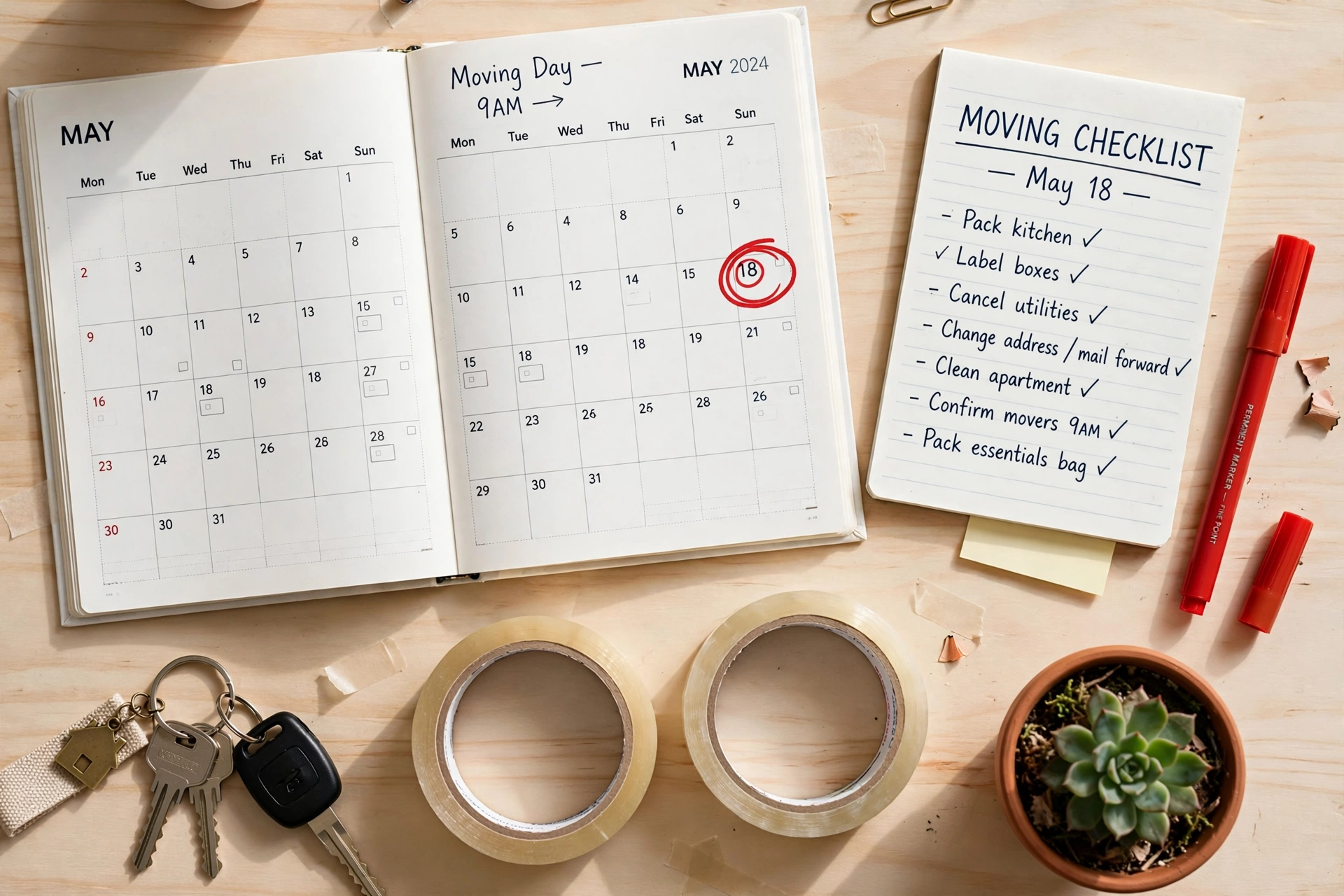
A moving house checklist works because a move is really 50 small projects wearing a trench coat. Keep one master list, grouped by phase. A notebook works, and free tools like Trello or Asana suit digital planners.
8 to 6 weeks out: set the date, get mover quotes, create the moving folder, begin decluttering, measure large furniture and doorways at both homes.
6 to 4 weeks out: order supplies, pack non-essentials, file the change of address, transfer utilities, notify the landlord.
4 to 2 weeks out: pack room by room, confirm mover details, refill prescriptions, back up computer files.
Final week: pack essentials, finish laundry, defrost freezer, confirm all bookings, charge every device.
Moving day: supervise loading, final walkthrough, meter readings, key handover.
Declutter Before Moving
Decluttering is the highest-return task in the entire move. Movers charge by weight, volume, or time, so every item you remove saves money twice: on packing supplies and on transport. Go room by room with four bags labeled keep, donate, sell, and discard. Be strict with duplicates, expired pantry goods, and worn-out linens, and schedule donation pickups early so bags do not sit in your hallway for weeks. [INTERNAL LINK: room-by-room decluttering guide]
What Are the Best Packing Tips for Moving?
Gather supplies first. You need more boxes than you think, in small, medium, and large sizes, plus tape, bubble wrap, packing paper, and thick markers. Small boxes are for heavy items like books; large boxes are for light, bulky items like pillows. An overstuffed box is how belongings get damaged.
Pack in the right order. Start with rooms you use least: garage, storage closets, bookshelves, seasonal decor. Kitchens and daily bathrooms go last. Finish one room before starting the next.
Label for the destination, not the origin. If your old guest room becomes the new home office, a box labeled “guest room” leaves movers guessing. Label it “home office” and it lands correctly the first time. Write the destination room and contents on the top and one side of every box, since stacked boxes hide top labels. Number boxes and keep a matching list in your moving folder.
Protect fragile items. Wrap plates vertically like records, cushion glasses individually, and fill empty box space with packing paper so nothing shifts. Mark fragile boxes on multiple sides.
Keep hardware with furniture. Put screws and bolts from disassembled furniture in labeled zip bags taped to the piece itself, and photograph electronics setups before unplugging cables.
How to Choose a Moving Company You Can Trust
| Method | Best for | Watch out for |
|---|---|---|
| Full-service movers | Large homes, long distances, tight schedules | Highest cost; book 5 to 8 weeks ahead |
| Hybrid (you pack, they drive) | Mid-size moves, budget control | You still do all packing labor |
| DIY truck rental (U-Haul, Penske) | Small local moves, tight budgets | Driving a loaded truck plus fuel and labor |
Get at least three written quotes based on an in-home or video survey, never a phone guess. A legitimate moving company asks about stairs, elevators, and specialty items before quoting. For interstate moves in the United States, verify licensing with the Federal Motor Carrier Safety Administration (FMCSA) and confirm insurance coverage.
Red flags: quotes far below the others, large cash deposits demanded upfront, no physical address, or a company answering the phone with a generic “movers” instead of a business name.
Understanding Moving Insurance in Plain English
Movers offer “valuation coverage,” which is not quite insurance. Basic released-value protection is usually free but covers only a small amount per pound. Full-value protection costs extra but requires the mover to repair, replace, or pay for damaged items. Check which level your quote includes, photograph high-value items before packing, and keep jewelry, documents, and small electronics with you. For genuinely valuable goods, compare a separate third-party moving insurance policy.
How Much Should You Budget for a Move?
The mover’s quote is only the headline number:
| Cost | Notes |
|---|---|
| Mover or truck rental | Get binding written quotes; confirm extras like stairs or long carries |
| Packing supplies | Boxes, tape, wrap, markers; almost always underestimated |
| Deposits and first month | New rental deposits often overlap with the old place |
| Overlapping rent | Even one week of double housing costs real money |
| Cleaning | Supplies or a service for both homes |
| Utility setup fees | Internet installation appointments can lag weeks |
| Mover tips | A common custom is tipping each mover for good service |
| Moving-week food | You will not be cooking; plan for takeout |
Add a 10 percent contingency buffer on top. Small surprises, from a parking ticket for the truck to a replacement shower curtain, should not become stressful ones. [INTERNAL LINK: how to budget for big life expenses]
How to Move House Without Stress With Kids or Pets
A plan for moving with kids works best when children feel informed early, so explore the new neighborhood online together, and let each child pack a personal bag with favorite toys and comfort items. Keep mealtimes and bedtimes normal during packing week, and arrange for young children to stay with a trusted person on moving day if possible.
Pets need their own plan: transfer vet records and refill medications beforehand, keep carriers, food, and litter accessible rather than buried in the truck, and set up one quiet room in the new home first as a safe base. Update ID tags and microchip registration with the new address in week one.
First Time Moving Out? Read This First
Read your lease for notice periods, cleaning requirements, and deposit return terms. Take dated photos of every room when you leave and record utility meter readings on moving day. Stock a starter kit before day one: toilet paper, paper towels, basic tools, light bulbs, a plunger, cleaning supplies, and a shower curtain. Set up renter’s insurance early; it is inexpensive and covers belongings from day one. Finally, introduce yourself to one neighbor in the first week. One friendly face nearby makes a new place feel like home faster than any furniture arrangement.
How to Plan a Stress-Free Move in Under Four Weeks
Week 4: Book movers immediately; availability is the biggest risk. Declutter ruthlessly while you pack, room by room. Order supplies for fast delivery.
Week 3: Pack non-essentials in fixed daily sessions, two boxes an evening. File the change of address and transfer utilities now.
Week 2: Confirm movers in writing. Pack everything except a one-week survival kit.
Week 1: Pack the essentials box, finish laundry, defrost the freezer, do the walkthrough.
Never skip: the essentials box, mover confirmation, address changes, and the final walkthrough. What you can drop: perfect organization. Label by room only and sort details after arrival. If time is truly brutal, hiring packers just for the kitchen and fragile items is money well spent.
What Goes in Your Moving Day Essentials Box?
This box travels with you, not in the truck. Pack it last, open it first: medications and basic first aid, toiletries and toilet paper, phone chargers and a power bank, a change of clothes and pajamas, bed sheets, towels, kettle, mugs, snacks, paper plates, important documents, basic tools, cleaning supplies, and pet supplies if needed.
Change of Address Checklist
Start four weeks out:
- Postal service: file a change of address with the United States Postal Service
- Government: DMV or driver’s license, voter registration, tax authorities
- Money: banks, credit cards, loans, insurance, employer payroll
- Health: doctors, dentists, pharmacy, vet
- Home: utilities, internet, landlord, home insurance
- Life: subscriptions, memberships, schools, regular deliveries
On moving day, open every closet, cabinet, and drawer during your final walkthrough, check the attic and garage, and photograph each empty room as a condition record.
How Should You Tackle the First Week After the Move?
Unpack in priority order, not box-number order. Day one: beds, bedding, bathroom essentials, and kitchen basics. Days two and three: clothes, work setups, and the full kitchen. Then go room by room, finishing each box completely before opening the next. Paced unpacking over one to two weeks beats a frantic weekend and leads to better-organized rooms. Break down boxes for recycling as rooms clear. [INTERNAL LINK: small-space home organization ideas] Hang one photo early; it tells your brain this is home, which is the real finish line of any relocation.


Frequently Asked Questions
How far in advance should you start packing to move?
Begin with non-essentials about six weeks before moving day: books, decor, seasonal clothes, and storage areas. Work room by room from least-used to most-used spaces, saving kitchens and daily bathrooms for the final week. Six weeks keeps the workload to a few boxes a day instead of a frantic final weekend.
Should I hire movers or do it myself?
Hire movers for large homes, long distances, or tight timelines; the cost buys speed and safety. DIY with a rental truck suits small local moves on tight budgets if you have strong helpers. A hybrid option, where you pack and professionals drive, balances cost and effort for mid-size moves.
What should I do first when I arrive at the new house?
Walk through and photograph any existing damage before unloading, confirm utilities are on, and check keys and access. Direct boxes to their labeled rooms, set up beds and bathrooms first, and keep your essentials box with you. Then unpack kitchen basics before anything else.
How can I keep moving costs down?
Declutter aggressively before getting quotes, since less volume means lower cost. Move mid-week or mid-month when demand dips, compare at least three written quotes, pack yourself rather than buying packing services, and add a 10 percent buffer so surprises stay manageable.
What items will moving companies not transport?
Movers generally refuse hazardous materials: paint, chemicals, aerosols, propane, fireworks, and open liquids. They also avoid perishable food, plants on long moves, and valuables like cash, jewelry, and important documents. Carry those yourself, and ask for the full restricted-items list when booking.
How do I change my address when I move?
File a change of address with the postal service about four weeks before moving day. Then update your driver’s license, voter registration, banks, insurance, employer, doctors, pharmacy, utilities, and subscriptions individually. Work through a written list over two weeks so nothing is missed.
Conclusion
Learning how to plan a stress-free move is really about replacing last-minute panic with steady weekly progress. Start eight weeks out, declutter before you pack, label every box for its destination, vet your movers carefully, and keep your essentials box within arm’s reach. Add a realistic budget with a contingency buffer and a room-by-room unpacking plan, and moving day becomes what it should be: the first day in your new home, not the hardest. Pick your moving date today, open a checklist, and take one action now: book the movers or reserve the truck. Everything else flows from that single decision, and starting early is the entire secret.