

The best board games for family game night are Ticket to Ride, Catan, Azul, Codenames, Pandemic, Carcassonne, Dixit, Sushi Go Party!, Kingdomino, Sequence, Blokus, Just One, Forbidden Desert, Telestrations, and Herd Mentality. These 15 games cover ages 4 and up, play in 15 to 90 minutes, and give every player at the table a real chance to win.
Family board games turn one evening a week into time the whole family remembers. A board game is a tabletop game in which players move pieces on a patterned board, and the best family board games keep rules short, turns quick, and luck mixed with choice. This guide lists 15 picks with players, ages, and play times, plus how to pick and how to run a weekly night. Browse the Entertainment guides for more family night ideas.
Key Takeaways
- The best all-round pick is Ticket to Ride: 2 to 5 players, ages 8 and up, 30 to 60 minutes, and rules taught in 5 minutes.
- Match the game to the youngest player: ages 4 to 7 need Blokus or Sequence, ages 8 to 12 need Ticket to Ride or Azul, and teens need Catan.
- Cooperative games such as Pandemic let the whole table win or lose together, which suits families that dislike direct competition.
- A weekly game night works best at a fixed hour, with one 30 minute game and one 15 minute game per night.
Table of Contents
- What Are the Best Board Games for Family Game Night?
- How Do You Pick a Family Board Game?
- Which Family Board Games Work Best for Young Kids?
- Which Family Board Games Work Best for Mixed Ages?
- What Are the Best Strategy Board Games for Families?
- What Are the Best Cooperative Family Board Games?
- What Are the Best Party Board Games for Big Groups?
- Classic vs Modern Family Board Games: Which Should You Buy?
- How Do You Run a Weekly Family Game Night?
- What Mistakes Ruin Family Game Night?
- Conclusion
- FAQs
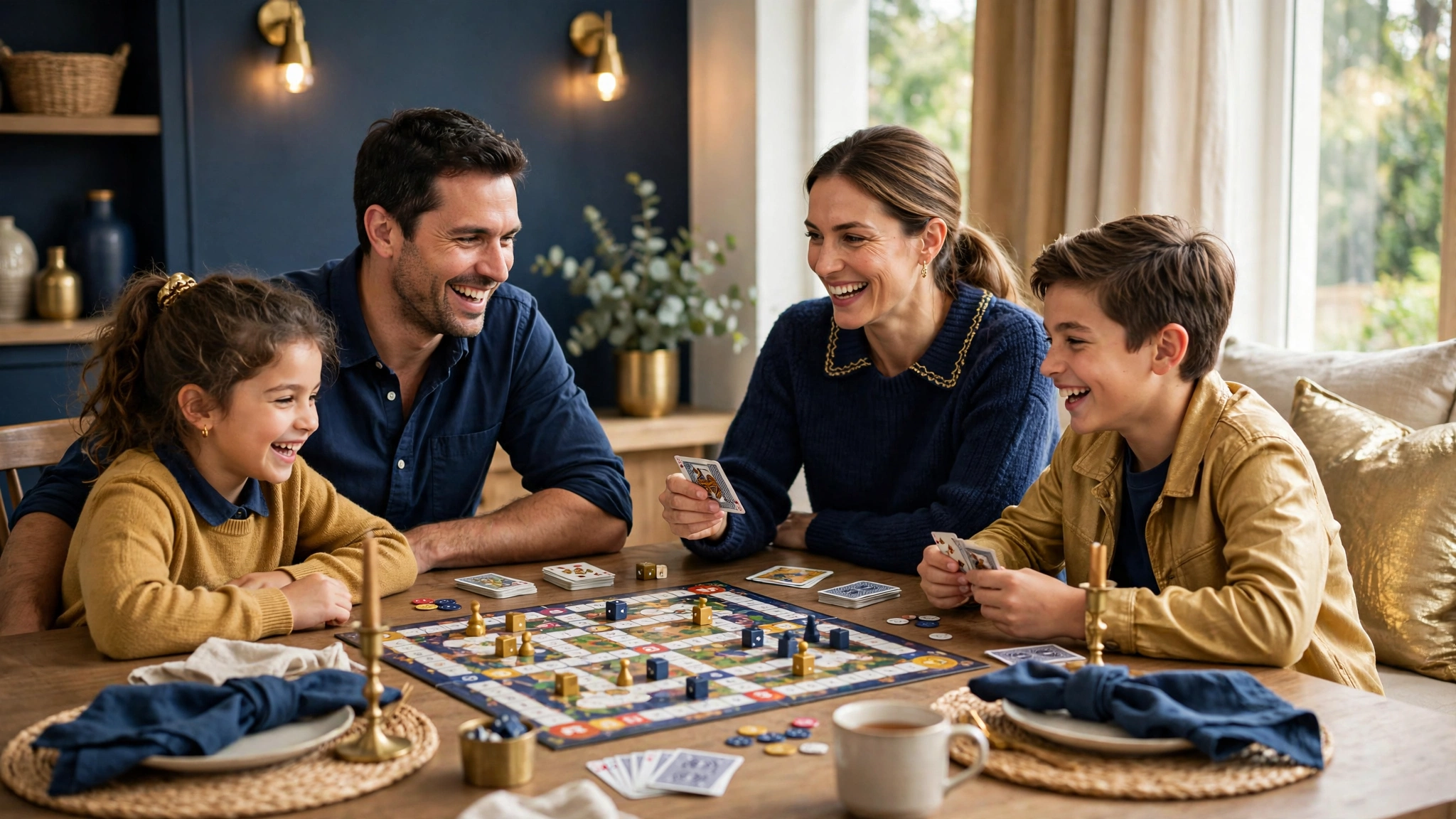
What Are the Best Board Games for Family Game Night?
The best board games for family game night are the 15 games in the table below, picked for short rules, quick turns, and fair play across ages.
| # | Game | Players | Ages | Play time | Type |
|---|---|---|---|---|---|
| 1 | Ticket to Ride | 2 to 5 | 8+ | 30 to 60 min | Strategy |
| 2 | Catan | 3 to 4 | 10+ | 60 to 90 min | Strategy |
| 3 | Azul | 2 to 4 | 8+ | 30 to 45 min | Strategy |
| 4 | Codenames | 4 to 8+ | 10+ | 15 min | Party |
| 5 | Pandemic | 2 to 4 | 8+ | 45 to 60 min | Cooperative |
| 6 | Carcassonne | 2 to 5 | 7+ | 30 to 45 min | Strategy |
| 7 | Dixit | 3 to 6 | 8+ | 30 min | Party |
| 8 | Sushi Go Party! | 2 to 8 | 8+ | 20 min | Party |
| 9 | Kingdomino | 2 to 4 | 8+ | 15 to 20 min | Strategy |
| 10 | Sequence | 2 to 12 | 7+ | 15 to 30 min | Strategy |
| 11 | Blokus | 2 to 4 | 7+ | 20 to 30 min | Strategy |
| 12 | Just One | 3 to 7 | 8+ | 20 min | Cooperative party |
| 13 | Forbidden Desert | 2 to 5 | 10+ | 45 min | Cooperative |
| 14 | Telestrations | 4 to 8 | 8+ | 20 to 30 min | Party |
| 15 | Herd Mentality | 4 to 20 | 10+ | 20 min | Party |
Ticket to Ride leads the list because it suits the widest table: 2 to 5 players, ages 8 and up, and a game that ends in under an hour. The Spiel des Jahres is a German award for family-friendly games, created in 1978, and 6 games on this list have won it: Carcassonne (2001), Ticket to Ride (2004), Kingdomino (2017), Azul (2018), Just One (2019), and Cascadia (2022). A win can lift sales to around 500,000 copies (Source: Wikipedia, 2026).

How Do You Pick a Family Board Game?
You pick a family board game by checking 5 facts before you buy: the youngest player’s age, the usual player count, the play time, the teach time, and the game type. A game that fails any one of these 5 checks stays on the shelf.
Start with the youngest player. A box age is a guide, not a promise: a game marked 8 and up still needs reading help for a 7 year old, so check the reading load, not just the number. Next, count the usual table: a 2 to 4 player game fails a family of 6, so big families need Sequence at up to 12 players or Herd Mentality at up to 20 players. Then check play time against bedtime: Catan suits a weekend at 60 to 90 minutes, while Codenames suits a school night at 15 minutes. Teach time matters too: rules that take 20 minutes to explain lose the room before the first turn, so look for rules taught in 5 minutes. Last, pick the type that fits the mood: strategy for thinking, cooperative for teamwork, and party for laughs.
Which Family Board Games Work Best for Young Kids?
The family board games that work best for young kids are Blokus, Sequence, and Carcassonne, because all 3 use shapes and pictures more than words and all 3 play in under 45 minutes. A child aged 4 to 7 needs no reading, short turns, and a clear visual goal.
Blokus is the best first strategy game for ages 7 and up: each player places coloured pieces on a shared board, and the player who places the most pieces wins. The rules take 2 minutes to teach, turns last seconds, and a child can beat an adult by blocking space. Sequence suits ages 7 and up and larger groups: players place chips on a board to make 5 in a row, and teams of 2 or 3 let a young child play with a parent. Carcassonne suits ages 7 and up: players draw a tile, place it to build a shared map of roads and cities, and place a follower to score points. The tiles teach planning without reading, and the game ends in 30 to 45 minutes.
Which Family Board Games Work Best for Mixed Ages?
The family board games that work best for mixed ages are Ticket to Ride, Azul, Kingdomino, and Sushi Go Party!, because each one gives a child a real chance to win while still giving adults choices to plan. Mixed-age play fails when the adult always wins, so the best games mix luck with choice.
Ticket to Ride works for ages 8 and up: players collect coloured train cards and claim railway routes on a map. The goal is visible on the board, the rules take 5 minutes to teach, and a child who plans one route can beat an adult who plans three. Azul works for ages 8 and up: players draft coloured tiles and place them in a pattern, so no reading is needed. Kingdomino works for ages 8 and up: players pick domino tiles with land types and build a 5 by 5 kingdom, and the game ends in 15 to 20 minutes. Sushi Go Party! works for ages 8 and up: players pass hands of sushi cards and keep the cards that score best, and the pictures do the teaching. The shared rule for mixed ages is simple: pick games where the board shows the goal and the pieces show the choices.
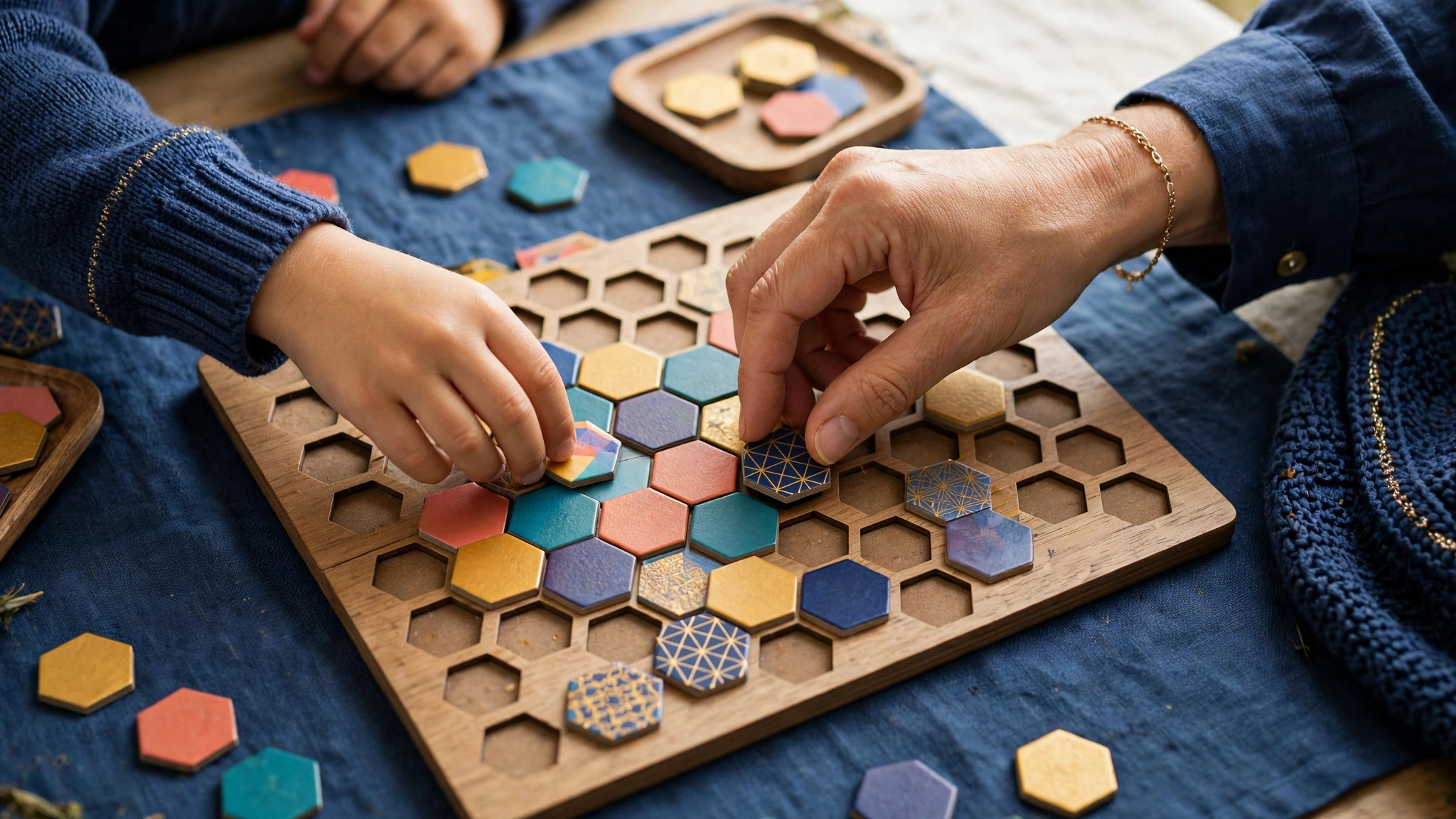
What Are the Best Strategy Board Games for Families?
The best strategy board games for families are Ticket to Ride, Catan, Azul, Carcassonne, and Kingdomino, because each one teaches planning in under 5 minutes and finishes in under 90 minutes.
Catan is the deepest pick on this list: players trade wood, brick, sheep, wheat, and ore to build roads, settlements, and cities on a shared island. Catan first appeared in Germany in 1995, and it plays 3 to 4 players in 60 to 90 minutes for ages 10 and up. The trading is the heart of the game: a player who trades well wins, and a player who never trades loses. Azul is the calmest pick, Carcassonne is the most open pick, and Kingdomino is the fastest at 15 to 20 minutes. Start with Ticket to Ride, then try Catan when the youngest player turns 10.
What Are the Best Cooperative Family Board Games?
The best cooperative family board games are Pandemic, Forbidden Desert, and Just One, because all 3 make the whole table win or lose together and all 3 give every player a job to do.
Pandemic is the best-known cooperative board game: 2 to 4 players work as a team to stop 4 diseases from spreading across a world map, and the table wins or loses as one team. Pandemic plays in 45 to 60 minutes for ages 8 and up, and each turn the table talks, agrees a plan, and then moves. Forbidden Desert plays 2 to 5 players in 45 minutes for ages 10 and up: the team is lost in a desert, the board shifts each turn, and the team must find parts and escape before the storm buries them. Just One is the lightest cooperative pick: 3 to 7 players give one-word clues to help one player guess a secret word, and matching clues get removed, so the clues must be original.

What Are the Best Party Board Games for Big Groups?
The best party board games for big groups are Codenames, Dixit, Telestrations, Sushi Go Party!, and Herd Mentality, because each one plays 6 or more people, teaches in under 5 minutes, and finishes in 30 minutes or less.
Codenames plays 4 to 8 or more players in 15 minutes for ages 10 and up: two teams race to find their secret words from one-word clues given by a spymaster. The spymaster needs a strong vocabulary, so put an adult in that role and mix ages on each team. Dixit plays 3 to 6 players in 30 minutes for ages 8 and up: players pick a picture card that matches a spoken clue, and the rest try to spot it. Dixit rewards imagination, not knowledge, so a child can beat an adult. Telestrations plays 4 to 8 players in 20 to 30 minutes for ages 8 and up: players draw a word, pass the sketch, and guess what the drawing shows, and the chain of wrong guesses is the fun. Herd Mentality plays 4 to 20 players in 20 minutes for ages 10 and up: players write the answer they think the group will give, and anyone who disagrees with the group gets the pink cow.
After the game, plan the rest of the night with Best Mystery Movies to Watch Right Now.
Classic vs Modern Family Board Games: Which Should You Buy?
Modern family board games suit most families better than classics, because modern games finish faster, teach faster, and give every player a chance, while classics suit families who want a familiar game with no learning curve.
| Feature | Classic games | Modern games |
|---|---|---|
| Examples | Monopoly, The Game of Life, Scrabble | Ticket to Ride, Catan, Azul, Cascadia |
| Typical play time | 60 to 180 minutes | 15 to 60 minutes |
| Teach time | Already known | 5 minutes to teach |
| Player elimination | Common | Rare, all play to the end |
| Luck vs choice | Heavy luck | Mixed luck and choice |
| Best for | Nostalgia nights, grandparents | Weekly game night, mixed ages |
Monopoly is the biggest classic: it is licensed in 103 countries and printed in 37 languages (Source: Wikipedia, 2026). The Game of Life is the oldest classic on this list: it first appeared in 1860 as The Checkered Game of Life (Source: TechEngage, 2026). Classics have one weakness: Monopoly can run past 2 hours and can eliminate a player early, so the eliminated player watches the rest of the game. Modern games fixed this: Ticket to Ride ends in under an hour and keeps every player in the game to the last turn.

How Do You Run a Weekly Family Game Night?
You run a weekly family game night by fixing one evening, one start time, and one rotation: one 30 minute game and one 15 minute game per night, with a different player picking the games each week.
Follow these 5 steps each week:
- Fix the night and the hour, such as Friday at 7:00 PM, and keep it for 4 weeks.
- Pick one 30 minute game and one 15 minute game before dinner.
- Teach the rules in 5 minutes or less, and play one practice round if the game is new.
- Let a different player choose next week’s games, and rotate the chooser each week.
- End on time, even mid-game, and note the winner on a score sheet on the fridge.
Snacks help: keep food away from the board and use a side table, because grease and cards do not mix. Phones go in a basket by the door for the hour. Board game cafes show how strong this habit is: more than 5,000 board game cafes opened in the United States in 2016 alone (Source: Wikipedia, 2026). At my own table, the 30 minute games get played twice as often as the 90 minute games, because the short games leave time for a second round.
What Mistakes Ruin Family Game Night?
The mistakes that ruin family game night most are picking a game that runs too long, picking a game above the youngest player’s age, skipping the rules talk, letting one player dominate, and playing to win instead of playing to play.
The too-long game is the most common: a 90 minute game on a school night ends with tired players and a half-finished board, so save Catan for the weekend and play Kingdomino on weeknights. The wrong-age pick is next: a game that needs reading fails a 7 year old, so check the reading load before the box age. The skipped rules talk wastes the first 20 minutes, so teach the rules before the first turn and play one open practice round. The win-at-all-costs mood spoils the night for children, so score the night on laughs and close games, not on wins alone.
Conclusion
The best family board games for family game night give every player a real turn, a real choice, and a real chance to win, and the 15 games in this guide cover ages 4 and up in 15 to 90 minutes. Start with Ticket to Ride, add Azul and Codenames, then try Catan when the youngest player turns 10. Fix one night a week, keep the games short, and let a different player choose each week. Voice of Wave covers family entertainment picks in this plain style.
Read more entertainment guides on the Voice of Wave blog.
FAQs
What is the best board game for family game night?
The best board game for family game night is Ticket to Ride, because it plays 2 to 5 people aged 8 and up in 30 to 60 minutes, teaches in 5 minutes, and gives every player a clear goal. Ticket to Ride won the Spiel des Jahres in 2004, and it suits families new to board games.
What board games are good for a family with young kids?
Blokus, Sequence, and Carcassonne are good for a family with young kids, because all 3 use shapes and pictures more than words and all 3 play in under 45 minutes. Blokus and Sequence suit ages 7 and up, while Carcassonne suits ages 7 and up with a map that grows tile by tile.
How many players do family board games support?
Family board games support 2 to 20 players, and the right count depends on the game. Ticket to Ride plays 2 to 5, Catan plays 3 to 4, Codenames plays 4 to 8 or more, Sequence plays 2 to 12, and Herd Mentality plays 4 to 20. Big families should pick Sequence or Herd Mentality.
How long should a family game night last?
A family game night should last 60 to 90 minutes, with one 30 minute game and one 15 minute game per night. A 60 minute night fits a school night, while a 90 minute night suits a weekend. End on time even mid-game, so the night stays a habit instead of a chore.
Are cooperative board games good for families?
Yes, cooperative board games are good for families, because the whole table wins or loses together and no child loses alone. Pandemic, Forbidden Desert, and Just One are the best cooperative picks for families. Use one house rule: the player whose turn it is makes the final call.
What is the best board game for a large family?
The best board game for a large family is Sequence, because it plays 2 to 12 players in teams and teaches in 5 minutes. Herd Mentality is the best party pick for large families, because it plays 4 to 20 players in 20 minutes. Run two tables at once when the group passes 12 players.