
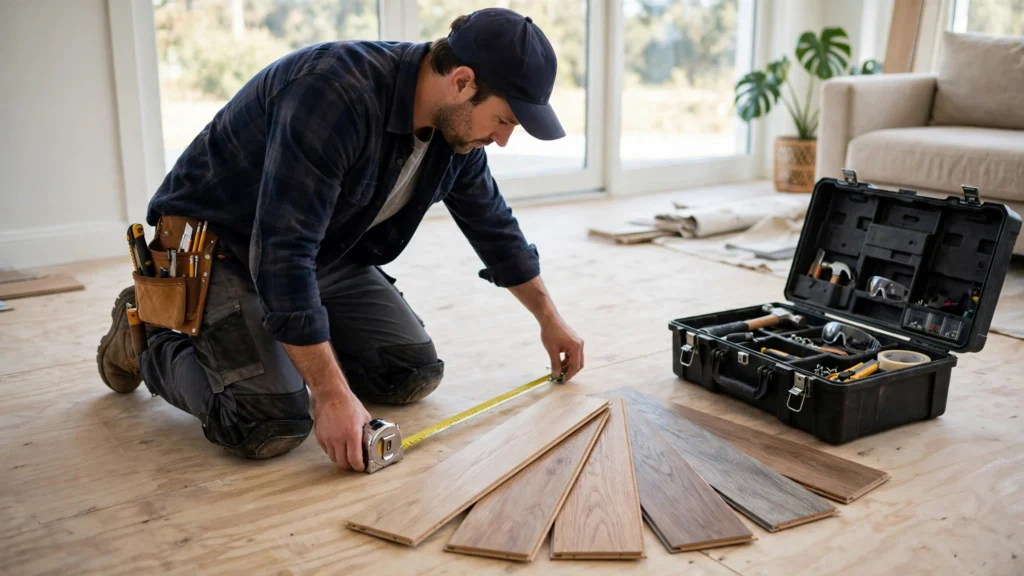
A flooring contractor is a tradesperson who measures, prepares, and installs floor covering in a home, and you choose a flooring contractor by checking license and insurance, comparing 3 itemized quotes, and calling 2 recent references before you sign a contract. A flooring contractor handles 5 main jobs: site measurement, subfloor preparation, old floor removal, new floor installation, and trim and finish work. This guide covers what a flooring contractor does, how to find one, how to check license, insurance, and experience, what questions to ask, how to compare quotes, 2026 costs, contractor vs handyman vs store, warning signs, contract terms, and installation day and inspection. The steps below work for hardwood, luxury vinyl plank, laminate, tile, carpet, and stone floors, and they fit small rooms and whole homes alike.
Key Takeaways
- Check license and insurance first: ask for the license number and insurance certificate before you discuss price.
- Compare 3 itemized quotes: each quote must list material, labor, removal, subfloor work, trim, and disposal.
- Call 2 recent references: one recent client and one client from 2 years ago.
- Get the workmanship warranty in writing: 1 to 2 years is common, and the product warranty is separate.
- Hold final payment until inspection: pay the balance only after a joint walkthrough and a written punch list.
Table of Contents
- What Does a Flooring Contractor Do?
- How Do You Find a Flooring Contractor Near You?
- How Do You Check a Flooring Contractor License, Insurance, and Experience?
- What Questions Should You Ask a Flooring Contractor?
- How Do You Compare Flooring Contractor Quotes?
- How Much Does a Flooring Contractor Cost in 2026?
- Flooring Contractor vs Handyman vs Flooring Store: Which Option Fits?
- What Warning Signs Should You Watch For?
- What Should a Flooring Contract Include?
- How Do You Manage Installation Day and Inspect the Finished Floor?
- Conclusion
- Frequently Asked Questions
What Does a Flooring Contractor Do?
A flooring contractor is a tradesperson who installs floor covering, and a flooring contractor measures rooms, checks the subfloor, removes the old floor, installs the new floor, and fits trim and transitions. A flooring contractor works with 7 main material types: solid hardwood, engineered hardwood, luxury vinyl plank, laminate, ceramic tile, carpet, and natural stone. A flooring contractor also orders material and schedules the crew.
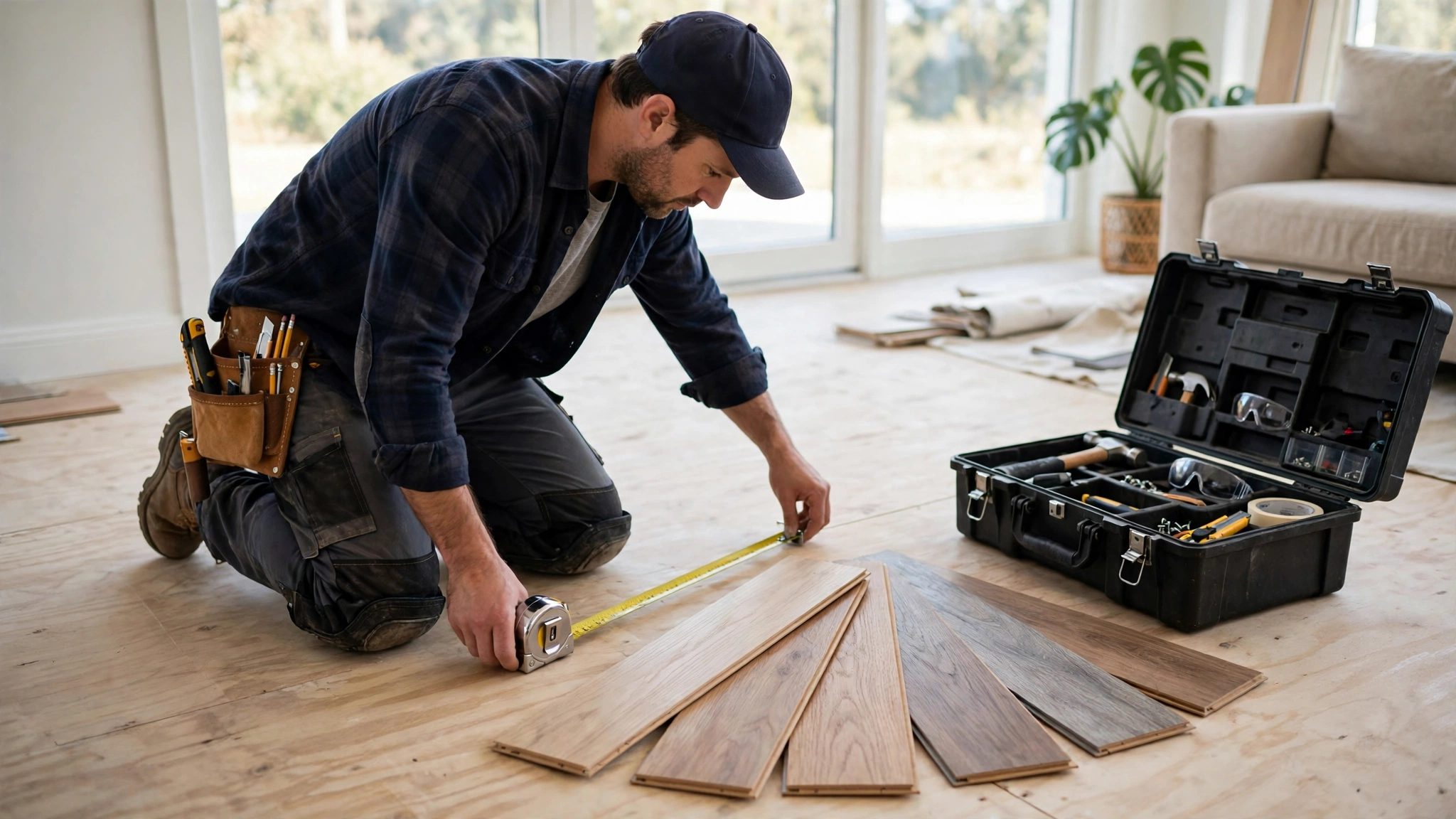
A flooring contractor starts with a site visit that covers room measurement, subfloor flatness, moisture readings, and damage under the old floor. Flooring materials include carpet, laminate, tile, and vinyl as standard floor covering choices. A flooring contractor who quotes from photos alone cannot check the subfloor, and the subfloor decides how long the new floor lasts.
How Do You Find a Flooring Contractor Near You?
To find a flooring contractor near you, ask 3 people you trust for a referral, search Google Reviews and the Better Business Bureau, and shortlist 3 flooring contractors with recent local work in your material. Referrals from people whose floors you have walked on carry more weight than star ratings alone. You can see the work and ask about price, schedule, and cleanup. Ask each referral: did the price match the quote, did the job finish on time, and does the floor still look good a year later.
Read 10 recent reviews per flooring contractor and look for repeat themes. Check the Better Business Bureau for complaint history. The Home Improvement guides on Voice of Wave cover related house care topics, and this guide fits that same practical pattern: facts first, then steps.
How Do You Check a Flooring Contractor License, Insurance, and Experience?
To check a flooring contractor license, insurance, and experience, ask for the license number and the insurance certificate, verify the license with your state licensing board, and ask for 2 references in your material. License rules for flooring vary by state and city, so check the rule where the work will happen, not where the flooring contractor is based. California lists flooring work under C-15 and tile work under C-54, while other states use a general contractor license or no flooring license at all.
Insurance has 2 parts: general liability insurance, which pays for damage to your home during the work, and workers compensation insurance, which pays if a crew member is hurt on your property. Without workers compensation cover, an injury claim can reach the homeowner. Ask the insurer to send the certificate direct, because a forwarded PDF can be old or edited.
A flooring contractor should have 5 or more years of work in your material and recent jobs like yours. Ask for 2 references: one recent client and one older client from at least 2 years ago. Ask about price, schedule, cleanup, gaps, and squeaks. CFI certification tests installation skill, and NWFA training covers wood flooring. The flooring contractor must still follow the written installation instructions for your product, because a careless install can void the product warranty.

What Questions Should You Ask a Flooring Contractor?
The questions to ask a flooring contractor cover license, insurance, experience, scope, timeline, payment, and warranty, and you should ask all 12 questions below before you sign a contract. Ask the questions at the estimate visit, not by phone, so the flooring contractor answers while looking at your rooms and your subfloor.
- Are you licensed and insured for this work, and can you show proof today?
- How many jobs in this material have you finished in the past 12 months?
- Who will be on site each day: your employees or subcontractors?
- Will you measure and test the subfloor before you quote?
- Does the quote include removal, disposal, subfloor prep, and trim?
- How will you test subfloor moisture and flatness?
- How long will the material need to acclimate in the home before install?
- What is the start date, the finish date, and the daily work hours?
- What is the payment schedule and deposit?
- What workmanship warranty do you offer in writing?
- How will you control dust and protect the rest of the home?
- What happens if you find rot under the old floor?
Listen for clear answers on subfloor prep and acclimation: the flooring contractor should name the moisture test, the flatness limit, and the acclimation time. A change order is a written price and scope change that both sides sign before the extra work starts.
How Do You Compare Flooring Contractor Quotes?
To compare flooring contractor quotes, ask 3 flooring contractors for itemized quotes on the same scope, then compare each line, not just the total price. A good quote lists each line: material by brand and product name, installation labor, underlayment, adhesive or fasteners, subfloor prep, old floor removal, disposal, transitions, baseboards, stairs, and cleanup. A quote that leaves out subfloor prep or disposal will add those costs later as extras.
Use this 7 point check on each quote: scope (rooms, closets, stairs, and transitions named); material (brand, product, color, and wear layer stated); prep (subfloor work priced or marked as an allowance); removal (old floor, tack strips, glue, and disposal); trim (baseboards, shoe molding, and stair nosing); warranty (workmanship and product terms in writing); payment (deposit, progress, and final payment tied to inspection). A quote that is 30 percent below the other 2 quotes with no clear reason usually leaves out prep, disposal, or trim.

How Much Does a Flooring Contractor Cost in 2026?
A flooring contractor costs $1,528 to $4,850 for a typical home installation in 2026, with a national average of $3,153, according to Angi (2026), based on 5,966 verified projects. The total depends on 4 factors: material, room size, subfloor condition, and local labor rates. Labor alone often runs $2 to $8 per square foot, and installed prices fall between $4 and $15 per square foot, according to HouseCall Pro (2026).
| Flooring type | Installed cost per sq ft in 2026 | Source |
|---|---|---|
| Carpet | $2 to $8 | HouseCall Pro (2026) |
| Laminate | $3 to $8 | Renovate (2026) |
| Luxury vinyl plank | $4 to $10 | Renovate (2026) |
| Engineered hardwood | $8 to $15 | Renovate (2026) |
| Solid hardwood | $12 to $22 | Renovate (2026) |
| Ceramic tile | $6 to $13 | Renovate (2026) |
Subfloor work is the main cost surprise: leveling, plywood replacement, and moisture barriers are often priced apart from the base install. New hardwood floors return about 118 percent of their cost at resale, and refinishing returns about 147 percent, according to the National Association of Realtors 2022 Remodeling Impact Report.
Flooring Contractor vs Handyman vs Flooring Store: Which Option Fits?
A flooring contractor fits most full room installs, a handyman fits small repairs, and a flooring store fits buyers who want one party to supply and install the floor. The 3 routes differ in 5 ways: skill depth, warranty, material supply, price, and who answers when a fault appears. A flooring contractor brings material skill, a written workmanship warranty, and a crew that does flooring every week. A handyman brings lower cost and fast booking, but often lacks flooring certification and a written workmanship warranty.
| Factor | Flooring contractor | Handyman | Flooring store |
|---|---|---|---|
| Best for | Full room or whole home | Small repairs | Supply plus install |
| Material skill | Deep, material matched | General, varies by job | Deep, store vetted installers |
| Workmanship warranty | Yes, 1 to 2 years in writing | Rarely in writing | Yes, through the store |
| Who supplies material | You or contractor | Usually you | The store |
| Who answers faults | The contractor | Often unclear | The store |
A general contractor is a construction manager who oversees a building site and manages vendors and trades, and a flooring contractor is the trade specialist inside that chain. Pick a flooring contractor for 2 or more rooms, for tile or hardwood, or when the subfloor needs repair. Pick a handyman only for a small repair, such as replacing 3 damaged planks, and only when the handyman can show past flooring work.
What Warning Signs Should You Watch For?
Warning signs when hiring a flooring contractor are no license or insurance proof, a quote with no itemized scope, a demand for full payment upfront, no written warranty, and pressure to sign on the first visit. A flooring contractor who will not show a license number or an insurance certificate has not met the first check. No low price makes up for that gap. A flooring contractor who quotes by phone has not seen the subfloor, and the subfloor is where most install failures start.
Watch for 6 more signs: no local references; a quote that names no brand or product; no written warranty; a start date that keeps moving; a crew that changes every day with no named lead installer; and a demand that you buy all material yourself with no product warranty route. One sign alone may have a fair reason, so ask about it. Two or more signs together mean you should move to the next flooring contractor on your shortlist.
Planning a full floor replacement? Read the flooring renovation guide to compare costs and types before you pick a contractor.
What Should a Flooring Contract Include?
A flooring contract should include the full scope, the exact material, the total price, the payment schedule, the start and finish dates, the workmanship warranty, and the change order rule, all in writing before work starts. A verbal promise has no weight when a dispute starts, so every term must sit in the signed contract. The contract should name each room, closet, stair run, and transition, and the brand, product, color, and wear layer of the material.
Payment terms need 3 lines: the deposit, the progress payment, and the final payment. A common plan is 30 percent at signing, 30 percent when material arrives, and 40 percent after the final walkthrough, and you should never pay more than 50 percent upfront. Tie the final payment to the walkthrough and to a written punch list. The contract should also state work hours, cleanup, dust control, furniture moving, permits, and the workmanship warranty length. Keep a signed copy, the quote, the receipts, and the warranty papers in one folder.
How Do You Manage Installation Day and Inspect the Finished Floor?
To manage installation day and inspect the finished floor, clear each room, agree the daily start time and dust control with the flooring contractor, and walk every room with the contractor before you pay the balance. Remove small items and breakables yourself, and move cars out of the driveway for the delivery truck.
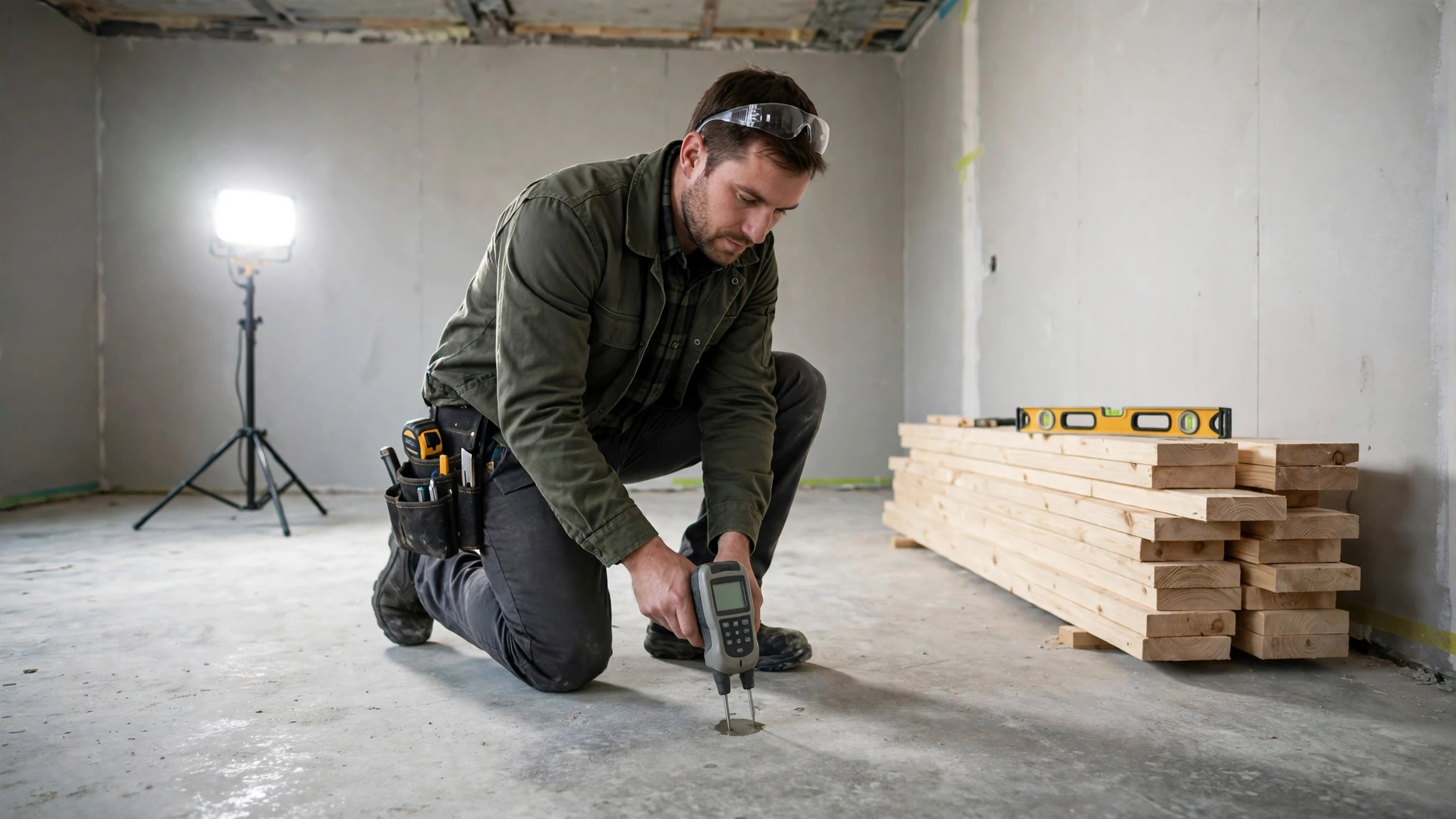
Installation day runs in 5 stages: protection, removal, prep, install, and finish. The crew should protect hallways, seal doorways, and set up dust extraction for cutting. Prep covers moisture testing, flatness checks, leveling, and replacing soft boards. Most rooms take 1 to 3 days, while sanding and refinishing existing hardwood takes closer to a full week, according to Renovate (2026). From my own walkthroughs, the floors that failed first were laid over damp concrete with no moisture test.

Do the final walkthrough in daylight, because poor light hides gaps and finish marks. Walk the floor in socks to feel for squeaks, soft spots, and height changes. Use this 8 point check: gaps (joints are tight and even); transitions (strips sit flush, with no lip); trim (baseboards and shoe molding are fitted and finished); stairs (nosing is fixed); finish (no scratches, dents, or glue marks); squeaks (no movement or noise); doors (doors swing free); cleanup (no dust or offcuts left). Write every fault on the punch list with the room name and a photo, and agree a fix date. Final payment should wait until the fixes pass a second walkthrough.

Conclusion
To choose a flooring contractor, check license and insurance first, compare 3 itemized quotes, call 2 recent references, and sign a written contract with a workmanship warranty before work starts. A flooring contractor who measures the rooms, tests the subfloor, names the exact material, and puts the warranty in writing gives you a floor that lasts. A flooring contractor who skips the site visit, hides the scope in one total price, or asks for full payment upfront gives you a risk, not a deal. Use the 12 questions and the 7 point quote check in this guide, and hold the final payment until the walkthrough passes. The right flooring contractor costs more than the cheapest bid and less than doing the job twice.
Frequently Asked Questions
How do I find a good flooring contractor near me?
To find a good flooring contractor near you, ask 3 trusted people for referrals, read 10 recent reviews per candidate, and shortlist 3 flooring contractors with recent local work in your material. Check the Better Business Bureau for complaint history, ask each candidate for 2 references, and visit one past job if you can.
How much does a flooring contractor cost?
A flooring contractor costs $1,528 to $4,850 for a typical home installation in 2026, with a national average of $3,153, according to Angi (2026). Labor alone often runs $2 to $8 per square foot, and installed prices for most home projects fall between $4 and $15 per square foot, according to HouseCall Pro (2026).
Do flooring contractors need to be licensed and insured?
Yes, flooring contractors need a license and insurance where the local rules require them, and you should verify both before you sign a contract. License rules vary by state and city, so check the rule where the work will happen. Ask for general liability and workers compensation insurance, and ask the insurer to send the certificate direct to you.
What questions should I ask a flooring contractor before hiring?
Ask a flooring contractor about license, insurance, material experience, subfloor testing, scope, timeline, payment, and warranty before you hire. Ask who will be on site each day, whether the quote includes removal and disposal, and how the crew will control dust. Ask for the workmanship warranty in writing and for 2 references you can call.
How long does flooring installation take?
Flooring installation takes 1 to 3 days per room for most materials, while sanding and refinishing existing hardwood takes closer to a full week, according to Renovate (2026). A kitchen can be out of use for 5 to 10 days, and a whole home install can run 1 to 3 weeks. Ask for a written day plan before work starts.
Should I buy my own flooring materials or let the contractor supply them?
Let the flooring contractor supply the material when you want one party to take charge of quality, delivery, and warranty. Buy the material yourself only when you want a specific product the contractor cannot source. Warranty coverage often depends on the product, the installer, and whether the install followed the written instructions.