
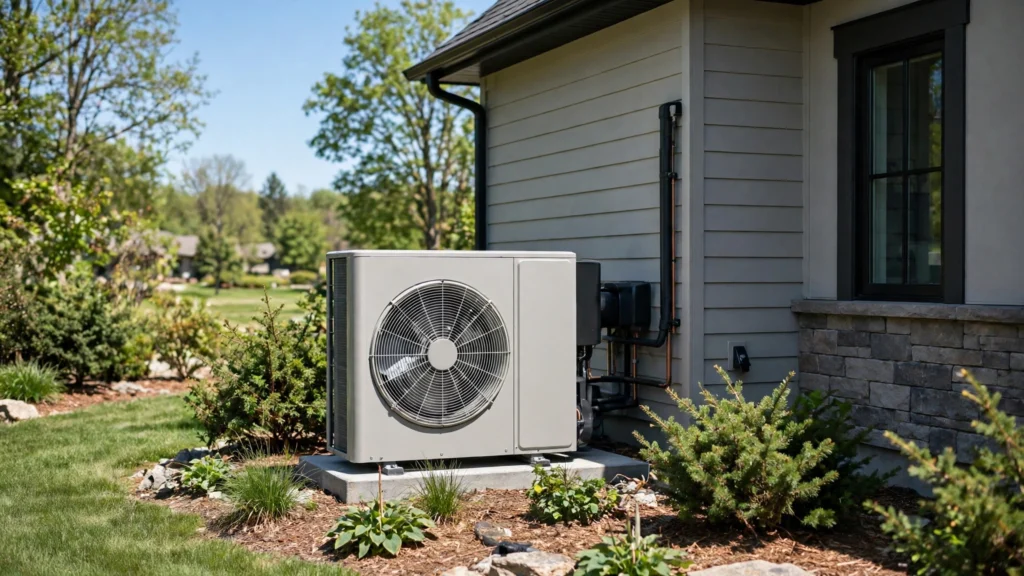
Heat pump systems move heat instead of making heat, so one unit heats a home in winter and cools it in summer. A heat pump system uses electricity and a refrigerant cycle to pull heat from outdoor air, ground, or water and release it indoors, then reverses the flow to remove indoor heat in warm weather.
Heat pump systems come in 5 main types: air-source ducted, ductless mini-split, ground-source, air-to-water, and hybrid dual-fuel systems. This guide explains how heat pump systems work, the parts inside them, efficiency ratings, installed costs, sizing, cold-climate performance, and maintenance. Browse more Home Improvement guides for related home topics. The guide ends with a decision checklist for comparing quotes.
Key Takeaways
- Heat pump systems move heat with a refrigerant cycle, and one unit provides both heating and cooling.
- Air-source systems are the most common type, and ground-source systems give the highest efficiency at the highest install cost.
- A COP of 3 means 3 units of heat move indoors for each unit of electricity used.
- Installed cost for a ducted air-source system often falls between $6,500 and $12,000 (Source: Modernize, 2026).
- Correct size comes from a Manual J load calculation, not from floor area alone.
- Cold-climate models heat well below freezing, and a hybrid system covers the coldest days.
Table of Contents
- What Are Heat Pump Systems?
- How Do Heat Pump Systems Work?
- What Are the Main Types of Heat Pump Systems?
- What Parts Make Up a Heat Pump System?
- How Efficient Are Heat Pump Systems?
- How Much Do Heat Pump Systems Cost?
- How Do You Size a Heat Pump System for Your Home?
- Are Heat Pump Systems Right for Cold Climates?
- What Maintenance Do Heat Pump Systems Need?
- Heat Pump Systems vs Furnaces and Air Conditioners
- How Do You Choose the Right Heat Pump System?
- Conclusion
- Frequently Asked Questions
What Are Heat Pump Systems?
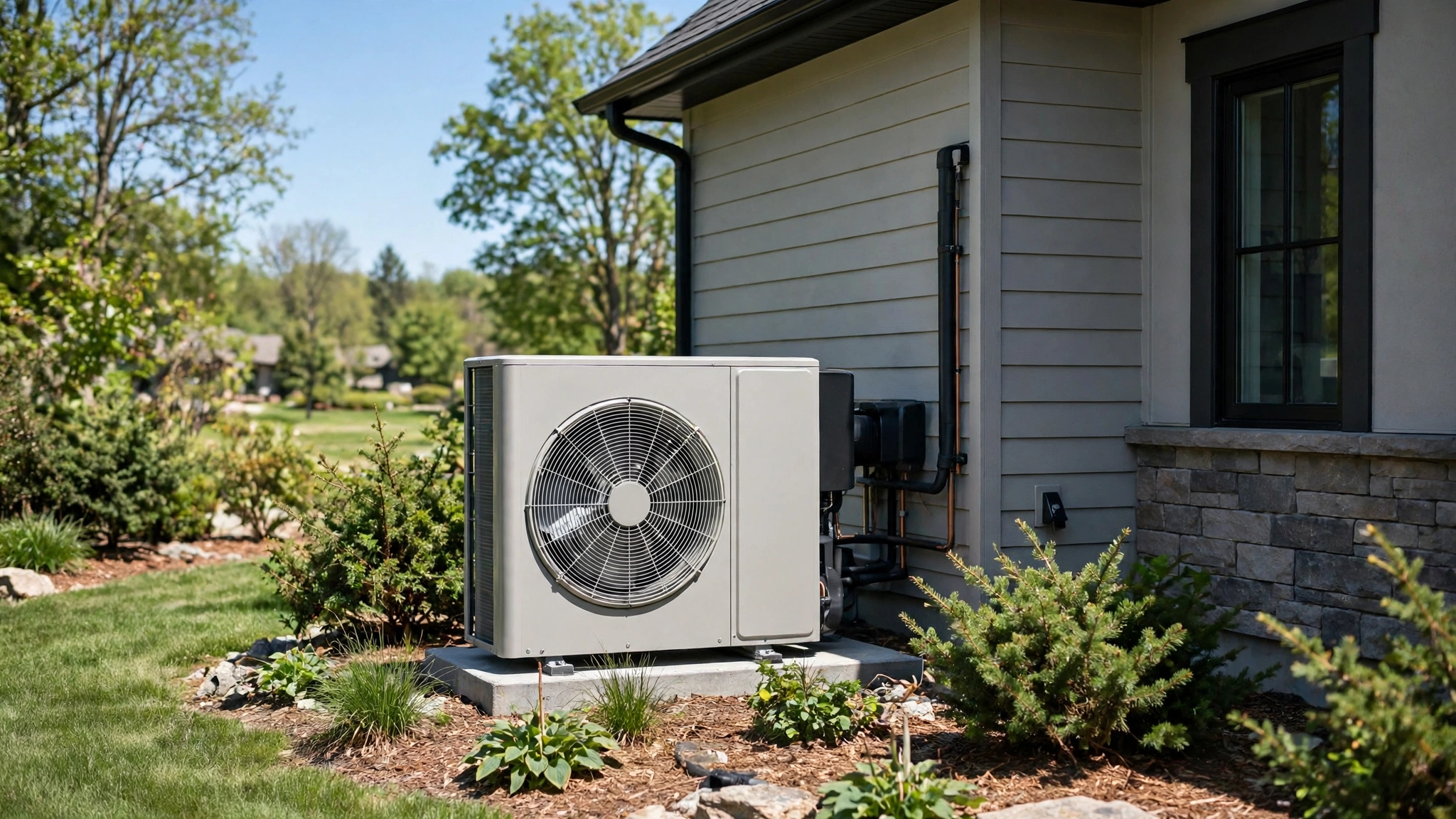
Heat pump systems are electric heating and cooling systems that transfer heat between a home and the outdoors with a refrigerant cycle. Heat pump systems heat a home by moving outdoor heat indoors, and heat pump systems cool a home by moving indoor heat outdoors. A heat pump system replaces a separate furnace and air conditioner in most homes.
A furnace burns fuel or uses resistance coils to create heat, and a heat pump system moves heat that already exists in outdoor air, ground, or water. Heat pump systems can transfer 1 to 4.5 kWh of thermal energy into a building for each 1 kWh of electricity used (Source: Wikipedia, 2026). An air conditioner cools only, and a heat pump system adds a reversing valve, so the same hardware heats in winter. Ducted systems use existing ductwork, and ductless systems use wall-mounted indoor heads.
How Do Heat Pump Systems Work?
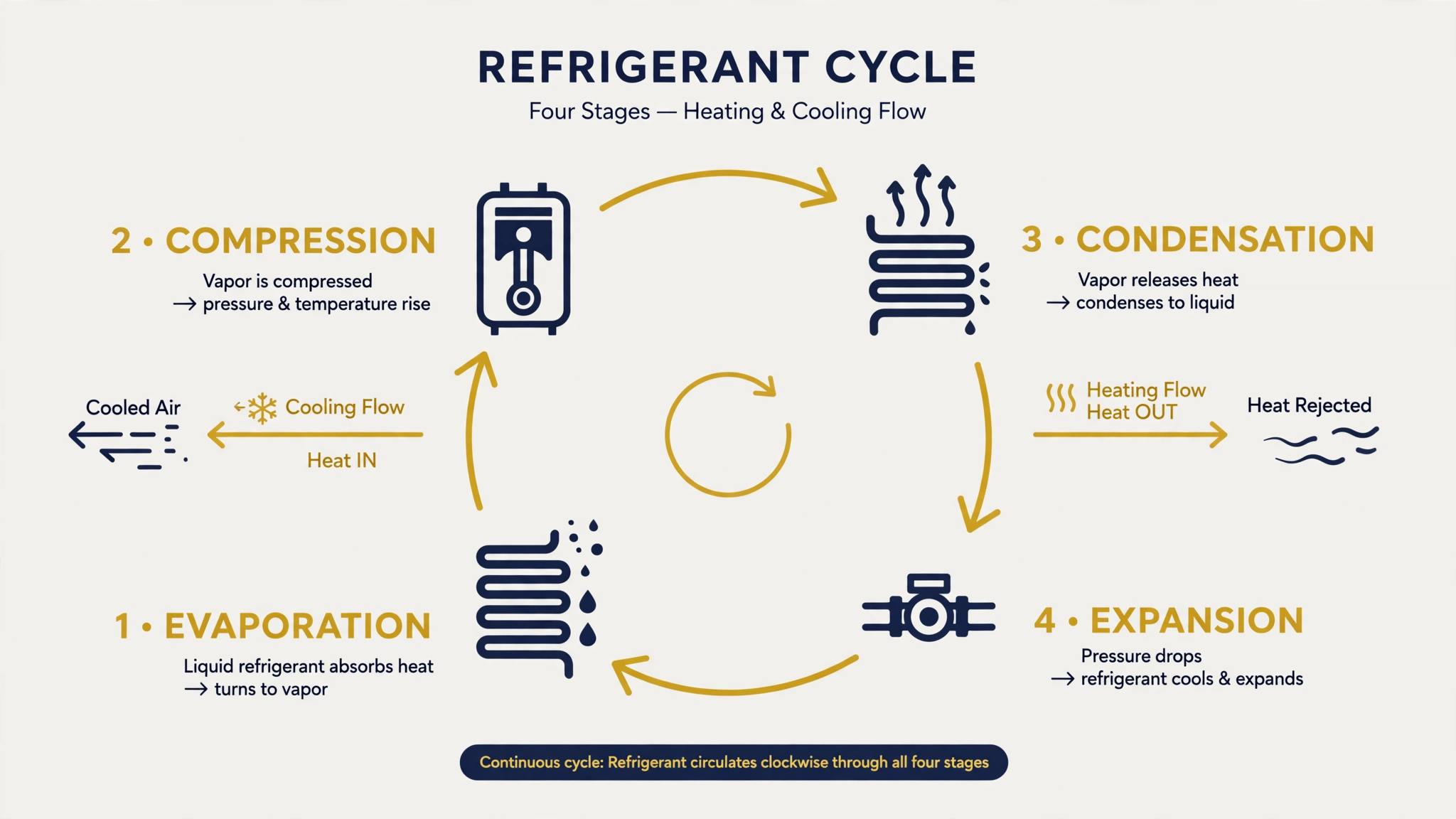
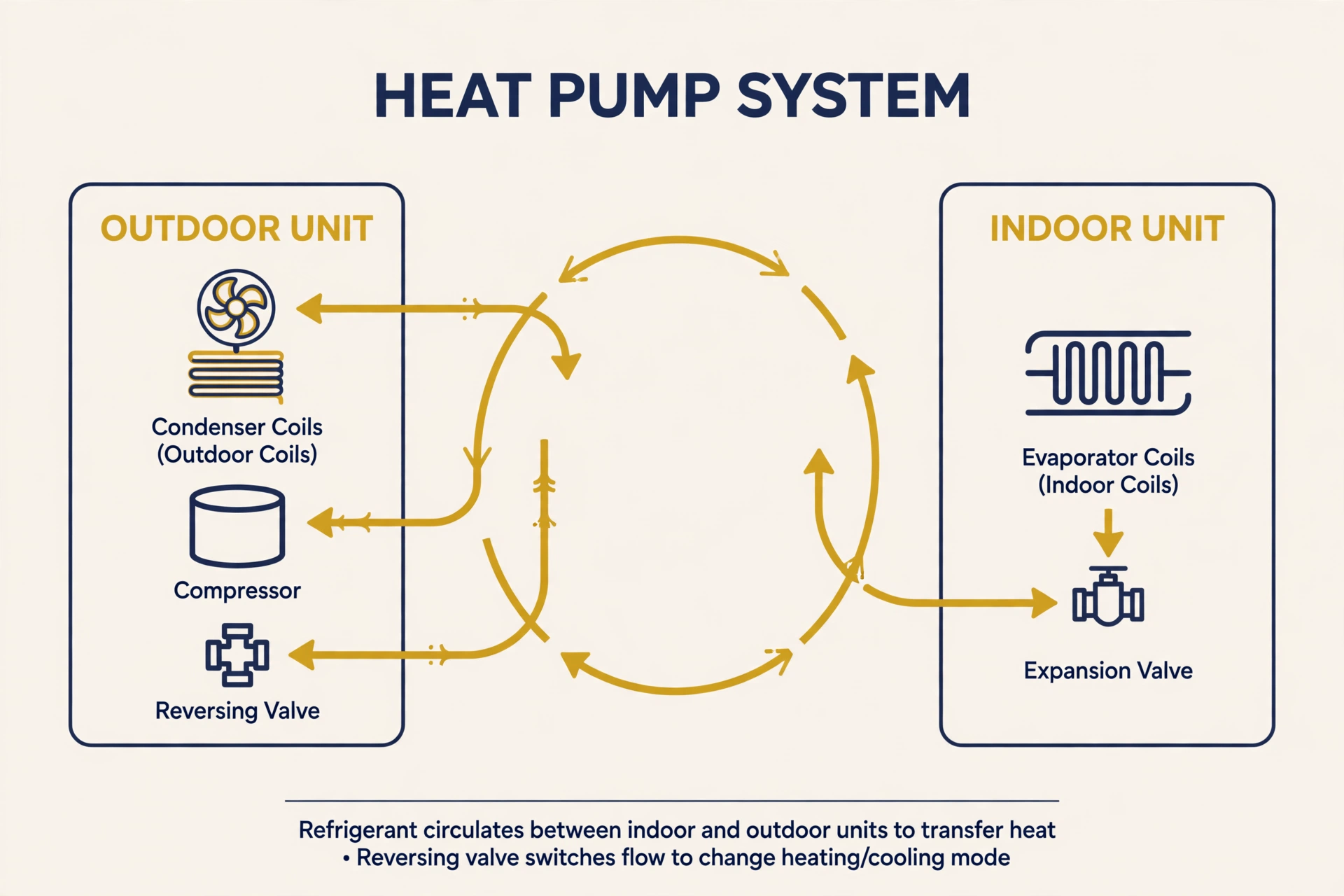
Heat pump systems work by circulating refrigerant through a closed loop that absorbs heat in one place and releases heat in another place. Heat pump systems repeat a 4-stage cycle of evaporation, compression, condensation, and expansion. A reversing valve flips the direction of refrigerant flow, so heat pump systems switch between heating mode and cooling mode with the same parts.
The 4 stages run in order in heating mode:
- Evaporation: Cold refrigerant in the outdoor coil absorbs heat from outdoor air and turns into a gas.
- Compression: The compressor squeezes the gas, and pressure and temperature rise.
- Condensation: Hot gas in the indoor coil releases heat into the home and turns back into a liquid.
- Expansion: The expansion valve drops the pressure, and the cycle starts again.
Heat pump systems pull heat from cold outdoor air because cold air still holds heat energy above absolute zero. A practical check I use on a cold morning: stand near the outdoor unit, listen for a steady fan sound, and check that warm air flows from the indoor vents within a few minutes. In cooling mode, the cycle runs in reverse. Learn how a heat pump moves heat in the full technical reference.
What Are the Main Types of Heat Pump Systems?
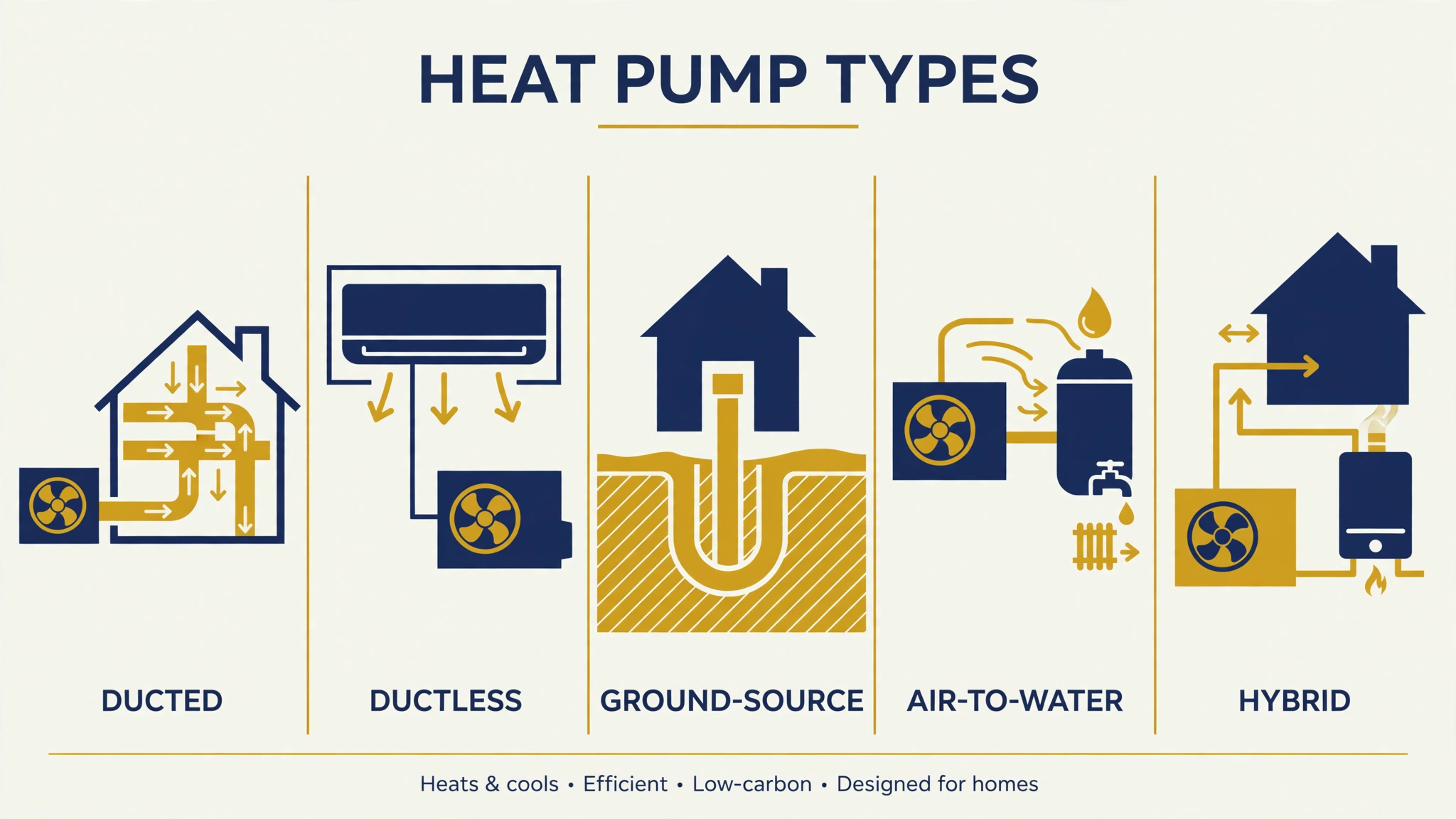
Heat pump systems come in 5 main types: air-source ducted, ductless mini-split, ground-source, air-to-water, and hybrid dual-fuel systems. Heat pump systems differ by heat source, by duct needs, and by install cost. Air-source heat pump systems are the most common type in US homes, and ground-source heat pump systems give the highest efficiency.
Air-source systems move heat between indoor air and outdoor air, and air-source systems cost the least to install. Ductless mini-split systems heat and cool single rooms without ducts, and each indoor head has its own control. Ground-source systems exchange heat with the ground through buried loops and hold efficiency in very cold and very hot weather. Air-to-water systems move heat into water for radiators and underfloor heating. Hybrid systems pair a heat pump with a gas or oil furnace for the coldest days. Cold-climate systems use inverter compressors and larger coils to hold output well below freezing.
| Type | Heat source | Ducts needed | Install cost range | Best for |
|---|---|---|---|---|
| Air-source ducted | Outdoor air | Yes | $6,500 to $12,000 | Homes with ducts |
| Ductless mini-split | Outdoor air | No | $2,000 to $6,000 per zone | Rooms without ducts |
| Ground-source | Ground | Yes or no | $15,000 to $35,000 | Long-term homes |
| Air-to-water | Outdoor air | Water pipes | Varies by home | Hydronic heating homes |
| Hybrid dual-fuel | Outdoor air plus furnace | Yes | Varies by furnace | Cold climates with a furnace |
Cost ranges in the table come from Modernize (2026) for air-source, ductless, and ground-source types.
What Parts Make Up a Heat Pump System?
Heat pump systems have 6 main parts: an outdoor unit, an indoor unit, a compressor, two coils, an expansion valve, and a reversing valve. Heat pump systems move refrigerant between the outdoor unit and the indoor unit through copper lines, and heat pump systems use a thermostat to set the target temperature.
| Part | Job |
|---|---|
| Outdoor unit | Holds the compressor, outdoor coil, and fan; needs clear airflow. |
| Indoor unit | Holds the indoor coil and air handler; feeds ducts or a wall head. |
| Compressor | Pumps refrigerant and raises its pressure and temperature. |
| Coils | The evaporator coil absorbs heat, and the condenser coil releases heat. |
| Expansion valve | Drops pressure so refrigerant cools and absorbs heat again. |
| Reversing valve | Directs flow, and the reversing valve lets one machine heat and cool. |
The thermostat controls the system. A smart thermostat can stage auxiliary heat so the backup heater runs only when the heat pump cannot meet the load. Set the thermostat and leave it steady, because large setbacks force the backup heater on.
How Efficient Are Heat Pump Systems?
Heat pump systems are efficient because heat pump systems move 2 to 5 units of heat for each unit of electricity used, while resistance heat makes 1 unit per unit. Four ratings show heat pump efficiency: COP, SEER2, HSPF2, and EER2. COP, or coefficient of performance, is the ratio of heat moved to electricity used.
SEER2 rates cooling efficiency over a full season, and higher SEER2 means lower cooling cost. HSPF2 rates heating efficiency over a full season, and higher HSPF2 means lower heating cost. EER2 rates cooling at one peak condition, and SCOP averages COP over a full heating season.
The US Department of Energy states that modern air-source heat pumps can reduce electricity use for heating by about 50 percent compared with electric furnaces or baseboard heaters (Source: US Department of Energy, 2026). Ground-source systems reach a COP of 3 to 6 in normal use (Source: Wikipedia, 2026), and ground-source systems hold that range because ground temperature stays stable.
Three facts shape real efficiency. First, sealed ducts raise efficiency because leaks waste heated and cooled air. Second, radiators and underfloor heating at 30 to 40 degrees C raise COP. Third, correct size matters: an oversized system short-cycles, and an undersized system runs the backup heater too often.
How Much Do Heat Pump Systems Cost?
Heat pump systems cost $6,500 to $12,000 installed for a ducted air-source system in most US homes, before incentives (Source: Modernize, 2026). Ductless single-zone systems cost $2,000 to $6,000 installed, multi-zone ductless systems cost $8,000 to $15,000 installed, and ground-source systems cost $15,000 to $35,000 installed (Source: Modernize, 2026).
Install cost covers the outdoor unit, indoor unit, refrigerant lines, thermostat, and labour. Extra costs can add up: duct repair, an electrical panel upgrade, a concrete pad, and permits. Get each item listed on the quote.
Incentives cut the net cost. A federal tax credit covers up to $2,000 for qualifying heat pump systems that meet ENERGY STAR Most Efficient criteria (Source: ENERGY STAR, 2026). State and utility rebates add more in many areas, so check the ENERGY STAR rebate finder and the state energy office for current figures before buying. Homeowners who switch from electric resistance heat to a heat pump see a median annual saving of $300 to $650 (Source: EnergySage, 2026).
Running cost depends on the local electricity price, the local gas price, and the system COP. Divide the electricity price per kWh by the COP to get the cost per kWh of delivered heat. If electricity costs $0.18 per kWh and the heat pump runs at a COP of 3, delivered heat costs about $0.06 per kWh.
How Do You Size a Heat Pump System for Your Home?
Heat pump systems need the right size, and the right size comes from a Manual J load calculation. Heat pump systems sized by floor area alone often end up too large or too small. A Manual J calculation uses insulation, windows, air leakage, ceiling height, and local climate data to set the load in BTU per hour.
A rough rule of thumb is 1 ton of capacity per 500 square feet of living space (Source: EnergySage, 2026). The rule gives a starting guess only, and the rule fails in homes with poor insulation, large windows, high ceilings, or leaky ducts. Use the rule to check a quote, not to pick the size. One ton equals 12,000 BTU per hour.
Four checks belong in every sizing visit:
- Load calculation: Ask for the Manual J report in writing, with the design temperatures used.
- Duct check: Ask for a duct leakage test, because leaky ducts waste conditioned air.
- Insulation check: Check attic insulation and air sealing first, because insulation cuts the load.
- Electrical check: Check the panel capacity, because a heat pump plus backup heat may need a panel upgrade.
An oversized system short-cycles, wears parts, and leaves humidity high. An undersized system runs without pause on cold days, and the backup heater covers the gap at full electric cost. If a contractor quotes a size without a Manual J, ask for the calculation or get a second quote.

Are Heat Pump Systems Right for Cold Climates?
Yes, heat pump systems work in cold climates, and cold-climate models heat homes at temperatures well below freezing. Heat pump systems extract heat from outdoor air even at minus 15 degrees F, and some cold-climate models hold rated heating output down to 5 degrees F and keep running at minus 15 to minus 22 degrees F (Source: Bryant, 2026).
Cold-climate models use variable-speed inverter compressors, larger outdoor coils, and controls that manage defrost cycles. The outdoor coil frosts in damp cold air, and the system reverses briefly to melt the frost. Ask the contractor for the heating capacity at 5 degrees F and at minus 5 degrees F in writing.
A hybrid dual-fuel system suits the coldest regions. The heat pump heats in mild cold, and the furnace takes over below a set temperature, often around 25 to 35 degrees F. The switchover point, called the balance point, depends on the heat pump size, the home heat loss, and local fuel prices. Cold-climate homes also need good insulation and an outdoor unit raised above the usual snow line.
What Maintenance Do Heat Pump Systems Need?
Heat pump systems need light care each season, and heat pump systems last longer when filters stay clean and coils stay clear. Heat pump systems still need airflow, clean coils, and a yearly pro check. Split the work into homeowner tasks and pro tasks.
Homeowner tasks each month in the heating and cooling seasons:
- Filter: Check the filter each month, and replace a dirty filter at once.
- Outdoor unit: Remove leaves, grass, snow, and ice, and keep 2 feet of clear space on all sides.
- Condensate drain: Clear a clog before water backs up indoors.
- Listen and look: Note new noise, weak airflow, or a sudden bill rise, and call a pro when any of these appear.
Pro tasks once a year, in spring or fall:
- Coil cleaning: Clean the indoor and outdoor coils, because dirt cuts heat transfer.
- Refrigerant check: Check charge and look for leaks, because low charge cuts capacity.
- Electrical check: Check wiring, capacitors, and controls for wear.
- Duct and airflow check: Measure airflow and check ducts for leaks.
Heat pump systems run all year, so book the pro visit in spring before cooling season or in fall before heating season, not after the first breakdown.
Heat Pump Systems vs Furnaces and Air Conditioners
Heat pump systems replace two machines with one machine, and heat pump systems cut heating cost against electric resistance heat while matching furnace comfort in most climates. Heat pump systems heat and cool, and a furnace heats only, so a furnace home also needs an air conditioner. Heat pump systems run on electricity, and furnaces burn gas, oil, or propane.
| Feature | Heat pump system | Gas furnace plus air conditioner | Electric resistance plus air conditioner |
|---|---|---|---|
| Heating and cooling | One unit does both | Two units | Two units |
| Energy source | Electricity | Gas plus electricity | Electricity |
| Heating efficiency | COP 2 to 5 | 80 to 98 percent AFUE | COP 1 |
| On-site combustion | None | Yes | None |
| Install cost | Moderate to high | Moderate to high | Low to moderate |
| Best climate | Mild to cold with right model | Very cold | Mild |
A gas furnace wins on raw heat output in extreme cold. A heat pump system wins on running cost in mild and moderate cold. If the furnace is young, a hybrid system keeps it and adds a heat pump. If both units are old, a full heat pump system replaces both at once.
Read Heat Pump Replacement: Signs and Timing to learn when repair stops paying and a new system makes sense.
How Do You Choose the Right Heat Pump System?
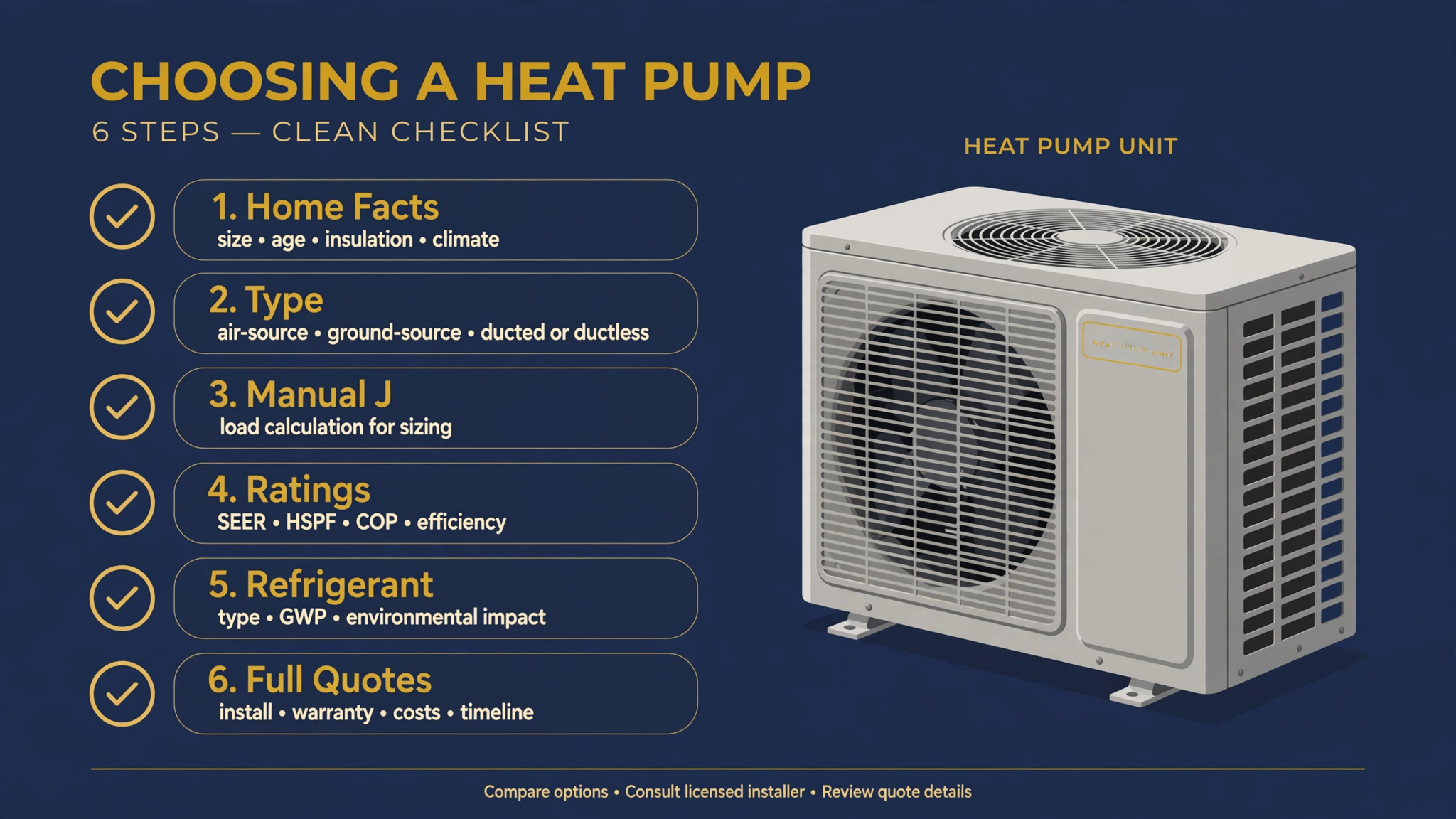
Heat pump systems fit a home when the type matches the ducts, the size matches the load, and the efficiency rating matches the climate. Heat pump systems fail as a purchase when any of those three links breaks. Use the 6 steps below in order, and keep each quote on the same scope so the prices compare fairly.
- Home facts: Note floor area, duct state, insulation, window count, and the coldest winter nights.
- Type: Choose ducted air-source for homes with good ducts, mini-split for homes without ducts, ground-source for long-term homes with land, and hybrid for very cold regions with a working furnace.
- Manual J: Ask each contractor for a written load calculation, not a floor-area guess.
- Ratings: Compare SEER2, HSPF2, and COP at the same test conditions, and ask for capacity at 5 degrees F for cold regions.
- Refrigerant: Ask which refrigerant the quoted model uses, because new systems use R-32 or R-454B instead of R-410A, which is being phased down under the AIM Act (Source: One Hour Heating and Air Conditioning, 2026).
- Full quotes: Compare installed price, duct work, panel work, warranty, and the installer record, not the equipment price alone.
Ask for three quotes from licensed contractors, and ask each one the same questions: model number, SEER2 and HSPF2 ratings, Manual J result, balance point for a hybrid system, and warranty on parts, compressor, and labour. A clear answer on each point marks a careful installer, and a vague answer marks a quote to set aside. Voice of Wave covers home topics in plain terms, and this guide follows that same approach.
Conclusion
Heat pump systems give a home one electric system for heating and cooling, and heat pump systems move heat instead of making heat. Air-source systems suit most homes, ductless systems suit rooms without ducts, ground-source systems give the highest efficiency, and hybrid systems cover the coldest days. A standard ducted air-source system costs $6,500 to $12,000 installed before incentives (Source: Modernize, 2026). Pick the type that fits the home, size it with a load calculation, and compare three full quotes before signing.
Explore the latest articles on the Voice of Wave blog
Frequently Asked Questions
What is a heat pump system?
A heat pump system is an electric heating and cooling system that moves heat with a refrigerant cycle instead of making heat by burning fuel. One unit heats a home in winter by moving outdoor heat indoors, and the same unit cools in summer by moving indoor heat outdoors.
How does a heat pump work in winter?
A heat pump works in winter by absorbing heat from cold outdoor air into refrigerant, compressing the refrigerant to raise its temperature, and releasing that heat through the indoor coil. Cold outdoor air still holds heat energy, so the cycle keeps working well below freezing.
What size heat pump do I need?
The right size comes from a Manual J load calculation, which uses insulation, windows, air leakage, and local climate to set the load in BTU per hour. A rough rule is 1 ton per 500 square feet, but that rule alone can leave a system too large or too small.
Do heat pumps work in cold climates?
Yes, heat pumps work in cold climates, and cold-climate models hold heating output at temperatures well below freezing. Some models keep running at minus 15 to minus 22 degrees F, and a hybrid system with a furnace covers the coldest days when the heat pump alone cannot meet the load.
How much does a heat pump system cost to install?
A ducted air-source heat pump system costs $6,500 to $12,000 installed in most US homes before incentives. Ductless single-zone systems cost $2,000 to $6,000 installed, multi-zone systems cost $8,000 to $15,000 installed, and ground-source systems cost $15,000 to $35,000 installed.
How long do heat pump systems last?
Heat pump systems last many years with regular care, and ground-source loops last far longer than the indoor equipment. Clean filters, clear coils, and a yearly pro check protect that span, while skipped care and wrong size shorten it. Most systems serve a home for well over a decade before replacement makes sense.
Are heat pumps cheaper to run than a gas furnace?
Heat pumps cost less to run than a gas furnace when the local electricity price, the system COP, and the gas price line up in their favour. Divide the electricity price per kWh by the COP to find the cost per kWh of delivered heat, then compare that figure with the cost of gas heat at furnace efficiency.