
Introduction
How to plan a road trip comes down to 8 clear decisions: pick your dates and route shape, set a daily driving limit, place overnight stops, choose the sights between them, build a budget, book the hard nights first, prep the car, and pack a car kit. A road trip is a long-distance journey by car where the drive itself is part of the trip, not just the way to reach a place. Good planning cuts cost, cuts stress, and leaves room for detours. This guide covers the route, the daily driving limit, the budget math, the car check, the packing list, and the mistakes that ruin trips, with a worked budget example, a 5-day sample plan, and a checklist you can reuse for any drive.
Key Takeaways
- Cap driving at 4 to 6 hours per day, or 200 to 400 miles, and add 20 to 30% to map times for stops.
- Book the scarce nights first: national park lodges and small towns sell out early.
- Price the whole trip before you book anything: fuel, lodging, food, tolls, attractions, and a 10 to 15% buffer.
- Service the car 1 to 2 weeks before departure and download offline maps for the full route.
- Leave one day open in every trip longer than 4 days.
Table of Contents
- How Do You Plan a Road Trip in 8 Steps?
- How Far Should You Drive in a Day?
- How Do You Choose the Best Route and Stops?
- How Much Does a Road Trip Cost?
- What Should You Check on Your Car Before a Road Trip?
- What Should You Pack for a Road Trip?
- Road Trip vs Flying: Which Fits Your Trip?
- What Are the Most Common Road Trip Mistakes to Avoid?
- Conclusion
- Frequently Asked Questions
How Do You Plan a Road Trip in 8 Steps?
To plan a road trip, fix your dates and trip length first, then pick a route shape, set a daily driving limit of 4 to 6 hours, place overnight stops at that spacing, choose 2 to 3 anchor sights per day, build a full budget, book the scarce nights first, and prep the car 1 to 2 weeks before departure.
Follow these 8 steps in order:
- Fix your dates and total trip length before you open a map.
- Pick a route shape: loop, one-way, or out-and-back.
- Set your daily driving limit in hours, not miles.
- Place overnight stops at that driving spacing.
- Choose 2 to 3 anchor sights for each day.
- Build the full budget before you book anything.
- Book the scarce nights first, then the rest.
- Service the car and pack 1 to 2 weeks out.
The route shape decides the whole feel of the trip. A loop starts and ends at home and shows new roads each day, with no repeat driving. A one-way drive covers the most ground but can carry a one-way rental drop-off fee. An out-and-back is the simplest to plan, but you see the same road twice.
Book the nights that will sell out before the nights that will not. Small towns, national park lodges, island stays, and festival dates go first, while city hotels with many rooms can wait. Browse the Travel section on Voice of Wave for destination guides that pair with your route.
Start planning 4 to 6 weeks ahead for a trip of a week or more, and 1 to 2 weeks ahead for a weekend trip. National park campgrounds and permits deserve 2 to 3 months, since popular sites sell out early.
How Far Should You Drive in a Day?
Drive 4 to 6 hours per day, or about 200 to 400 miles (320 to 640 km) on highways. Mountain roads, coastal roads, and city traffic cut that distance in half. With kids in the car, cap the day at 3 to 4 hours, stop every 2 hours, and rotate drivers every 2 to 3 hours.
Map apps show best-case driving time, not real driving time. Add 20 to 30% to every estimate for fuel stops, food, photos, traffic, and road work. A 5-hour map estimate becomes a 6 to 6.5-hour day, so plan around the longer number.
Build rest into the plan. On any trip longer than 4 or 5 days, schedule at least one full rest day with no driving. Use that day to walk around one place, do laundry, and let everyone recharge. The rest day is the difference between a trip that feels like a vacation and one that feels like a delivery job.
In a January 2022 survey by OnePoll of 2,000 American drivers, the average driver had taken about 7 road trips in a lifetime, and 78% said they found special places they would have missed by another mode of travel. The same survey found that 51% valued bonding time with family and friends, 48% valued the freedom to stop anywhere, and 46% valued the savings. Source: OnePoll (2022), via Wikipedia.
How Do You Choose the Best Route and Stops?
To choose the best route and stops, mark your start, your end, and 3 to 5 must-see places on a map first, then connect them with the most scenic road, not the fastest highway. Give each stop worth a real visit at least 2 nights, and leave gaps between the fixed points for detours and viewpoints.
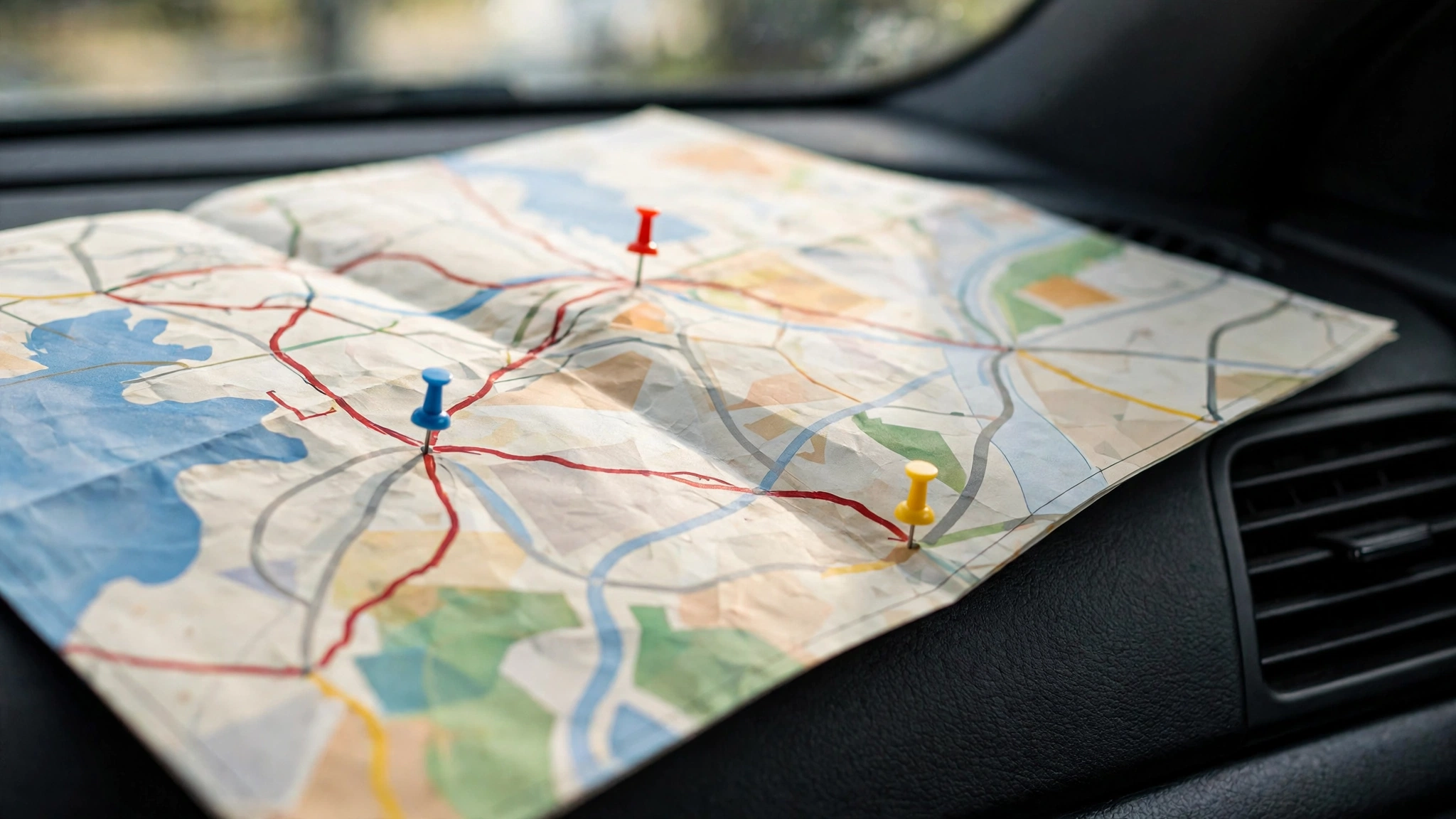
Open Google Maps and save a custom map with a pin for every place that interests you: sights, restaurants, viewpoints, and possible overnight towns. Pins that cluster together mark a place worth a night, while pins alone on a long stretch mark a day with more driving and fewer stops. Roadtrippers plots the same route with attractions along the corridor.
Scenic roads are often the whole point of the drive. A scenic route is a road marked for natural or cultural beauty, and many countries run official scenic byway programs. The first long-distance drive by car took place in Germany in 1888, when Bertha Benz drove 106 km (66 miles) from Mannheim to Pforzheim in over 12 hours. Read the full history of the road trip for the early cross-country drives, including the first North American crossing, which took 63 days in 1903.
Here is a sample 5-day loop plan to copy and adapt.
| Day | Drive | Main stop | Overnight |
|---|---|---|---|
| 2 | 3 hours | Mountain pass and viewpoint | Mountain lodge |
| 3 | 0 hours | Hiking and rest day | Mountain lodge |
| 4 | 4 hours | Historic town and old market | Historic town |
| 5 | 4 hours | Coastal viewpoint | Home |
How Much Does a Road Trip Cost?
A road trip costs about $150 to $320 per day for a family of 4, and about $80 to $180 per day for 2 adults, based on fuel, lodging, food, tolls, and attractions. Fuel is the most common surprise cost, so price each category on its own with the table below, then add a 10 to 15% buffer.
| Cost | How to estimate it |
|---|---|
| Lodging | Nights times nightly rate |
| Food | Daily food budget times days |
| Tolls and parking | Route toll total plus nightly parking fees |
| Attractions | Entry fees for each planned stop |
| Buffer | 10 to 15% of the total for surprises |
Work the fuel math once and the rest of the budget follows. A 2,000-mile trip in a car that gets 30 miles per gallon needs about 67 gallons. At $3.50 per gallon, fuel costs about $233. The same 2,000 miles at 20 miles per gallon needs 100 gallons and costs about $350. Add 4 nights of lodging at $120 ($480) and 5 days of food at $60 ($300), and the trip totals about $1,013 before the buffer.
Cut the food bill with a cooler. Sandwiches, fruit, and drinks for lunches cost far less than restaurant lunches for a family. Campgrounds cost $15 to $40 per night against $60 to $180 for motels and hotels, so one or two camping nights lower the total by a clear amount. Free stops help too: national forests, state parks, and scenic viewpoints cost little or nothing.
Packing for the drive? Read Packing Tips for International Travel for a packing system that works for road trips too.
What Should You Check on Your Car Before a Road Trip?
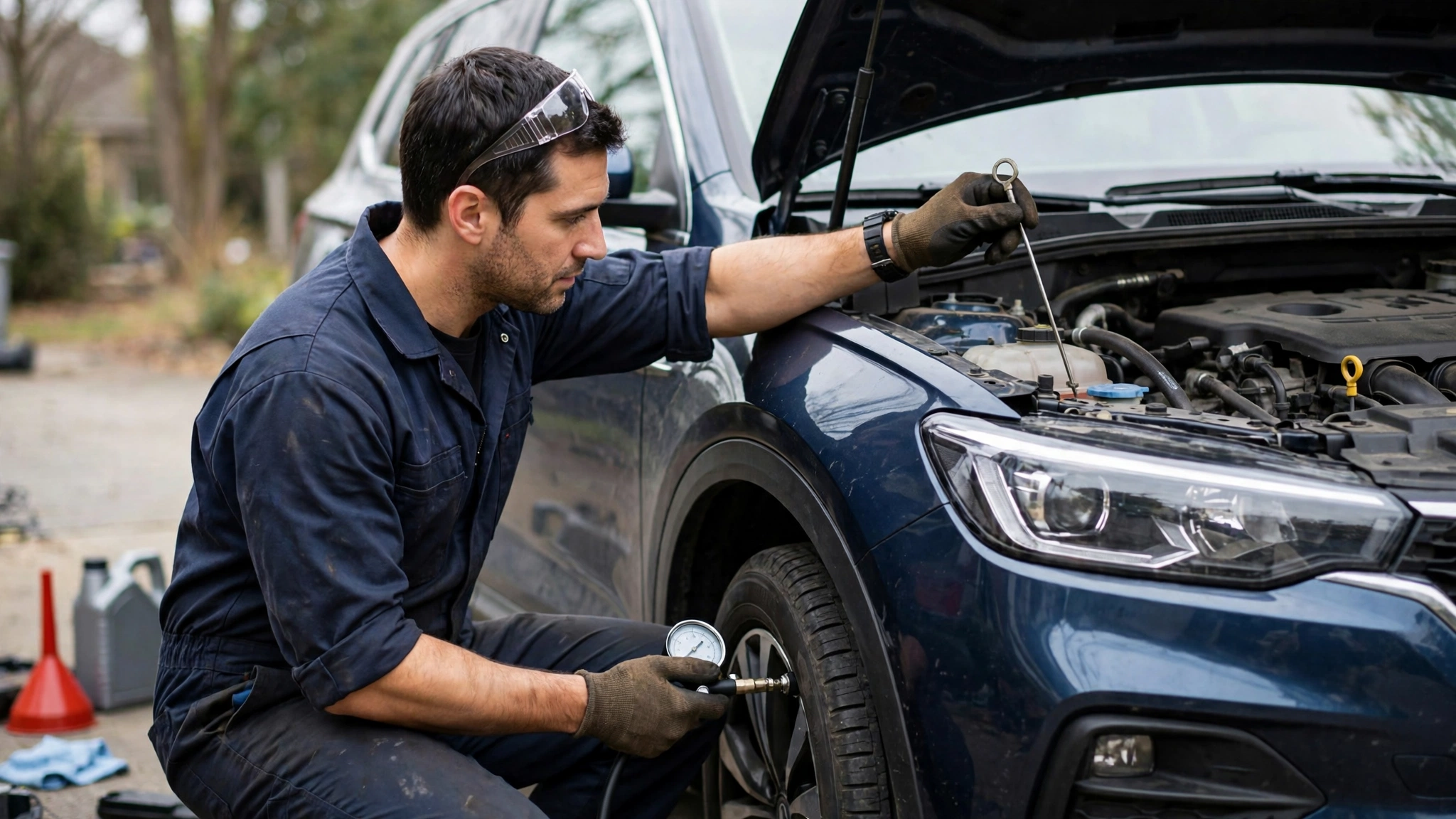
Before a road trip, check tires, oil, coolant, brakes, battery, lights, wipers, belts, and hoses, and confirm the spare tire and jack are in the car. Get the car serviced 1 to 2 weeks before departure. Carry your license, insurance, registration, and a roadside assistance number.
Check tire pressure when the tires are cold, and check tread depth with a coin or a gauge. Top up oil, coolant, and windshield washer fluid. Test the brakes for noise or vibration, and ask the mechanic to check the battery, belts, and hoses. A visit 1 to 2 weeks before departure leaves time to fix anything the mechanic finds.
Renting is a fair choice when your own car is old or small. A rental spares your car the miles and gives you a newer car with working air conditioning. Compare the rental cost against fuel and wear on your own car, and check whether it covers the states or countries on your route. One-way rentals can carry a drop-off fee, so check that fee before you book.
Electric cars need a different kind of prep. Plan charging stops on the long legs and check that fast chargers sit on your route, not 20 miles off it. Cold weather cuts driving range, so add a charging stop in winter. Download the charger apps before you leave, and keep a backup charger for each stop.
Cross-border drives need papers in order. Passports need at least 6 months of validity past your return date for many countries, and some countries require an International Driving Permit on top of your license. Insurance must cover every country you cross, and some routes need a road vignette bought before the border. Keep paper copies of bookings and insurance.

What Should You Pack for a Road Trip?
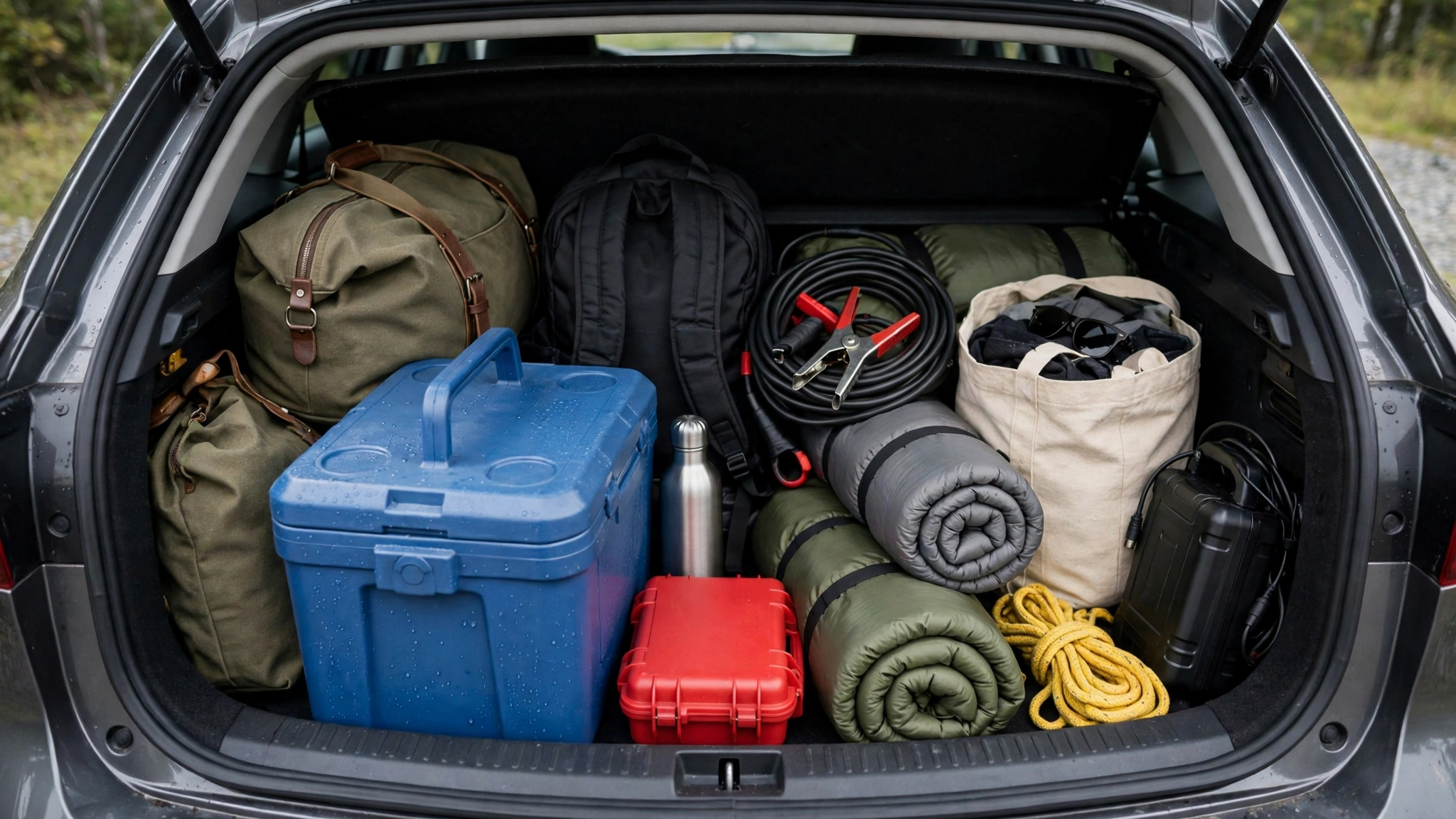
Pack one bag per person plus a car kit for a road trip. The car kit holds a phone mount, chargers, a cooler with food and water, a first aid kit, a flashlight, jumper cables, trash bags, and maps. Pack clothes in outfits that mix and match, and keep the items you need up front.
Pack in 5 groups: documents, clothes, toiletries and health items, tech and chargers, and food and comfort items. Keep each group separate until the end, since mixing them in one bag leads to overpacking. Roll clothes to save space and cut wrinkles. Limit shoes to 2 or 3 pairs, and pick clothes in one small color palette so every top works with every bottom.
Food planning is part of packing. A cooler with sandwiches, fruit, snacks, and cold water covers lunches and cuts stops. Bring a trash bag for the car, paper towels, and hand wipes. On my own drives, the cooler is the item I reach for most: cold water and sandwiches at a rest stop beat a fast-food line.
Travelers with access needs should check step-free access, parking, and restrooms at each planned stop before the trip, since rural stops vary widely. Pet owners should check pet rules at each lodging stop in advance, since many hotels charge a pet fee or allow pets only in certain rooms. Carry water and food for the pet, and plan stops where it can walk.
Road Trip vs Flying: Which Fits Your Trip?
A road trip fits trips under 500 miles, groups of 2 or more, and routes with sights worth stopping for. Flying fits solo trips over 1,000 miles and tight schedules. Compare the full door-to-door cost of each option, not just ticket price against fuel price, before you choose.
| Factor | Road trip | Flying |
|---|---|---|
| Flexibility | High, stop anywhere on the route | Low, fixed schedule and fixed stops |
| Packing | No weight limits, bring the cooler | Strict baggage limits and fees |
| Time | Slower over long distances | Faster over 500 miles or more |
| Best for | 2 or more travelers, scenic routes | Solo travelers, trips over 1,000 miles |
The math changes with group size. One tank of fuel moves 4 people for the same price as 1 person, while 4 plane tickets cost 4 times as much as 1 ticket. A solo traveler on a 1,500-mile trip saves time and often money by flying, while a family of 4 on a 400-mile trip saves money by driving.
What Are the Most Common Road Trip Mistakes to Avoid?
The most common road trip mistakes are driving too far per day, booking every night as non-refundable, skipping the car check, packing the night before, and driving with no offline maps. Fix each one by capping the day at 4 to 6 hours, keeping one night flexible, servicing the car early, and downloading the full route.
- Driving too far per day. A 10-hour driving day leaves no time for sights and leaves the driver tired. Cap the day at 4 to 6 hours.
- Booking every night as non-refundable. Plans change on the road. Keep at least the last night refundable so you can shift the plan.
- Skipping the car check. A worn belt or low coolant turns into a breakdown far from home. Service the car 1 to 2 weeks out.
- Packing the night before. Rushed packing forgets chargers, medicine, and documents. Pack 2 days early.
- Driving with no offline maps. Cell service drops in rural areas and mountains. Download offline maps for the full route.
- Ignoring seasonal closures. Mountain passes and scenic roads close for months in winter. Check opening dates before you book.
- No buffer in the budget. A flat tire or a closed road costs money. Keep a 10 to 15% buffer in the budget for surprises.
More trip planning guides appear on Voice of Wave each week.
Conclusion
How to plan a road trip comes down to 8 clear decisions: dates and route shape, a daily driving limit of 4 to 6 hours, overnight stops at that spacing, 2 to 3 anchor sights per day, a full budget with a buffer, the scarce nights booked first, a serviced car, and a packed car kit. A road trip is a long-distance journey by car where the drive itself is part of the trip. Plan the numbers first, leave room for detours, and the road does the rest.
Find your next trip idea: explore the latest travel guides and trip plans on the Voice of Wave blog.
Frequently Asked Questions
How far in advance should I plan a road trip?
Plan a road trip 4 to 6 weeks ahead for a trip of a week or more, and 1 to 2 weeks ahead for a weekend trip. Book national park campgrounds and lodges 2 to 3 months ahead, since sites and permits sell out early. Start the car service 1 to 2 weeks before departure, not the night before.
How many hours should you drive per day on a road trip?
Drive 4 to 6 hours per day, or 200 to 400 miles (320 to 640 km) on highways. With kids in the car, cap the day at 3 to 4 hours and stop every 2 hours. Add 20 to 30% to the time your map app shows, since stops, traffic, and road work add time on every leg.
How much does a road trip cost per day?
A road trip costs about $150 to $320 per day for a family of 4, and $80 to $180 per day for 2 adults. Fuel, lodging, and food take the largest share. A cooler with packed lunches cuts the food bill, and campgrounds cost far less than hotels on the same route.
What is the best app for planning a road trip?
Google Maps is the best app for navigation and for saving a custom map with pins for every stop. Roadtrippers is the best app for finding attractions along the route and building a multi-stop plan. Use Roadtrippers to build the route, then export it to Google Maps for live driving directions.
How do you plan a road trip with kids?
Plan a road trip with kids by capping each driving leg at 2 to 3 hours and stopping at parks, playgrounds, and viewpoints between legs. Pack snacks, water, and a small bag of games for each child. Book lodging with a pool or a yard, and keep one full rest day in every trip longer than 4 days.
Is a road trip cheaper than flying?
A road trip is cheaper than flying for 2 or more travelers on trips under 500 miles, since one tank of fuel moves the whole group. Flying is cheaper for solo travelers on trips over 1,000 miles. Compare the full cost of each option, with lodging, food, and airport parking, before you decide.