
Written by Michael Brooks for Voice of Wave.
Last updated: October 2026
A pool care guide is a complete routine for keeping pool water clear, balanced and safe for swimmers. Keep pool water clean and safe by running the pump daily, testing water 2 to 3 times per week, holding free chlorine at 1 to 3 ppm and pH between 7.2 and 7.8, and shocking every one to two weeks.
A pool stays clean when three systems work together: circulation moves the water through the filter, cleaning removes physical debris, and chemistry kills microorganisms. Pool care also protects the pool surface and equipment from corrosion and scale, which cuts repair costs. The weekly routine takes most owners 30 to 60 minutes once the steps become habit. This guide covers testing, the 5 chemical targets, balancing order, shocking, the weekly schedule, filters, problem fixes, seasonal opening and closing, and safety rules.
Key Takeaways
- Test pool water 2 to 3 times per week and keep free chlorine at 1 to 3 ppm, pH at 7.2 to 7.8, and total alkalinity at 80 to 120 ppm.
- Run the pool pump 6 to 12 hours per day in summer so all water passes through the filter (Source: Wikipedia “Swimming pool sanitation”, 2026).
- Skim the surface daily, brush walls weekly, vacuum weekly, and shock every one to two weeks.
- Balance chemicals in order: alkalinity first, then pH, then chlorine, then stabilizer.
- Open the pool in spring with a full clean and close it in fall before the first freeze.
Table of Contents
- What Is a Pool Care Guide?
- What Are the 5 Parts of a Pool Care Routine?
- How Do You Test Pool Water?
- What Do Pool Water Chemicals Do?
- How Do You Balance Pool Chemicals in the Right Order?
- How Do You Shock a Pool?
- What Does a Weekly Pool Maintenance Routine Look Like?
- How Do You Clean Different Pool Filters?
- What Are the Most Common Pool Problems and Their Fixes?
- How Do You Open and Close a Pool Each Season?
- What Safety Rules Keep Pool Users Safe?
- Conclusion
- Frequently Asked Questions
What Is a Pool Care Guide?
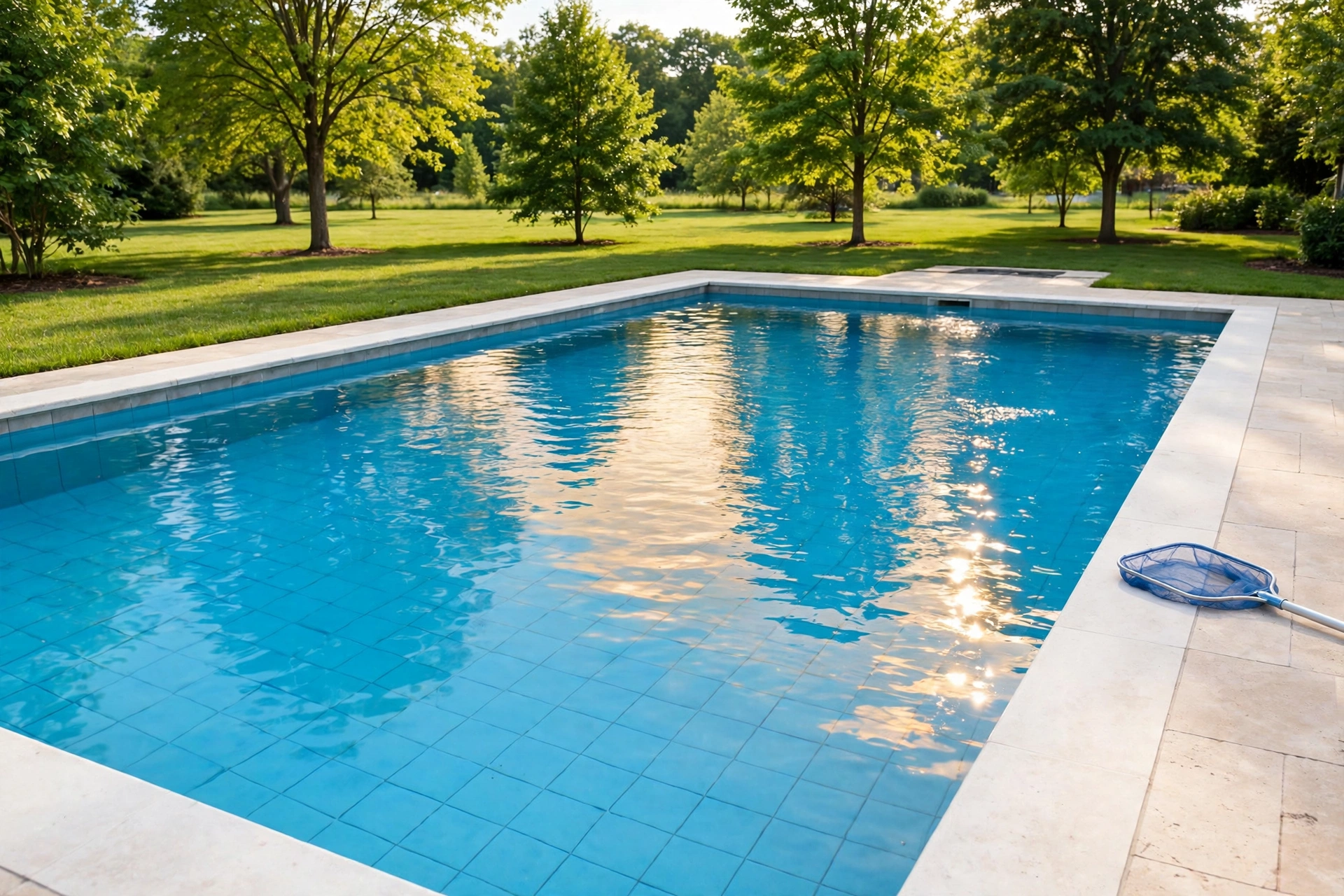
A pool care guide is a complete, repeatable routine for keeping pool water clear, balanced and safe for swimmers. The routine covers circulation (pump and filter runtimes), cleaning (skimming, brushing, vacuuming), water chemistry (pH, chlorine, alkalinity, calcium hardness and stabilizer), equipment checks and seasonal opening and closing.
Pool care works as a cycle: leaves, sunscreen, sweat and rain enter the water daily and change the chemistry. A fixed weekly routine catches changes early, when they take minutes to fix.
Beginners should start with the testing schedule and the chemical ranges in this guide, then add the cleaning and equipment tasks as the routine becomes habit. For more home and yard maintenance topics, browse the Home Improvement guides on Voice of Wave.
What Are the 5 Parts of a Pool Care Routine?
The 5 parts of a pool care routine are circulation, cleaning, water chemistry, water level and equipment, and seasonal care. Circulation moves water through the filter. Cleaning removes debris. Water chemistry kills germs and balances the water. Water level and equipment checks keep the system running. Seasonal care adapts the routine to weather.
- Circulation: run the pump 6 to 12 hours per day in summer so the full water volume passes through the filter.
- Cleaning: skim the surface, brush the walls and steps, vacuum the floor, and empty the skimmer and pump baskets.
- Water chemistry: test and adjust pH, free chlorine, total alkalinity, calcium hardness and cyanuric acid.
- Water level and equipment: keep the water at the middle of the skimmer opening and check the filter pressure gauge weekly.
- Seasonal care: open in spring, close in fall, and adjust chemical doses for heat, rain and heavy swimmer loads.
Each part supports the others: a clean filter improves circulation, and balanced water protects equipment from scale and corrosion.
How Do You Test Pool Water?
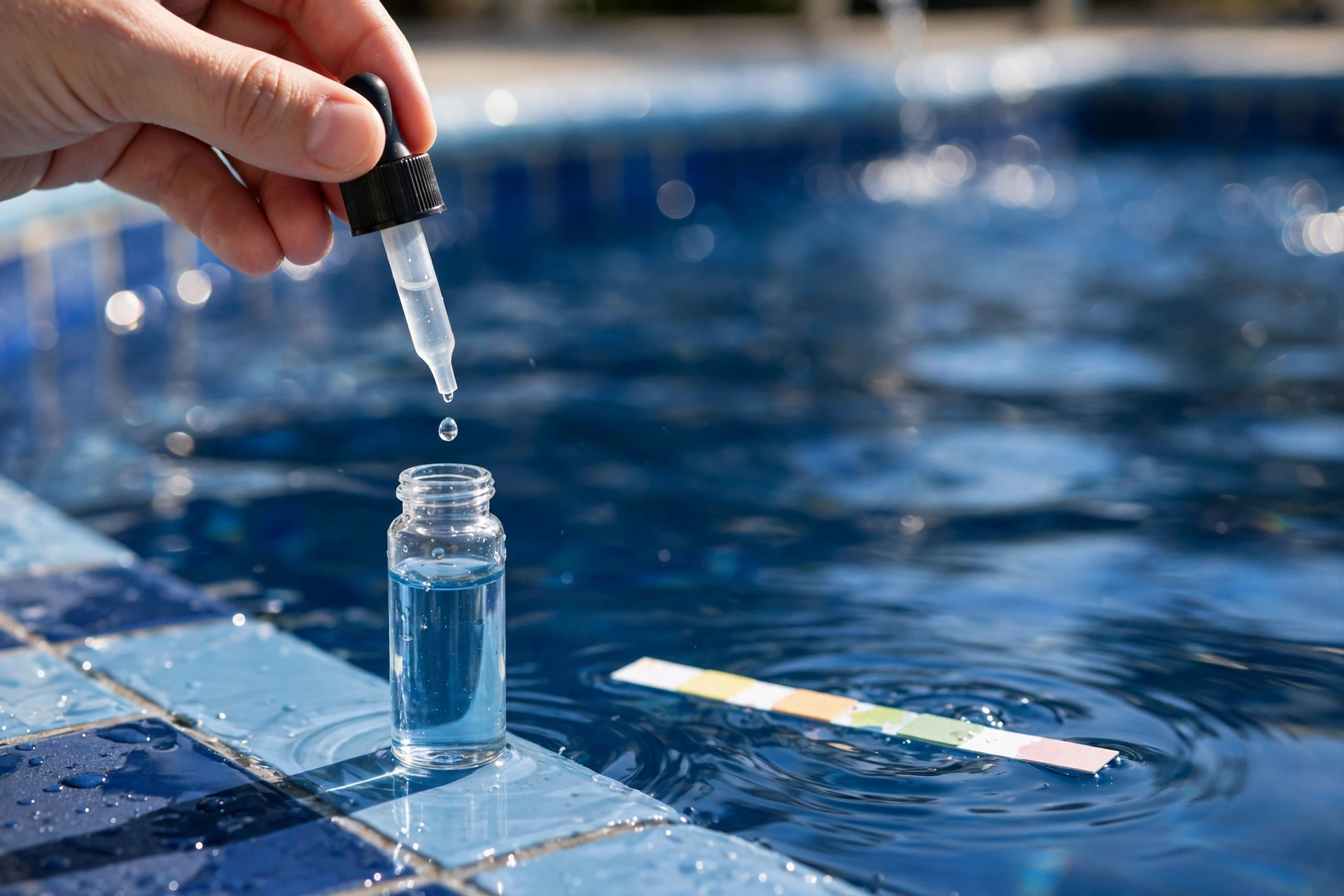
Test pool water 2 to 3 times per week during swim season and once per week in the off season. Collect the sample 30 cm below the surface, away from return jets, and test free chlorine, pH, total alkalinity and cyanuric acid. Use test strips for speed, a liquid drop kit for accuracy, or a digital tester for precision.
Testing is the control panel of pool care. The numbers tell you exactly what to add and how much, which removes guesswork.
| Test method | Speed | Accuracy | Best for |
|---|---|---|---|
| Test strips | 30 seconds | Good screening | Quick mid-week checks |
| Liquid drop kit | 2 to 5 minutes | High | Weekly balancing decisions |
| Digital tester | 1 to 2 minutes | Highest | Owners who want precise numbers |
Test in the evening when chlorine is most stable, and write each result down in a log. A log shows drift over time: if pH climbs every week, you will spot the pattern and adjust the dose before the water turns cloudy.
What Do Pool Water Chemicals Do?
Pool water chemicals do 3 jobs: sanitize the water, balance the water, and protect the water from sunlight. Free chlorine sanitizes by killing bacteria and algae. pH controls how well chlorine works and how comfortable the water feels. Water level and equipment checks keep the system running. Seasonal care adapts the routine to weather.
- Test all 5 chemicals and write the results down.
- Adjust total alkalinity to 80 to 120 ppm with alkalinity increaser or muriatic acid per the product label.
- Adjust pH to 7.2 to 7.8 after alkalinity is in range.
- Set free chlorine to 1 to 3 ppm with tablets, liquid chlorine or granules.
- Check cyanuric acid and calcium hardness and correct only if outside the target ranges.
- Retest after 4 hours to confirm the adjustments held.
Add chemicals with the pump running so they mix evenly, and dissolve granular products in a bucket of pool water before pouring them in. Never mix different chemicals together in the same container. Wait the time the label states between additions.
How Do You Shock a Pool?
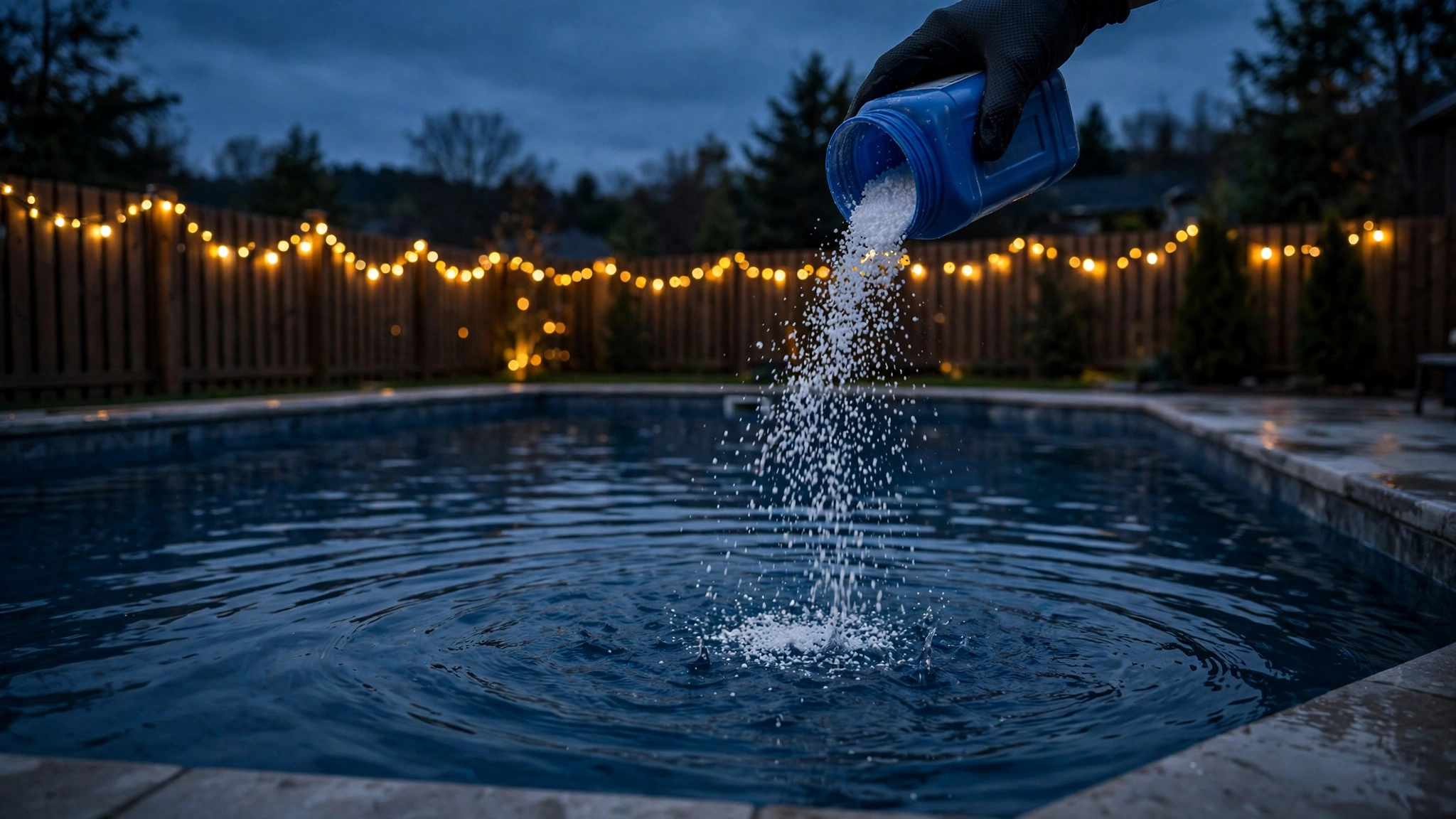
Shock a pool by adding a dose of oxidizer to destroy chloramines, kill algae and reset the sanitizer level. Shock every one to two weeks in summer, and also shock after heavy swimmer loads, storms or visible algae. Shock at dusk so sunlight does not burn off the dose, and keep swimmers out until chlorine normalizes.
Chloramines form when chlorine binds with sweat, urine and sunscreen, and they cause the sharp chlorine smell of a poorly kept pool. Shocking breaks them apart. Chlorine-releasing compounds are the most widely used pool disinfectants (see these chlorine compounds on Wikipedia), and shock products use concentrated forms of the same chemistry.
Use chlorine shock for routine oxidation and algae cleanup. Use non-chlorine shock (potassium peroxymonosulfate) for a faster return to swimming, since it needs no waiting period. Follow the label dose and run the pump overnight after shocking.
What Does a Weekly Pool Maintenance Routine Look Like?
A weekly pool maintenance routine takes 30 to 60 minutes: skim the surface daily, brush walls and steps weekly, vacuum the floor weekly, empty baskets weekly, test water 2 to 3 times per week, shock every one to two weeks, and check filter pressure weekly. A fixed schedule keeps each task small and prevents big weekend cleanups.
| Frequency | Task |
|---|---|
| Daily | Skim the surface, check the water level, glance at the pump for odd noise |
| Weekly | Brush walls, steps and ladders; vacuum the floor; empty skimmer and pump baskets; test water 2 to 3 times; check filter pressure; clean the waterline tile |
| Every 1 to 2 weeks | Shock the pool; backwash a sand filter or rinse a cartridge when pressure rises 8 to 10 psi above the clean reading |
| Monthly | Inspect the pump, filter, heater and lights; clean the filter thoroughly |
In my own pool season, skimming the surface before the pump starts each morning keeps the skimmer basket from packing solid by noon, which protects the pump from starving for water. Keep the surrounding deck safe too: see the deck repair and maintenance guide.
How Do You Clean Different Pool Filters?
Clean a sand filter by backwashing when the pressure gauge rises 8 to 10 psi above the clean reading. Clean a cartridge filter by removing the cartridge and hosing it down every 2 to 6 weeks. Clean a DE filter by backwashing and recharging with DE powder per the manufacturer. A dirty filter raises energy use and clouds the water.
| Filter type | How it cleans | Cleaning frequency | Lifespan notes |
|---|---|---|---|
| Sand | Backwash reverses flow to flush trapped dirt | When pressure rises 8 to 10 psi | Replace sand every 5 to 7 years |
| Cartridge | Remove and hose the pleated cartridge | Every 2 to 6 weeks | Replace the cartridge every 2 to 3 years |
| DE (diatomaceous earth) | Backwash, then recharge with DE powder | Monthly backwash plus annual deep clean | Finest filtration of the three; powder handling needs care |
Backwash where local rules allow. After backwashing a sand or DE filter, run the rinse setting for 30 seconds to settle the media. Voice of Wave publishes practical home guides like this one on a regular schedule.
What Are the Most Common Pool Problems and Their Fixes?
The most common pool problems are green water, cloudy water, algae on walls, a strong chlorine smell and low or high pH. Green water needs shock plus brushing. Cloudy water needs filtration, balanced chemistry and clarifier only after the basics are fixed. A chlorine smell means too little free chlorine, not too much, and needs shocking.
| Problem | Likely cause | Fix |
|---|---|---|
| Green water | Algae bloom from low chlorine | Brush all surfaces, shock at dusk, run the pump 24 hours, retest and repeat if needed |
| Algae spots on walls | Dead spots with poor circulation | Brush the spots directly, shock, aim return jets toward the spots |
| Strong chlorine smell | Chloramines from combined chlorine | Shock to break chloramines apart; the smell fades as free chlorine returns |
| pH too low | Acid rain, heavy use, some chlorine types | Add pH increaser with the pump running, retest in 4 hours |
| pH too high | New plaster, hard fill water, aeration | Add muriatic acid per label, retest in 4 hours |
| Foam on the surface | Algaecide overdose, sunscreen buildup | Skim the foam, check chemical doses, dilute with fresh water if severe |
Fix chemistry first: most problems trace back to one of the 5 target ranges, and a full test reveals it in minutes.
How Do You Open and Close a Pool Each Season?
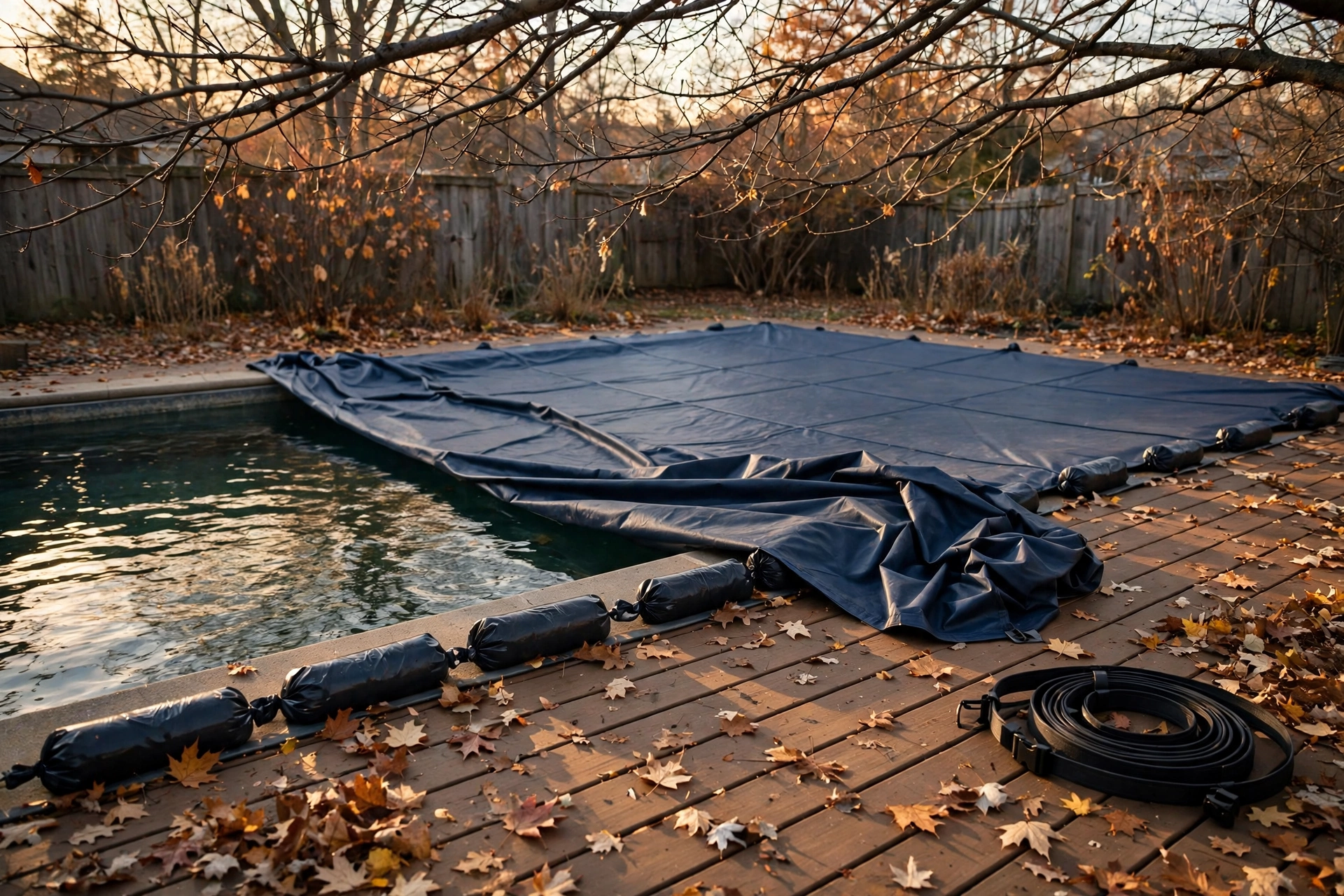
Open a pool in spring by removing the cover, clearing debris, reconnecting equipment, filling to the mid-skimmer level, running the pump, shocking, and balancing chemicals. Close a pool in fall by balancing chemicals, lowering the water below the skimmer, draining equipment, adding winter chemicals, and fitting a secure cover before the first freeze.
Spring opening steps in order: remove and clean the cover, clear debris, reconnect the pump, filter and heater, fill to the correct level, prime the pump, run the filter for 24 hours, shock at dusk, then balance alkalinity, pH, chlorine and stabilizer.
Fall closing steps in order: brush and vacuum thoroughly, balance all chemicals, lower the water below the skimmer and return lines, drain the pump, filter and heater, blow out the lines, add winterizing chemicals per the label, and fit the cover tightly.
What Safety Rules Keep Pool Users Safe?
The safety rules that matter most are constant adult supervision of children, a 4-sided fence with a self-closing gate, no swimming alone, secure chemical storage, and no swimming after illness. Drowning is fast and silent, so supervision means eyes on the water with no phone distractions.
- Supervise always: assign one adult as the watcher and rotate the job in shifts.
- Fence the pool: a 4-sided fence that separates the pool from the house, with a self-closing, self-latching gate.
- Store chemicals safely: keep pool chemicals locked, dry, ventilated and away from children and pets; never mix products.
- Shower before swimming: a quick shower cuts the sweat, sunscreen and cosmetics that consume chlorine. Researchers estimate pools contain 30 to 80 mL of urine for each person that uses the pool (Source: Environmental Science and Technology, 2016, via Wikipedia “Swimming pool sanitation”).
- Stay out when sick: no swimming with diarrhea or for 2 weeks after an outbreak, since the Cryptosporidium parasite survives more than 7 days in properly chlorinated water (Source: CDC guidance via Wikipedia “Swimming pool sanitation”, 2026).
- Check drains: keep drain covers intact and teach children to stay away from suction outlets.
Conclusion
This pool care guide covered the full routine: the 5 parts of the routine (circulation, cleaning, chemistry, water level and equipment, seasonal care), water testing methods, what each chemical does, the correct balancing order, shocking, the weekly maintenance schedule, filter cleaning, common problem fixes, seasonal opening and closing, and safety rules. Test 2 to 3 times per week, hold the 5 target ranges, clean on schedule and the water stays clear all season.
Continue reading: browse the latest articles for more home maintenance guides.
Frequently Asked Questions
How often should I test my pool water?
Test pool water 2 to 3 times per week during swim season and once per week in the off season. Test more often after storms, pool parties or heavy heat waves. Write each result in a log so you can spot drift early.
What is the ideal pH level for a pool?
The ideal pool pH level is 7.2 to 7.8 (Source: Wikipedia “Swimming pool sanitation”, 2026). This range keeps chlorine effective, protects the pool surface and equipment, and matches human tears at 7.4, which is why it feels comfortable on eyes.
Why does my pool smell like chlorine?
A strong chlorine smell means too little free chlorine, not too much. The smell comes from chloramines, which form when chlorine binds with sweat and urine. Shock the pool to break chloramines apart and the smell fades. Ventilate indoor pools during treatment.
How long should I run my pool pump each day?
Run a residential pool pump 6 to 12 hours per day in summer and about 4 hours per day in winter when the pool is not in use (Source: Wikipedia “Swimming pool sanitation”, 2026). A timer makes the schedule automatic and cuts electricity costs.
Can I use household bleach to shock my pool?
Yes, plain unscented sodium hypochlorite bleach works as pool shock because it is liquid chlorine. Check the label for additives and use a pool dose calculator for your pool volume. Keep swimmers out until free chlorine falls back to 1 to 3 ppm.
Do I need to shower before swimming in my pool?
Yes. Showering removes sweat, sunscreen, cosmetics and body oils that consume chlorine and form chloramines. Less contamination means lower chemical use and clearer water. Make it a house rule for every swimmer. A 60-second rinse is enough to make a real difference.