
Written by Emily Roberts for Voice of Wave.
Last updated: October 2026
Buying a home in Venice, Italy means following Italy’s standard five-step property process: get an Italian tax code, make a written offer, sign a preliminary contract with a 20 to 30 percent deposit, pass the notary’s legal checks, and sign the final deed. Foreign buyers face no general ban, but most pay full second-home taxes and closing costs.
Prices average about €4,877 per square meter across the city in 2026, with San Marco topping €6,000 and Murano and Burano near €2,500 to €2,700 (Sources: Idealista via EuroPropertyData 2026; Immobiliare.it via Dolce Living, May 2026). This guide covers who can buy, neighborhood costs, taxes and fees, checks for old apartments, rental rules, and daily life.
Key Takeaways
- Most foreign buyers, including non-EU citizens, can buy a home in Venice, Italy with full ownership rights.
- Citywide prices average about €4,877 per square meter in 2026; San Marco costs the most and Murano and Burano cost the least.
- Foreign second-home buyers should budget 7 to 18 percent of the price in closing costs on top of the purchase price.
- The buying process has five steps and usually completes within a few months, with a possible 60-day wait for listed buildings.
- Short-term rentals in the historic center face strict limits, so confirm the rental rules before buying for income.
Table of Contents
- Can Foreigners Buy a Home in Venice, Italy?
- How Much Does Buying a Home in Venice Italy Cost in 2026?
- Venice Neighborhoods and Prices: Which Sestiere Fits Your Budget?
- The 5 Steps to Buying Property in Venice, Italy
- Taxes and Extra Fees When Buying a Home in Venice
- What to Check Before Buying an Old Venetian Apartment
- Can You Rent Out Your Venice Home to Tourists?
- What Is Daily Life Like When You Live in Venice?
- Frequently Asked Questions
Can Foreigners Buy a Home in Venice, Italy?
Yes. Most foreign buyers, including non-EU citizens, can buy a home in Venice, Italy with full ownership rights. Italy applies a reciprocity rule, but citizens of the United States, the United Kingdom and most other countries can buy freely. The practical first step is getting a codice fiscale, the Italian tax code, which every buyer needs for the notary deed.
The codice fiscale is a tax identification code that Italy requires for almost every official transaction, including signing a property deed. Non-residents can request one at an Italian consulate or a local tax office in Italy. Without it, the notary cannot complete the purchase.
Most foreign buyers also open an Italian bank account before the final deed, because the balance is usually paid by bank transfer at the signing. Buyers who cannot attend in person can grant power of attorney to an Italian-speaking representative, often their lawyer.
How Much Does Buying a Home in Venice Italy Cost in 2026?
Buying a home in Venice Italy costs about €4,877 per square meter on average in 2026, up 6.7 percent from the previous year (Source: Idealista via EuroPropertyData 2026). The historic center costs far more than the mainland: San Marco averages €6,000 per square meter while Murano and Burano sit near €2,500 to €2,700 (Source: Immobiliare.it via Dolce Living, May 2026).
That average blends the expensive historic center with cheaper mainland districts such as Mestre, so it understates what most buyers pay in the old city. For more Italy-focused reading, explore the travel guides in the Travel section on Voice of Wave. On the ground, a studio or one-bedroom apartment in Venice typically lists between €200,000 and €300,000, while two-bedroom flats in historic buildings range from €300,000 to €500,000 depending on floor and location (Source: Properties in Italy). Prestigious addresses on the Grand Canal can reach €10,000 per square meter (Source: Properties in Italy). Features that push prices up include water views, water access, original architectural details and balconies, while a terrace or private courtyard adds a premium because both are rare in Venice (Source: Properties in Italy).
Venice Neighborhoods and Prices: Which Sestiere Fits Your Budget?
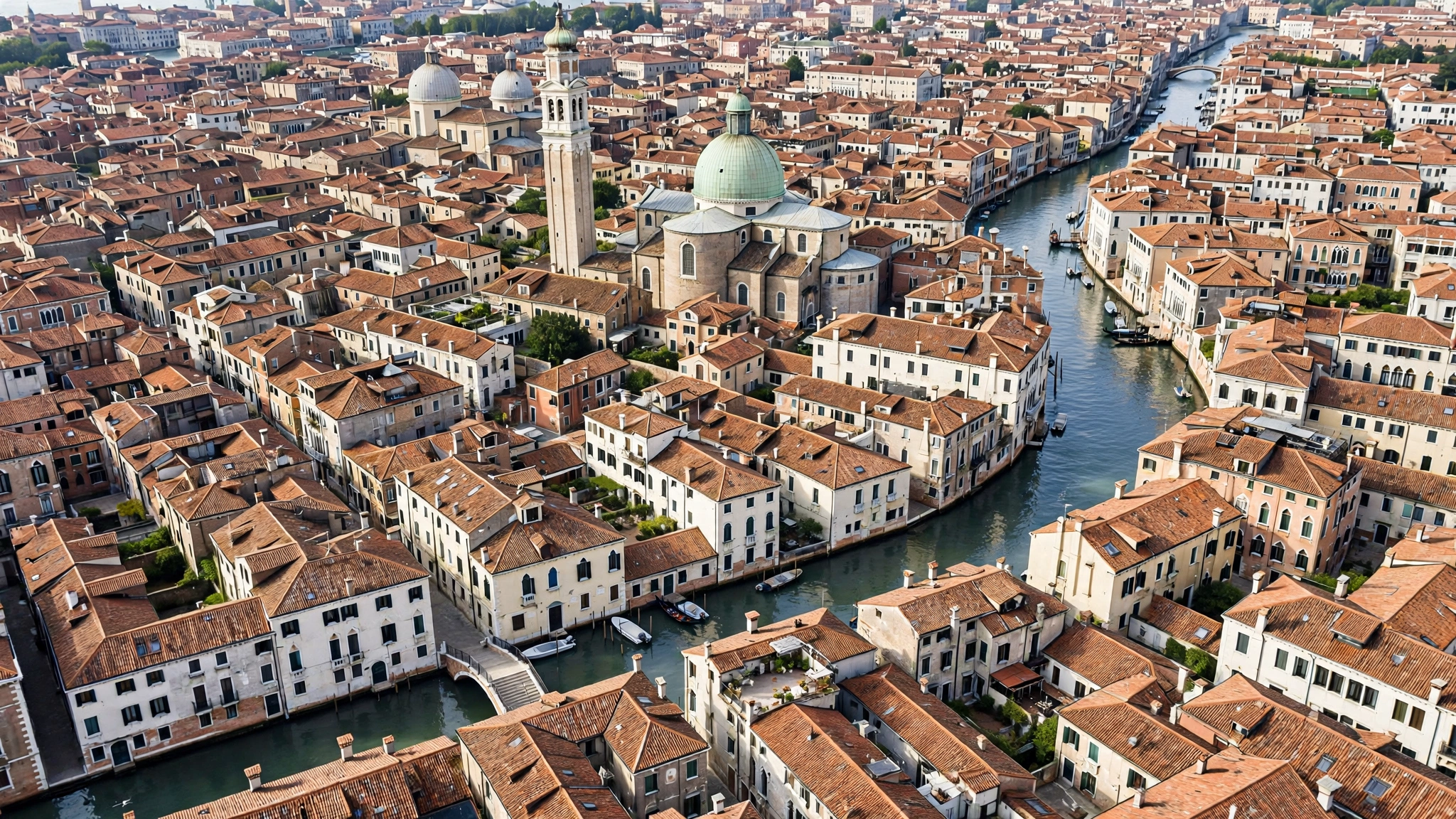
The six sestieri of historic Venice span a wide price range in 2026. San Marco is the most expensive at about €6,000 per square meter, followed by Dorsoduro at €5,700 and Cannaregio at €5,300, while San Polo and Santa Croce average €5,000 (Source: Immobiliare.it via Dolce Living, May 2026). Giudecca, Murano and Burano offer cheaper entry points.
The city itself is built on 126 islands linked by 472 bridges in the Venetian Lagoon (Source: Wikipedia), which is why prices change sharply from one area to the next.
| Area | Avg. asking price (2026) | Character |
|---|---|---|
| San Marco | €6,000/sqm | Tourist heart; Rialto and St. Mark’s; highest prices |
| Dorsoduro | €5,700/sqm | Art galleries, university quarter; strong demand |
| Cannaregio | €5,300/sqm | Residential canals; good value near the station |
| San Polo | €5,000/sqm | Local markets; central but calmer |
| Santa Croce | €5,000/sqm | Near the bus and car terminals; practical base |
| Castello (east) | Lower than center | Via Garibaldi and Sant’Elena; most reasonable in the center |
| Giudecca | €4,800/sqm | Island across the canal; part of Dorsoduro district |
| Murano | €2,700/sqm | Glassmaking island; cheapest entry with ferry access |
| Burano | €2,500/sqm | Colorful fishing island; quiet, less connected |
Source: Immobiliare.it via Dolce Living, May 2026.
San Marco commands its premium because it holds the Rialto Bridge and St. Mark’s Square. Buyers on a tighter budget look to eastern Castello, Giudecca and the outer lagoon islands, where the same euro buys noticeably more space.
The 5 Steps to Buying Property in Venice, Italy
Buying property in Venice, Italy takes five steps: 1) get a codice fiscale and open an Italian bank account, 2) make an offer (proposta) with a deposit, 3) sign the preliminary contract (compromesso) and pay 20 to 30 percent, 4) pass the notary’s legal checks, 5) sign the final deed (rogito) and pay the balance (Source: Venice Sotheby’s International Realty).
- Get your codice fiscale at a consulate or tax office, and open an Italian bank account.
- Find a property and submit a written offer (proposta); once accepted in writing, it binds both sides.
- Sign the preliminary contract (compromesso) and pay 20 to 30 percent of the price.
- Let the notary run title, planning and heritage checks on the property.
- Sign the final deed (rogito) before the notary and pay the remaining balance.
Most purchases complete within a few months, depending on financing and checks (Source: Dolce Living 2026). Unlike some markets, agreed deals rarely collapse at the last minute, because the written offer becomes binding early.
Taxes and Extra Fees When Buying a Home in Venice
Foreign buyers in Venice should budget 7 to 18 percent of the price, about €24,000 to €35,000 on a €295,000 apartment (Source: Investropa 2026). Registration tax of 2 to 9 percent is the largest cost on resale homes, plus notary fees of 1 to 2.5 percent and agent fees of 2 to 5 percent plus VAT (Source: Wise 2026).
Foreign buyers who will not become Italian residents pay the full second-home rates, which is the assumption behind the table below.
| Fee or tax | Typical range | Notes |
|---|---|---|
| Registration tax (resale) | 2% to 9% of cadastral value | Largest single cost |
| VAT (new builds from developers) | 4% to 22% | Replaces registration tax |
| Notary fees | 1% to 2.5% | Based on price; the buyer chooses the notary |
| Real estate agent fees | 2% to 5% plus 22% VAT | Both sides usually pay an agent |
| Legal fees | 1% to 2% plus 22% VAT | Independent lawyer advised |
| Land registry and cadastral taxes | Fixed €50 or €200 | Depends on the tax route |
Source: Wise 2026 for tax and fee ranges; Investropa 2026 for the total budget estimate.
Buying from a developer changes the math because VAT replaces registration tax. Keep a cash reserve beyond the deposit, since Italian mortgages for non-residents involve extra paperwork and valuation fees (Source: Investropa 2026).
What to Check Before Buying an Old Venetian Apartment
Before buying an old Venetian apartment, check flood exposure, damp, the building’s listed status, and the roof and foundation condition. Ground-floor flats face acqua alta flooding, and heritage-listed buildings need state approval for changes and face a 60-day state pre-emption wait at purchase (Source: Venice Sotheby’s International Realty). Hire a surveyor who knows Venice’s building rules.
Acqua alta, the seasonal high water that floods low parts of the city, is the risk none of the standard buying guides price in. Ask the seller how often the unit floods and what the last flood cost to repair.
Look for salt stains, peeling plaster and soft wood near the ground floor, the signs of damp from the canals. Third, confirm the building’s listed status with the notary, because listed status controls what renovations the heritage office will approve. Fourth, ask for the planimetria catastale, the cadastral floor plan, and compare it with the actual layout; unregistered alterations are common in old Venetian flats, and the buyer inherits the cost of regularizing them.
Can You Rent Out Your Venice Home to Tourists?
Yes, but short-term rentals in Venice face strict rules. The city limits new tourist rentals in the historic center, charges a tourist tax nearly double the hotel rate for short stays, and requires a regional code on every listing (Source: De Tullio Law Firm). Check rental feasibility with a lawyer before buying if income is part of your plan.
Venice has spent years tightening tourist-rental rules to protect housing for residents, and the rules keep changing. The basic math still attracts investors: long-term rentals in Venice typically yield 3 to 5 percent gross, while short-term tourist rentals can reach 5 to 8 percent gross before higher costs, taxes and management fees (Source: HataMatata 2026).
Planning to list your Venice flat as a rental? See [INTERNAL LINK: preparing a vacation rental for guests].
Settle the rental question before making an offer: ask a local lawyer whether the specific address can be licensed for tourist stays.
What Is Daily Life Like When You Live in Venice?
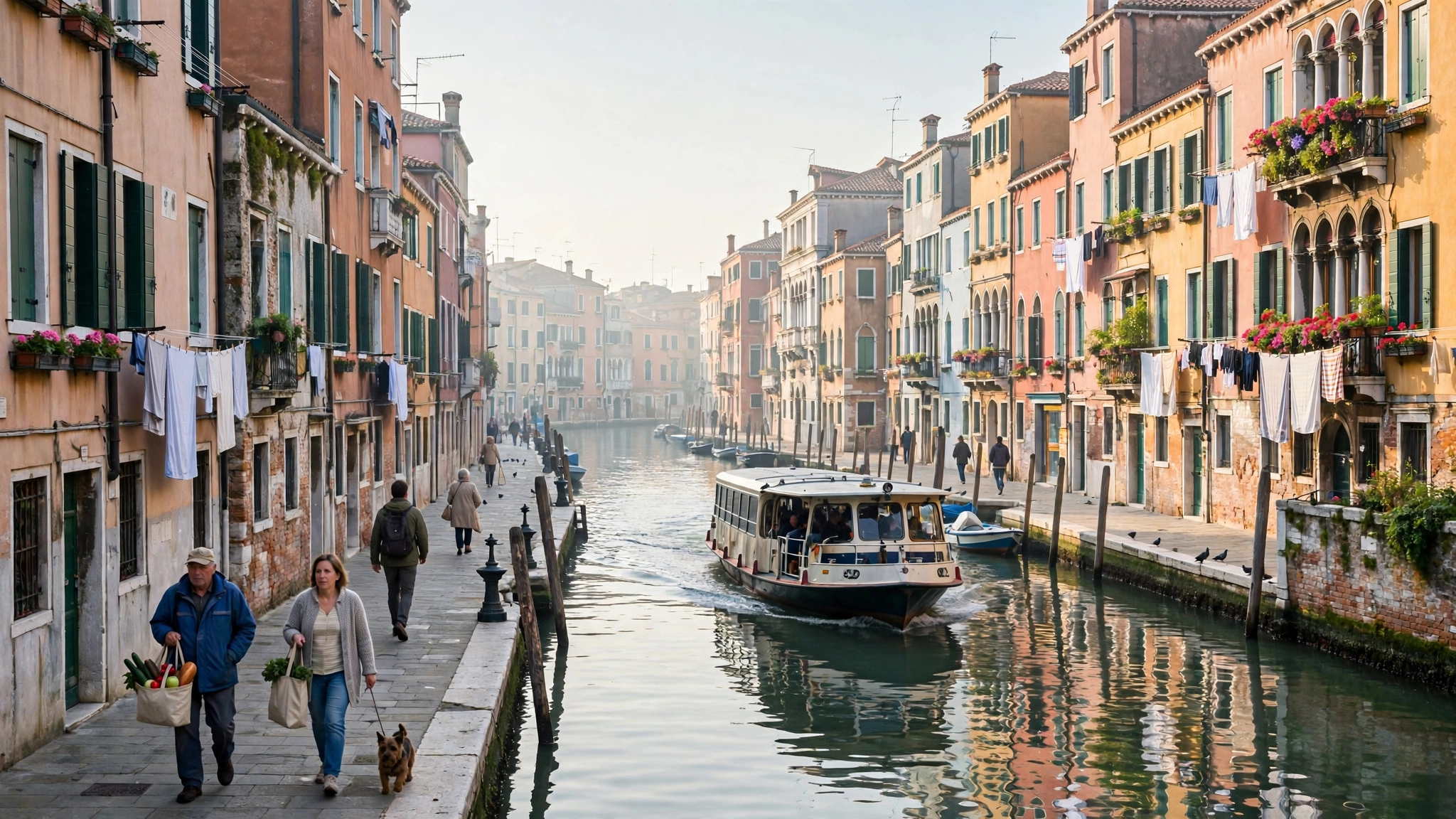
Daily life in Venice runs on foot and by water. There are no cars in the historic center, so residents walk, use vaporetto lines, or keep a boat. About 50,000 people live in the historic city while most of the municipality’s 249,385 residents live on the mainland (Source: Wikipedia 2026). Groceries, schools and clinics are spread across the sestieri.
Heavy shopping arrives by boat or hand cart, and the vaporetto water bus is the commuter train. Many families choose mainland Mestre for schools and easier logistics, commuting into the historic center by train or bus. Voice of Wave covers travel topics like this one for readers planning big moves, and Venice rewards buyers who visit in the off season before committing.
Conclusion
Buying a home in Venice, Italy is a realistic goal for foreign buyers who plan around the real costs. Prices run about €4,877 per square meter citywide in 2026, with the historic sestieri costing far more than the lagoon islands (Sources: Idealista via EuroPropertyData 2026; Immobiliare.it via Dolce Living, May 2026). The five-step process is straightforward, but the details decide the outcome: get the codice fiscale early, budget 7 to 18 percent for closing costs, verify flood exposure and the building’s listed status, and confirm rental rules before buying for income. Do that homework, and buying a home in Venice, Italy stays within budget and on schedule. For more travel planning ideas, explore the guides on Voice of Wave.
Looking for more travel guides like this one? Browse the latest articles on Voice of Wave: https://www.voiceofwave.com/blog/
Frequently Asked Questions
Can foreigners buy a home in Venice, Italy?
Yes. Most foreign buyers, including non-EU citizens, can buy a home in Venice, Italy with full ownership rights. Italy uses a reciprocity rule, but citizens of the United States, the United Kingdom and most other countries qualify. Every buyer needs an Italian tax code (codice fiscale) before the notary can complete the purchase deed.
How much does a house cost in Venice, Italy in 2026?
Venice averages about €4,877 per square meter in 2026, up 6.7 percent year on year (Source: Idealista via EuroPropertyData 2026). San Marco averages €6,000 while Murano and Burano sit near €2,500 to €2,700 (Source: Immobiliare.it via Dolce Living, May 2026). Studios typically list between €200,000 and €300,000 (Source: Properties in Italy).
What taxes and fees do I pay when buying a home in Venice?
Foreign buyers should budget 7 to 18 percent of the price (Source: Investropa 2026). Registration tax of 2 to 9 percent is the largest cost on resale homes, plus notary fees of 1 to 2.5 percent and agent fees of 2 to 5 percent plus VAT (Source: Wise 2026). New builds pay VAT of 4 to 22 percent instead.
Do I need an Italian tax code to buy property in Venice?
Yes. The codice fiscale is required for every buyer, including non-residents, because the notary cannot sign the deed without it. You can apply at an Italian consulate in your home country or at a tax office in Italy. Most buyers also open an Italian bank account before the final signing to handle the transfer.
Is buying a home in Venice a good investment for rental income?
It can be, with the right expectations. Long-term rentals typically yield 3 to 5 percent gross, while short-term tourist rentals can reach 5 to 8 percent gross with higher costs and seasonal swings (Source: HataMatata 2026). Venice limits new tourist rentals in the historic center, so confirm licensing with a local lawyer before buying for income.
How long does it take to buy a home in Venice, Italy?
Most purchases complete within a few months, depending on financing and the notary’s checks (Source: Dolce Living 2026). If the building is historically listed, add a 60-day state pre-emption period after the deed before ownership transfers (Source: Venice Sotheby’s International Realty). Arranging the tax code and bank account early keeps the timeline short.
Can I buy a cheaper home on Murano or Burano instead of central Venice?
Yes. Murano averages about €2,700 per square meter and Burano about €2,500, roughly half the price of the central sestieri (Source: Immobiliare.it via Dolce Living, May 2026). Both are lagoon islands reached by ferry, so daily life is quieter but less connected. They suit buyers who want a Venice address at a lower entry price.